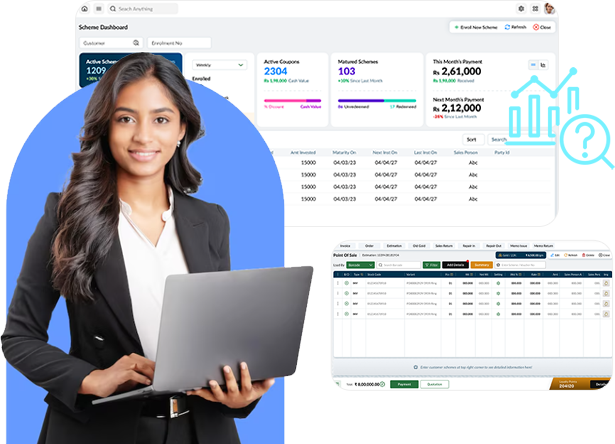

- Production losses in jewellery manufacturing are one of the most preventable sources of revenue leakage in the industry.
- Metal wastage, karigar accountability gaps, inaccurate job costing, and manual tracking errors quietly cost far more than most owners realize.
- Gold wastage tracking software makes these losses visible, attributable, and therefore preventable, not just absorbed as a cost of doing business.
- This guide covers the top 5 ways jewellery manufacturing software reduces those losses, with what Synergics Jewellery ERP delivers for manufacturers protecting their margins in 2026.
Jewellery manufacturing is a precision business, and gold jewellery software gives manufacturers control over every stage of production. Every gram of gold entering the workshop can be tracked until it becomes a finished piece, while every diamond and gemstone issued to a karigar gets accurately monitored against returns. The software records actual material consumption, production time, and job card details in real time, eliminating manual approximation and improving inventory accuracy, accountability, and overall efficiency.
The manufacturers protecting their margins in 2026 are the ones who replaced manual tracking with dedicated gold wastage tracking software, creating an unbroken digital trail from raw material receipt to finished goods inventory. That trail is what makes losses visible and attributable, rather than simply written off as the cost of doing business.
Here are the top 5 ways jewellery manufacturing software directly reduces production losses for manufacturers running Synergics Jewellery ERP.
1. Real-Time Gold Wastage Tracking Eliminates Unaccounted Loss
Every jewellery manufacturer issues metal to karigars and expects a finished piece back, along with any unused metal and recoverable scrap. Without a system tracking this exchange in real time, the gap between what was issued and what came back often surfaces days or weeks later, during a manual stocktake, by which point the accountability trail has gone cold and the loss simply gets written off.
Gold wastage tracking software changes this by creating a digital record of every material issue and return the moment it happens. The system knows exactly how much gold was issued for each job, who received it, when, what the expected output weight should be based on the design specification, and what the acceptable loss tolerance is for that specific type of piece. For cast pieces specifically, a meaningful share of this loss traces back further upstream, to wax consumption at the casting stage, before metal ever enters the mould.
What real-time metal tracking captures:
- Gold and silver issued by weight and karat to each karigar, per job
- Stones and diamonds issued by piece count and carat weight, per job
- Expected finished piece weight based on approved design specifications
- Actual finished piece weight on completion and return
- Scrap and sweepings returned alongside the finished piece
- Calculated loss versus benchmark loss for every job individually
When actual loss on any job exceeds the benchmark, the system flags it immediately instead of letting it disappear into an end-of-month reconciliation nobody examines closely enough.
2. Job Card Management Creates Karigar-Level Accountability
The second major source of production loss is a lack of individual accountability at the karigar level. When work gets distributed informally and tracked manually, there’s no way to tell which karigar consistently produces within acceptable loss parameters and which ones drive above-average wastage. Everyone works, losses occur, and no specific person or process gets identified as the source.
Job card management in Synergics Jewellery ERP creates a complete digital record for every piece of work assigned to every karigar. Each job card documents the design, the materials issued, the expected timeline, the acceptable loss tolerance, and the actual outcome once the job returns.
Over time, this builds a karigar performance database that managers use to make objective decisions about work allocation and process improvement. Karigars who consistently work within tolerance get priority for high-value jobs. Those with above-average loss patterns get flagged for training or process review before the losses compound.
Job card data tracked per karigar:
- Number of jobs completed in any time period
- Average metal loss percentage across all jobs
- Loss percentage by job type and metal type
- On-time completion rate against expected timelines
- Stone and diamond return rate against issue records
This level of individual accountability simply isn’t achievable with manual systems, and the loss reduction from every karigar knowing their work is measured individually shows up significantly within the first quarter.
3. Automated Loss Benchmarking Against Your Own Standards
Gold wastage tracking software goes beyond simply logging loss by providing real benchmarking and performance insight. Knowing your gold loss was 2.3% last month only means something when you can compare it against expected standards for your specific product mix. Real-time analytics and benchmark reporting let jewellery businesses identify whether loss sits within acceptable limits, catch inefficiencies early, and decide based on data instead of assumptions or unreliable industry comparisons.
Synergics Jewellery ERP builds loss benchmarking directly into production planning and the management workflow. The system maintains loss benchmarks by product category, process type, metal type, and karigar grade, drawing on your own historical production data rather than generic industry averages that may not reflect your specific mix of work.
How automated benchmarking works in practice:
- Benchmarks get established during implementation using historical production data
- Each new job is assigned a benchmark loss tolerance based on its category and process type
- Completed jobs are compared against benchmark automatically on return
- Jobs within tolerance close without escalation
- Jobs exceeding tolerance get flagged for management review with full job history visible
- Monthly reports surface loss trends by product category, karigar, and process type
Manufacturers using this approach consistently find that a small number of specific job types or specific karigars account for a disproportionate share of total losses. Addressing those specific issues produces outsized results compared to broad, general loss-reduction programs.
4. Integrated Hallmarking and Certification Tracking Prevents Compliance-Related Losses
Hallmarking compliance failures create losses that look different from material wastage but hurt just as much. Pieces that fail hallmarking inspection need rework or recycling at real cost. Customer orders that can’t be fulfilled on time because hallmarking documentation is incomplete cause relationship damage with consequences well beyond the immediate order.
Manufacturing software that integrates with hallmarking and BIS compliance processes ensures every piece moving through production has its certification status tracked alongside its physical status. Pieces approaching completion automatically trigger the hallmarking workflow, so documentation happens in parallel with finishing instead of after the piece is done and the customer is already waiting.
What integrated hallmarking tracking prevents:
- Pieces delivered to customers without required certification documentation
- Batches rejected at hallmarking due to purity inconsistencies that could have been caught earlier
- Order delays caused by hallmarking documentation being prepared after production instead of alongside it
- Rework costs from pieces that miss purity specifications because metal composition wasn’t tracked through production
Preventing even two or three hallmarking-related rework incidents per quarter typically more than justifies the investment for mid-sized manufacturers.
5. Production Cost Visibility Exposes Margin Erosion Before It Becomes a Crisis
The most insidious form of production loss isn’t a dramatic event. It’s gradual margin erosion, where the actual cost of producing each piece drifts above what the pricing model assumed, and nobody notices until accounts get reviewed at quarter-end or year-end.
This happens as material costs shift, production times extend, rejection and rework rates increase, or loss rates creep upward incrementally. Each individual change is small enough to overlook in a manual system, but collectively, they can push a profitable product category into margin-negative territory within a single season.
Synergics Jewellery ERP creates a live cost-per-job dashboard showing the actual cost of producing each piece as it moves through production, compared against the costing model used to set the selling price. When actual costs diverge from projected costs on any product category, managers see it immediately instead of discovering it weeks later when the damage is already done.
Live production costing captures:
- Actual metal consumption versus costing model assumption, per piece
- Actual karigar time versus time allocation used in pricing
- Stone and finding costs as actually consumed versus as estimated
- Overhead allocation based on actual production volume
- Cumulative margin position by product category, updated in real time
Manufacturers who implement this level of cost visibility consistently find product categories they’ve been pricing incorrectly for months or years, often their highest-volume lines, where even a small per-piece costing error compounds into substantial annual revenue leakage.
Sources of Loss and How Software Prevents Them
| Source of Loss | How Manufacturing Software Prevents It | Impact on Margins |
|---|---|---|
| Metal Wastage | Real-time issue and return tracking with instant loss flagging | Reduces unaccounted metal loss by 20-40% |
| Karigar Accountability Gaps | Job card management with individual performance tracking | Identifies high-loss karigars for training or review |
| Inaccurate Job Costing | Live cost-per-job dashboard with actual vs projected costs | Prevents margin erosion on high-volume lines |
| Stone & Diamond Loss | Piece count and carat tracking from issue to return | Eliminates unaccounted stone discrepancies |
| Compliance Failures | Integrated hallmarking and certification tracking | Prevents rework costs and order delays |
| Benchmark Gaps | Automated loss benchmarking against industry standards | Surfaces specific issues for targeted improvement |
Why Synergics Builds These Capabilities Differently Than Generic ERP
Generic ERP platforms treat manufacturing as a universal process, with customization layered on top to handle industry-specific requirements. Synergics Jewellery ERP works the other way, building outward from the jewellery industry’s actual operational requirements. That means the loss tracking, karigar accountability, and benchmarking systems described above aren’t add-ons. They’re core platform features, built from over a decade of working exclusively with jewellery manufacturers at scale.
Manufacturers running the full Synergics suite get further advantages when production connects seamlessly to the rest of the business. For businesses that both manufacture and wholesale, connecting production data with jewellery wholesale software creates visibility from the production floor through to the wholesale order book. That means production gets driven by actual order demand, not estimates that lead to excess production tying up capital, or insufficient production creating fulfillment delays that damage wholesale relationships.
Conclusion
Production losses rarely show up as one dramatic event. They accumulate quietly, through unaccounted metal wastage, karigar accountability gaps, and costing that slowly drifts from reality, until the numbers force a hard look at quarter-end. Gold wastage tracking software makes these losses visible while they’re still small and fixable, not after they’ve compounded into a real margin problem.
Want to see exactly where your production losses are hiding? Book a free demo with the Synergics team.
FAQs
1. How quickly does gold wastage tracking software reduce production losses after implementation?
Most manufacturers implementing Synergics Jewellery ERP begin seeing measurable loss reduction within the first 60 to 90 days of going live. The first visible impact is typically metal reconciliation accuracy, since karigar-level tracking creates immediate accountability. Benchmarking-driven improvements usually appear in monthly reports by the end of the first quarter.
2. Can jewellery manufacturing software track stone and diamond losses as well as metal?
Yes. Synergics Jewellery ERP tracks stones and diamonds by piece count, carat weight, and quality grade from issue to return for every job. The system records exactly what was issued to each karigar and matches it against what came back with the finished piece, flagging any discrepancy for investigation.
3. Is Synergics Jewellery ERP suitable for small jewellery manufacturers or only large operations?
Synergics Jewellery ERP serves manufacturers ranging from boutique operations with a small karigar team through to large-scale manufacturers producing thousands of pieces monthly. The core loss tracking and job card functionality delivers value at any production scale, since the accountability gap it solves exists regardless of operation size.
4. How does manufacturing software handle custom order production differently from standard production?
Custom order production runs through dedicated job cards linked directly to the specific customer order. The system holds the custom design specifications, the materials issued for that order, the committed delivery timeline, and the actual production cost as it accumulates, giving full visibility into both fulfillment status and margin performance in real time.
5. What data does a manufacturer need ready before implementing jewellery manufacturing software?
The most important data includes a product master with design specifications and standard weights per category, karigar master records, benchmark loss rates by product and process type if available, and historical production data to establish initial benchmarks. Synergics’ implementation team supports manufacturers through this preparation as part of standard onboarding.
6. Does jewellery manufacturing software integrate with accounting and finance systems?
Yes. Synergics Jewellery ERP integrates manufacturing cost data directly with the finance module, so production costs, material consumption, and inventory movements flow into the accounts automatically without manual journal entries. This is what enables the real-time margin visibility described above, since production and financial data live in the same system instead of being reconciled manually between separate platforms.