
TLDR: Manufacturing ERP software connects every operational function of a production business including procurement, production planning, inventory, quality control, financial reporting, and compliance into a single connected platform. Businesses that implement manufacturing ERP reduce production waste, improve on-time delivery rates, and make faster decisions based on real-time operational data. This blog covers the key benefits with specific examples and a practical framework for evaluating whether your manufacturing business is ready for ERP adoption.
The Direct Answer First
Manufacturing ERP delivers seven core benefits to production businesses: unified operational visibility across all departments, automated production planning based on live demand data, real-time raw material and finished goods inventory management, integrated quality control at every production stage, accurate cost tracking from raw material to finished product, streamlined compliance and audit readiness, and data-driven decision making through cross-functional analytics.
Each of these benefits compounds over time. A manufacturing business that has been running on disconnected systems for years does not just gain operational efficiency when it implements ERP. It gains the ability to see its own operation clearly, often for the first time, and to make decisions based on complete and current information rather than partial and delayed data.
Introduction
Manufacturing businesses run on complexity. A production facility managing raw material procurement from multiple suppliers, production scheduling across multiple lines or workshops, quality control at multiple stages, finished goods inventory across multiple warehouse locations, and financial reporting that needs to reflect all of the above accurately and on time is managing more moving parts than any manual or disconnected system was designed to handle.
The gap between what a manufacturing business needs to know to operate effectively and what its current systems actually show it is where operational inefficiency lives. Materials are ordered without accurate visibility into current stock levels, resulting in overstocking that ties up working capital or stockouts that halt production lines. Production schedules are built on yesterday’s data because the live production floor status is not accessible from the planning office. Quality issues that should have been caught at the raw material intake stage surface at the finished goods stage when the cost of correction is significantly higher.
Manufacturing software exists to close this gap. And in 2026, the manufacturing businesses that are competing most effectively are the ones that have implemented connected ERP platforms that give every function of the operation access to the same real-time data at the same time.
Synergics Solutions Private Limited has built and implemented manufacturing and retail ERP systems for businesses across jewellery manufacturing, fashion production, electronics assembly, and specialty manufacturing through its SEA ERP platform. The operational patterns that ERP adoption changes are consistent across categories, and the benefits follow a predictable sequence that this blog maps in full.
Benefit 1: Unified Operational Visibility Across Every Department
Manufacturing businesses that run on disconnected systems operate in information silos. The procurement team knows what has been ordered but not what is currently in production. The production floor knows what is being manufactured today but not what the sales team has promised for delivery next week. The finance team knows what was invoiced last month but not what the current production cost variance is against the budget.
Each department has its own picture of the business. None of them has the complete picture. Decisions made in one department without visibility into the other departments produce coordination failures that cost time and money at every stage of the production cycle.
Manufacturing ERP eliminates information silos by connecting every department to a single shared database. When a sales order is entered, the production planning module can see it immediately. When raw materials are received from a supplier, the inventory module updates in real time and the production scheduler can adjust the production plan accordingly. When a production batch is completed and moves to finished goods, the warehouse management module and the dispatch team both see it simultaneously without any manual communication.
This unified visibility is the foundational benefit from which all others flow. Every other benefit of ERP adoption depends on having all functions of the business connected to the same live data source.
Benefit 2: Automated Production Planning Based on Live Demand
Production planning in a manufacturing business without ERP is typically a manual process that relies on a planner’s experience and judgment to match production capacity against demand forecasts, raw material availability, and delivery commitments. This works when demand is predictable, when supplier relationships are stable, and when production runs as expected. It fails when any of these conditions change, which in most manufacturing environments happens regularly.
Jewellery Manufacturing software demonstrates this benefit particularly clearly in the jewellery production context, where production schedules need to account for gold rate fluctuations that affect material cost calculations in real time, custom order production timelines that run alongside batch production, and quality control stages that can cause delays at any point in the workflow. Manual planning in this environment produces schedules that are already outdated by the time they are distributed.
ERP-based production planning uses live data from the sales order pipeline, the current raw material inventory, the production floor status, and the supplier delivery schedule to generate and continuously update a production plan that reflects the actual current position of the business. When a customer order changes, the production plan updates. When a supplier delivery is delayed, the system flags the impact on production commitments and suggests alternative scheduling. When a production batch falls behind schedule, the knock-on effect on downstream commitments is immediately visible.
The result is a production planning function that is responsive to real conditions rather than reactive to problems that have already occurred.
Benefit 3: Real-Time Inventory Management From Raw Material to Finished Goods
Inventory management in manufacturing covers two distinct categories that generic inventory systems often handle poorly together: raw material and components inventory that feeds the production process, and finished goods inventory that feeds the dispatch and sales process.
Both categories need to be tracked accurately and in real time for the manufacturing operation to function efficiently. Raw material stock that appears available in the system but has already been allocated to an active production job creates a planning failure when the next job tries to use it. Finished goods inventory that shows in the warehouse management system before the quality control sign-off creates a dispatch risk if pieces are shipped before they have been cleared.
Manufacturing ERP tracks both categories within the same system with production job allocation creating automatic reservations on raw material stock the moment a job is opened. Materials consumed in production are deducted from inventory at the point of use rather than at the point of goods receipt or at month-end. Finished goods only enter the saleable inventory record after the defined quality control clearance step is completed.
For manufacturing businesses managing precious materials, this real-time tracking capability has direct financial implications. Every gram of gold, every certified diamond, and every high-value component that moves through the production process without being recorded accurately in the system is a potential shrinkage event or a cost variance that distorts the profitability picture. Manufacturing ERP makes these movements traceable and accountable at every stage.
Benefit 4: Integrated Quality Control at Every Production Stage
Quality control in manufacturing is most effective and least costly when it is embedded at every stage of the production process rather than applied as a gate at the end of the production line. A quality failure caught at the raw material intake stage costs a fraction of the same failure caught at the finished goods stage, and a fraction of a fraction of the same failure caught after goods have been dispatched to a customer.
Manufacturing ERP embeds quality checkpoints into the production workflow at every defined stage. Each stage cannot be marked complete in the system until the quality check for that stage has been recorded. If a quality check fails, the system flags the batch, prevents it from progressing to the next stage, and generates the workflow needed to address the issue, whether that is a rework instruction, a supplier rejection note, or a scrap and reorder process.
This systematic approach to quality management produces two compounding benefits. The first is direct cost reduction through earlier detection of quality issues. The second is the quality data trail that accumulates over time, showing which production stages, which suppliers, and which material batches are associated with the highest quality failure rates. This data drives continuous improvement in the production process in a way that is impossible without systematic quality recording.
Benefit 5: Accurate Cost Tracking From Raw Material to Finished Product
Understanding the true cost of manufacturing a specific product is one of the most operationally critical and most commonly inadequate capabilities in businesses that have not implemented ERP. Manual cost calculation typically captures direct material costs reasonably well but handles labour allocation, overhead apportionment, rework costs, and waste costs inconsistently, producing a cost figure that understates the true production cost and leads to pricing decisions that compress margin without the business realising it.
Jewellery software built for manufacturing operations tracks every cost element of a production job from the moment it opens. Raw material consumption is recorded at the actual weight used, valued at the actual landed cost including purchase price, import duty, and freight. Labour time is allocated to each production stage based on recorded start and end times. Quality control rework is recorded as an additional cost against the original job. And overhead costs are apportioned to production jobs based on the allocation methodology defined in the system.
The result is a production cost figure for each job and each product that reflects the actual cost of production rather than a budgeted estimate. Over time, the comparison between budgeted and actual production costs at the job level generates the insight needed to identify which products are genuinely profitable, which are marginal, and which are losing money at current pricing.
Benefit 6: Streamlined Compliance and Audit Readiness
Manufacturing businesses face compliance obligations across multiple dimensions: financial reporting requirements, tax compliance including VAT or sales tax depending on jurisdiction, environmental and safety regulations, and in regulated product categories like precious metals and gemstones, product traceability requirements that can be subject to customs or regulatory audit.
Manual compliance processes in manufacturing environments typically involve assembling documentation from multiple sources at the point of audit or reporting deadline, which is both time-consuming and prone to gaps that create audit risk. ERP compliance automation generates the required documentation as a byproduct of normal operational processing rather than as a separate end-of-period task.
Financial compliance reports are generated from the same transaction data used for operational management, with no manual reconciliation between operational and financial records. VAT returns in UAE operations, consumption tax in Japan, and sales tax in US operations are calculated automatically from transaction classifications applied at the point of entry. Production records, raw material certificates, and quality control documentation are stored within the system linked to the relevant jobs and batches, making audit responses a matter of retrieving existing records rather than reconstructing them from paper files.
Benefit 7: Data-Driven Decision Making Through Cross-Functional Analytics
The final and strategically most significant benefit of manufacturing ERP is the quality of decision-making it enables at every level of the business.
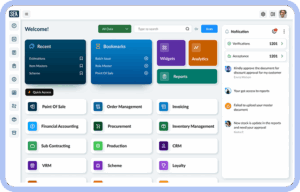
A manufacturing business owner or operations director with access to a real-time ERP dashboard can see, from a single screen, the current production floor status against the day’s plan, the raw material inventory position against the next two weeks of production requirements, the quality performance by production stage and supplier for the current month, the cost variance by product line against the budget, and the dispatch performance against customer delivery commitments.
These are the data points needed to make the operational and strategic decisions that drive a manufacturing business forward. Without ERP, assembling this picture requires pulling data from multiple sources, some of which will be out of date by the time the assembly is complete. With ERP, it is available in real time, always current, and accessible from any device.
For manufacturing businesses in the jewellery category specifically, retail jewellery software that extends from the manufacturing operation into the retail operation within the same platform adds a further analytical dimension: the ability to see the complete chain from production cost to retail price to customer transaction in a single connected view. This end-to-end visibility is what allows a jewellery manufacturing and retail business to optimise its full value chain rather than optimising manufacturing and retail as separate and disconnected operations.
SEA ERP by Synergics Solutions Private Limited is built to deliver this end-to-end operational picture for jewellery manufacturing and retail businesses, connecting production planning, inventory management, quality control, financial reporting, and retail operations in a single integrated platform designed for businesses that need to manage the complete journey from raw material to customer.
Frequently Asked Questions
What is manufacturing ERP software and how does it differ from standard business software? Manufacturing ERP software is a purpose-built platform that connects all operational functions of a production business including procurement, production planning, inventory management, quality control, cost tracking, financial reporting, and compliance into a single shared database. Standard business software typically covers one or two of these functions in isolation. Manufacturing ERP covers all of them simultaneously with real-time data flowing between every function automatically.
What is the most important benefit of implementing manufacturing ERP? The most foundational benefit is unified operational visibility, the ability for every department to see the same complete and current picture of the business simultaneously. This single benefit unlocks all other ERP advantages because production planning, inventory management, quality control, cost tracking, and financial reporting all become more effective when they operate from the same real-time data source rather than disconnected and partially outdated information.
How does manufacturing ERP reduce production waste? Manufacturing ERP reduces production waste through three mechanisms. Accurate real-time inventory tracking prevents over-ordering of raw materials and identifies slow-moving or excess stock before it becomes obsolete. Embedded quality control checkpoints at every production stage catch defects earlier in the process when correction costs are lower. And accurate production cost tracking by job identifies the specific products, processes, and suppliers responsible for the highest waste rates, enabling targeted improvement.
How long does it take for a manufacturing business to see ROI from ERP implementation? Most manufacturing businesses begin seeing measurable operational benefits within three to six months of full ERP implementation. Initial gains typically come from reduced manual processing time for inventory management, production scheduling, and financial reporting. Medium-term gains from improved production cost accuracy and quality control typically become visible within six to twelve months. Strategic gains from data-driven buying, pricing, and production decisions compound over a longer period.
Is manufacturing ERP suitable for small and mid-size production businesses? Yes. Manufacturing ERP is particularly valuable for small and mid-size production businesses because the manual processes that ERP replaces consume a disproportionately high share of staff time and attention in smaller operations. A manufacturing business with 20 to 100 employees that is managing production scheduling, inventory, quality control, and financial reporting manually is typically spending more time on administrative coordination than on value-adding production activity. ERP frees that time for productive use.
What should a jewellery manufacturer look for specifically in manufacturing ERP software? A jewellery manufacturer should look for native support for gold rate pricing integration that updates material costs automatically when the gold price moves, piece-level inventory tracking for high-value raw materials and finished goods, custom order production management as a distinct workflow alongside batch production, quality control checkpoints at the raw material intake and each production stage, and seamless integration between the manufacturing module and the retail or wholesale sales module so that finished goods flow directly into the selling inventory without manual transfer.
How does ERP improve supplier management for manufacturing businesses? Manufacturing ERP manages the complete supplier relationship within the same platform used for production and inventory. Purchase orders are generated automatically when stock falls below reorder thresholds. Goods receipt is recorded against the original purchase order, creating an automatic three-way match between order, receipt, and invoice. Supplier performance data including on-time delivery rates, quality rejection rates, and price variance against quoted costs is recorded automatically and available for supplier review meetings and renegotiations.