
TL;DR
The MRP full form is Maximum Retail Price, the highest price at which a product can legally be sold to a consumer in India under the Legal Metrology (Packaged Commodities) Rules, 2011. For most packaged goods, MRP is a single fixed number printed on the label. Gold and diamond jewellery works differently. Because gold prices move daily and every piece varies in weight, purity and craftsmanship, jewellery retailers calculate an effective selling price at the time of billing rather than printing one fixed MRP on every item. At Synergics Solutions, we build this pricing logic directly into our jewellery ERP so that gold rate updates, making charges, wastage, GST and hallmarking costs are calculated correctly on every single bill, every single day.

What Is the Full Form of MRP?
MRP stands for Maximum Retail Price. It is the ceiling price a manufacturer or seller is legally permitted to charge a customer for a product in India, and it must already include all applicable taxes, packaging costs and distribution margins.
The rule is enforced under the Legal Metrology Act, 2009, which requires that MRP be prominently printed on the label or packaging of most pre-packaged goods sold in the country. A retailer cannot legally sell above this number, though selling at or below it is permitted. This is different from a suggested retail price, which is only a recommendation and carries no legal weight.
For everyday packaged products such as groceries, cosmetics or electronics, MRP works as a fixed, one-time-printed figure. The manufacturer calculates it once, prints it on the packaging, and every retailer across the country sells at or under that number until a formal revision is announced through the Controller of Legal Metrology.
Why Jewellery Pricing Does Not Work Like a Standard MRP Label
This is where jewellery businesses face a genuinely different problem, and it is the reason we built Synergics Jewellery ERP the way we did.
A packet of biscuits has one weight, one recipe and one selling price that stays fixed for months. A gold necklace does not work that way. Two visually similar pieces can differ in gross weight, net weight, purity, stone value, wastage percentage and making charges. On top of that, the base input, gold, is priced on a live market rate that moves every single day, sometimes more than once in a day during volatile periods.
Because of this, gold and diamond jewellery is generally sold on a computed, transparent price breakup at the point of billing rather than a single static MRP printed weeks in advance. The retailer’s obligation under consumer protection law is not to hide a fixed number, it is to disclose every component of the final price clearly on the invoice, including:
- Gold rate applied on the day of sale
- Net weight of the metal used
- Making charges, shown as a percentage or a flat amount per gram
- Wastage charge, where applicable
- Stone or diamond value, billed separately from metal weight
- Hallmarking and certification charges
- GST at the applicable rate
This is the model followed by most large, transparent jewellery brands today, and it is also the compliance direction the industry has been moving toward since BIS hallmarking became mandatory nationwide from April 2023. A clear, itemised bill protects the customer just as effectively as a single printed MRP would, arguably more so, because it shows exactly what they are paying for.
 How the Final Selling Price Is Actually Calculated
Understanding the components behind a jewellery bill helps explain why software, rather than a manual price tag, has become essential for accurate, compliant pricing.
Gold Rate and Net Weight
The base value of any gold piece is its net weight multiplied by the current gold rate for that purity. A 22-karat piece and an 18-karat piece of identical gross weight will have very different metal values because their fine gold content is different.
Making Charges
Making charges cover the labour and craftsmanship that went into producing the piece. These are typically charged either as a percentage of the gold value or as a flat rate per gram, and they vary widely by design complexity, from roughly 3 to 25 percent depending on whether the piece is machine-made or hand-crafted.
Wastage
Some jewellers include a wastage charge to account for metal loss during manufacturing, though several transparent retailers now follow net weight billing and skip this charge entirely, itemising only what the customer actually receives.
Hallmarking Charges
Since hallmarking became compulsory, a small certification fee, generally in the range of ₹35 to ₹50 per piece, is added to confirm purity through the Bureau of Indian Standards’ HUID system. Every hallmarked piece carries a unique six-digit alphanumeric code that a customer can verify independently through the BIS Care app.
GST
Gold jewellery in India currently attracts 3 percent GST on the value of the jewellery, applied after all the above components are totalled.
Put together, the formula a jewellery retailer works with looks like this:
Final Price = (Net Weight × Gold Rate) + Making Charges + Wastage (if applicable) + Stone Value + Hallmarking Charge, then GST applied on the total
Every one of these variables can change from customer to customer, product to product and day to day. That is precisely why relying on manual calculation or spreadsheet-based pricing creates room for billing errors, pricing disputes and compliance risk at scale.
 The Legal Backdrop Every Jewellery Retailer Should Know
Jewellery pricing in India sits at the intersection of three separate regulatory frameworks, and it helps to understand how they connect.
Legal Metrology Rules
The Legal Metrology (Packaged Commodities) Rules, 2011 are the foundation of the MRP concept itself. They require that packaged goods carry a clearly visible declaration of the maximum price a consumer can be charged. Jewellery is typically sold loose or made-to-order rather than as a pre-packaged commodity with a fixed weight and recipe, which is why the industry has moved toward itemised, point-of-sale pricing instead of a single printed number. The underlying consumer protection intent, that a buyer should never be overcharged or misled about price, still applies in full.
BIS Hallmarking Standards
The Bureau of Indian Standards governs purity verification through the Hallmarking of Gold Jewellery and Gold Artifacts Order. Mandatory hallmarking, first rolled out in 256 districts in June 2021, was extended nationwide from April 2023, and now covers 14K, 18K and 22K gold as standard fineness grades, with 9K gold added to the mandatory scheme from July 2025 and silver hallmarking made mandatory from September 2025. Every hallmarked piece carries a BIS mark, a purity grade, and a unique HUID code that a customer can verify on the BIS Care app. This certification cost becomes one more line item that needs to be calculated and shown correctly on every bill.
GST Regulations
Gold jewellery attracts 3 percent GST on the total value of the piece, applied after gold value, making charges and any stone value have already been totalled. Retailers must also account for the fact that Input Tax Credit on raw gold purchases is restricted under Section 17(5) of the CGST Act, which affects how margins are calculated internally even though it does not appear as a separate line on the customer’s bill.
Taken together, these three frameworks mean a compliant jewellery bill today is a small piece of regulatory documentation in its own right. Getting even one component wrong, an outdated gold rate, a missed hallmarking charge, an incorrect GST calculation, creates a compliance gap that a manual or semi-automated billing process struggles to catch consistently across a growing business.
Why This Distinction Matters for Every Jewellery Business
Getting this pricing logic right is not just an accounting detail. It affects three things that directly determine whether a jewellery business runs smoothly or constantly firefights.
Customer trust. A buyer who sees a fully itemised bill, matching the current gold rate and a clearly stated making charge, trusts the transaction. A buyer who feels the price was arrived at inconsistently between visits or between staff members starts questioning the business.
Margin protection. If gold rate updates are applied late, inconsistently, or manually across branches, a retailer can unknowingly undersell stock at yesterday’s rate or overcharge and create disputes. Both scenarios erode margin and trust.
Regulatory compliance. With mandatory hallmarking, HUID tracking and GST rules tightening each year, a jewellery business needs pricing and billing records that are accurate, auditable and consistent across every branch and every biller.
This is exactly the operational gap that jewellery-specific software is built to close, and it is why generic accounting tools or plain billing software rarely hold up once a jewellery business grows beyond a single counter.
 How Synergics Jewellery ERP Handles Live Gold Pricing
We built Synergics Jewellery ERP around the reality that jewellery pricing changes constantly and needs to stay accurate without adding manual work for staff on the floor.
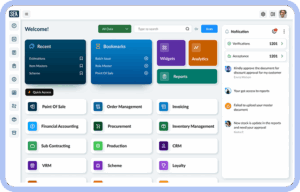
Inside the platform, gold, silver and diamond rates can be updated centrally, once, and the change reflects instantly across every connected branch, counter and biller. There is no need to manually rewrite price tags or recalculate each item by hand. When a biller pulls up a product at the counter, the system automatically applies the live rate, the correct making charge structure for that product category, any applicable wastage rule, hallmarking cost and GST, and generates a fully itemised invoice in seconds.
A few specific ways this shows up in day-to-day operations for the retailers we work with include:
- Centralised rate updates that push across every branch simultaneously, removing the risk of one store selling at an outdated rate
- Weight and purity tracking down to individual stock keeping units, so pricing always reflects the actual metal content of the piece being sold
- Configurable making charge rules by product category, design collection or karat, so staff never have to calculate this manually
- GST-compliant billing generated automatically at the point of sale
- Real-time inventory valuation that updates as gold rates move, giving business owners an accurate picture of stock value at any given moment, not just at month end
Our inventory management module and billing engine work together here, so the same rate change that updates a customer-facing price also updates the valuation of unsold stock sitting in the vault, which matters enormously for accurate financial reporting.
A Practical Example From the Retail Floor
Consider a mid-sized jewellery retailer running three showrooms in different cities. Every morning, the business updates its gold rate once its sourcing team confirms the day’s bullion price. Without centralised software, this meant a manager in each branch manually updating price boards, recalculating making charges by hand for dozens of product categories, and hoping every biller was working from the same numbers. On busy days, particularly during wedding season or Dhanteras, this manual process created a real risk: a biller in one branch working from an outdated rate sheet while another had already updated it, leading to two customers being billed differently for near-identical pieces within the same hour.
After moving to a centralised jewellery ERP, that same retailer updates the day’s gold rate once from a single dashboard. The change reflects across all three branches immediately, every biller works from the same live rate, and every invoice, regardless of which counter or city it is generated from, breaks down gold value, making charges, hallmarking cost and GST identically. The retailer also gains a real-time view of how the day’s rate movement has affected the value of unsold inventory sitting across all three locations, something that used to take a finance team days to reconcile manually at month end.
This pattern, consistent pricing across branches, accurate real-time inventory valuation and dramatically reduced billing time at the counter, is one of the most common outcomes we see reported by businesses using Synergics Jewellery ERP, particularly multi-branch retailers and manufacturers who cannot afford pricing inconsistency at scale.
A Second Example: Manufacturing to Retail Handoff
Pricing consistency does not only matter at the retail counter. It matters just as much for jewellery manufacturers and wholesalers who supply multiple retail partners.
Consider a manufacturing unit that produces gold chains and supplies them to a network of independent retail partners across a state. Historically, each time the gold rate moved, the manufacturer’s sales team would call, email or WhatsApp updated rates to every retail partner individually, and each retailer would then manually update their own price boards and billing records. This created a lag of anywhere from a few hours to a full day between the manufacturer’s rate update and the retail partner reflecting it correctly, during which either the retailer risked selling below the current market rate or a customer risked being quoted an inconsistent price compared to a competing store carrying the same design.
With a connected jewellery ERP that links manufacturing, wholesale distribution and retail billing on one platform, a rate update made at the manufacturing level can flow through to every connected retail partner’s billing system automatically, along with accurate product-level data such as gross weight, net weight, purity and design code. This closes the lag between wholesale rate changes and retail billing accuracy, and it also gives the manufacturer real-time visibility into how much inventory value is sitting with each retail partner at any given moment, which is difficult to track reliably through phone calls and spreadsheets alone.
This kind of handoff, from manufacturing through to wholesale and finally retail billing, is exactly why we built Synergics Jewellery ERP as a single connected suite rather than separate tools stitched together after the fact.
MRP vs Effective Selling Price: A Quick Comparison
| Aspect | Standard MRP (Packaged Goods) | Jewellery Effective Selling Price |
|---|---|---|
| Basis | Fixed price printed once by manufacturer | Calculated live using gold rate on the day of sale |
| Update frequency | Changes rarely, only on formal price revision | Can change daily or even multiple times a day |
| Governing rule | Legal Metrology (Packaged Commodities) Rules, 2011 | Bill itemisation, GST rules, BIS hallmarking norms |
| Displayed as | Single number on packaging | Itemised breakup: gold value, making charges, GST |
| Consistency requirement | Same price nationwide until revision | Same live rate applied identically across every branch |
| Compliance risk if inconsistent | Legal penalty for overcharging | Customer disputes, margin loss, audit discrepancies |
Frequently Asked Questions
What is the full form of MRP?
MRP stands for Maximum Retail Price. It is the highest price a seller is legally allowed to charge a customer for a product in India, inclusive of all taxes, under the Legal Metrology (Packaged Commodities) Rules, 2011.
Does gold jewellery have a fixed MRP like other products?
Not in the same way. Because gold prices change daily and every piece has a different weight, purity and design, jewellery is priced using an itemised, live calculation at the time of billing rather than a single fixed MRP printed in advance.
What components make up the final price of a gold jewellery item?
The final price generally includes the net gold weight multiplied by the current gold rate, making charges, wastage where applicable, stone or diamond value, hallmarking charges and GST.
Why do gold rates change so often, and how should a jeweller keep pricing accurate?
Gold is a globally traded commodity, so its price moves with international market conditions, currency exchange rates and domestic demand. Jewellers need a system that updates rates centrally and applies them instantly across every branch and biller to avoid pricing inconsistencies.
How does jewellery billing software help with MRP-related compliance?
Jewellery billing software automates the calculation of gold value, making charges, hallmarking fees and GST on every invoice, ensuring every bill is accurate, itemised and consistent across branches, which supports both customer trust and regulatory compliance.
Is hallmarking charge included in the MRP of jewellery?
Hallmarking charges are typically itemised separately on the invoice rather than folded into a single MRP figure, since the fee reflects a certification cost tied to the specific piece rather than the metal’s market value.
Bringing Accurate Pricing to Every Counter
Understanding the MRP full form is straightforward. Applying that same principle of fair, transparent, compliant pricing to a business where the core raw material changes value every day is the real operational challenge jewellery retailers face. That is the problem we set out to solve when we built Synergics Jewellery ERP: a single platform where gold rate updates, making charge rules, hallmarking costs and GST calculations work together automatically, so every bill, from every branch, reflects the correct price the first time.
If your business is still managing gold rate updates, making charges or multi-branch billing manually, it is worth seeing how a purpose-built jewellery ERP changes that. Visit Synergics Jewellery ERP to book a free, personalised demo and see the pricing and billing engine in action for your own product catalogue.