
- HUID is a six-character alphanumeric code assigned to every hallmarked gold jewellery piece in India by BIS-licensed assaying and hallmarking centres (AHCs).
- HUID hallmarking has been mandatory in phases since June 2021 for gold jewellers above specified thresholds.
- Modern jewellery software links each HUID to the specific piece in inventory, the sale transaction, and the customer invoice automatically, with no manual entry.
- A properly built system also manages old-stock retrofitting and generates the exact audit registers BIS inspectors request, not just a general compliance report.

What Is HUID?
HUID is a six-character alphanumeric code stamped on every hallmarked gold jewellery piece that uniquely identifies that specific item in the Bureau of Indian Standards national database. No two pieces carry the same HUID.
The code allows any buyer, retailer, or regulator to verify the authenticity and purity of a gold piece by searching the BIS Care app or portal using that code.
Before HUID was introduced, hallmarking used only purity marks and assay centre codes. The problem was that these marks could not identify individual pieces.
A fraudulent piece could carry the same marks as a genuine one. HUID changed this by making every piece traceable back to the specific Assaying and Hallmarking Centre (AHC), the specific date, and the specific purity assay.

Why HUID Matters for Every Gold Jeweller in India
HUID is not optional for gold jewellers above the specified turnover threshold. The Government of India made HUID hallmarking mandatory in phases starting June 2021, with the requirement extended progressively across districts and product categories.
Here is what jewellers are legally required to do:
- Sell only HUID-hallmarked gold jewellery above the applicable purity and weight thresholds
- Maintain records of HUID numbers linked to each piece sold
- Print the HUID number on the customer invoice
- Not sell pieces with older hallmarks that do not carry a HUID code after the specified transition deadline
Failure to comply can result in penalties from BIS, suspension of the jeweller’s registration, and legal action under the Bureau of Indian Standards Act. The compliance risk is real and the documentation requirement is ongoing, not a one-time setup.

The HUID Compliance Challenge for Jewellers
Understanding the legal requirement is simple. Implementing it operationally across hundreds or thousands of pieces in a busy retail environment is where most jewellers encounter problems.
1. Manual entry is error-prone at scale. A jewellery store with 500 active pieces needs 500 HUID numbers recorded correctly in the system. A single transposed character means the piece cannot be verified by the customer on the BIS Care app, creating immediate trust problems at the point of sale.
2. Pieces arrive from multiple suppliers. Gold jewellery enters a retail store from manufacturers, wholesalers, and consignment suppliers, each with their own hallmarking records. Reconciling HUID records across multiple inward sources without a systematic digital process creates gaps in documentation.
3. Invoices must include HUID numbers. In a manual billing process, staff must locate the correct HUID from their records and type it into the invoice for every transaction. At peak trading periods, this step gets skipped or done incorrectly.
4. Old stock compliance requires transition management. Jewellers who held stock with old hallmarks before the HUID mandate needed to get those pieces re-hallmarked and updated in their records.
In practice, this means batching pre-2021 hallmarked pieces, submitting them to the AHC for re-hallmarking under the HUID regime, and tracking each piece’s retrofit status individually, from submission through to the new HUID being issued.
Managing this transition on paper, without a system that tracks retrofit status piece by piece, is genuinely difficult for any store carrying legacy stock.
5. Regulatory audit readiness. If a BIS inspector asks a jeweller to produce HUID records for all pieces currently in stock and recently sold, a jeweller relying on paper records or spreadsheets faces a significant documentation challenge.
A jeweller running a proper jewellery ERP can produce the complete HUID audit trail in seconds.

How Jewellery Software Tracks HUID Automatically
Modern jewellery software addresses every one of these challenges by embedding HUID tracking directly into the daily operational workflow rather than treating it as a separate compliance task.
Here is exactly how it works in a purpose-built jewellery ERP system like Synergics Jewellery ERP.
At Goods Receipt
When new jewellery arrives from a supplier or manufacturer, the goods receipt workflow requires HUID entry as a mandatory field for each gold piece being accepted into inventory.
The staff member either scans the HUID from the piece’s hallmark certificate or enters it from the supplier’s documentation. The system validates the format and links the HUID to the piece’s unique inventory record before the goods receipt can be completed.
HUID data enters the system at the earliest possible point, linked to the specific piece from day one in the store’s inventory.
In the Inventory Record
Every gold piece carries its HUID as a searchable, reportable attribute alongside its weight, purity, design code, making charge, stone specifications, and current gold rate price. Any staff member can search inventory by HUID number and locate a specific piece instantly.
At the Point of Sale
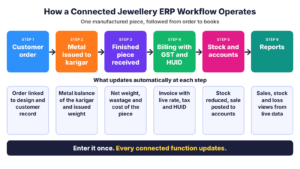
When a piece is scanned at the billing counter, whether by barcode or RFID, the billing system automatically pulls the HUID from the piece’s inventory record and includes it in the invoice. Staff never need to manually locate or enter the HUID.
On the Customer Invoice
The generated GST-compliant invoice includes the HUID number in the correct field, the hallmarking centre code, the purity designation, and the piece weight, meeting all BIS and GST documentation requirements without any additional manual work from billing staff.
Old-Stock Retrofit Tracking
For legacy stock still carrying pre-2021 hallmarks, a properly built system manages the full retrofit cycle: batching eligible pieces for AHC submission, tracking each piece’s status through re-hallmarking, and updating the inventory record automatically once the new HUID is issued.
This turns a process that’s genuinely painful to manage on paper into a simple status report showing exactly which pieces are pending, submitted, or completed.
For Audit and Reporting
Rather than a single generic compliance report, a properly configured system generates the specific registers BIS auditors typically request:
- The HUID register, listing every piece in current inventory with its HUID
- The sales register, showing every piece sold in a given period with its HUID and corresponding invoice
- The missing-HUID register, flagging any pieces in inventory without valid HUID data before they reach the sales floor
- The old-stock retrofit register, tracking legacy pieces through the re-hallmarking process
Having these four registers ready on demand turns a regulatory audit into a matter of running a report, not searching through paper records for days.
HUID Tracking: Manual Process vs Jewellery ERP
|
Function |
Manual Process |
Synergics Jewellery ERP |
|
HUID data entry |
Manually typed into spreadsheet or billing system at inward |
Mandatory field at goods receipt, linked to piece record automatically |
|
HUID on invoice |
Staff member locates and types HUID manually per transaction |
Pulled automatically from inventory record when piece is scanned |
|
HUID verification |
Staff checks paper records or spreadsheet |
Instant search by HUID across entire inventory |
|
Audit readiness |
Paper records or spreadsheet reconstruction |
Complete HUID audit trail, across all four registers, generated in seconds |
|
Missing HUID detection |
Discovered only when a piece is sold or during manual review |
System flags pieces with missing HUID data before they reach the sales floor |
|
Old-stock retrofit |
Tracked manually, easy to lose status on individual pieces |
Batched, submitted, and tracked piece by piece automatically |
|
Supplier HUID reconciliation |
Manual matching of supplier documents against internal records |
Linked at goods receipt, discrepancies flagged automatically |
|
Multi-branch HUID visibility |
Separate records per location, no consolidated view |
Consolidated HUID inventory across all branches in real time |
What Information Is Stored Against Each HUID in the System
A well-configured jewellery ERP stores the following data against each HUID number:
- The six-character HUID code itself
- Gold purity designation: 14K, 18K, 20K, 22K, or 24K
- Weight in grams
- Assaying and hallmarking centre (AHC) name and BIS registration number
- Date of hallmarking
- Supplier or manufacturer who provided the piece
- Date of goods receipt into the store
- Current inventory location: branch, display case, storage
- Stone specifications if the piece is studded
- Sale transaction reference if the piece has been sold
- Customer invoice number linked to the sale
- Date of sale
This complete record means the piece can be traced from its hallmarking centre through to the end customer at any point in its lifecycle.
BIS HUID Compliance: Key Rules Every Jeweller Must Know
|
Rule |
Detail |
|
Mandatory categories |
Gold jewellery and artefacts of 14K, 18K, 20K, 22K, and 24K purity |
|
Exemptions |
Gold coins of weight 2 grams or below, continuous plain gold chains manufactured using a machine, and gold jewellery for export |
|
HUID code format |
Six-character alphanumeric code, unique to each piece |
|
Where it appears |
Stamped on the piece alongside the BIS logo, purity mark, and AHC mark |
|
Verification method |
BIS Care app or BIS portal using the HUID code |
|
Invoice requirement |
HUID number must appear on the sale invoice |
|
Registration requirement |
Jewellers must be BIS registered to sell hallmarked jewellery |
|
Penalty for non-compliance |
Up to Rs 1 lakh fine and one year imprisonment under the BIS Act 2016 |
HUID and the Customer: Why It Builds Trust

HUID is not just a compliance requirement for jewellers. It is a trust-building tool for customers.
A customer who buys a gold piece with a HUID can verify its purity and authenticity instantly by searching the code in the BIS Care app.
There is no ambiguity and no reliance on the jeweller’s word.
This verification capability changes the customer relationship in a meaningful way. It is the difference between a jeweller saying their gold is 22K and a customer being able to verify it independently.
In a market where gold adulteration has historically concerned consumers, HUID provides a government-backed verification mechanism that protects the buyer and rewards honest jewellers with a real credibility advantage.
HUID Tracking in Multi-Branch Jewellery Operations

For jewellers operating more than one store, HUID tracking adds a layer of complexity that single-location systems cannot handle effectively.
When a piece transfers from one branch to another, the HUID must travel with it in the system. The receiving branch needs to see the complete piece record, including the HUID, original goods receipt details, and piece history, before accepting it into inventory.
Synergics Jewellery ERP manages this through its inter-branch transfer module. When a piece is transferred, the HUID and complete piece record move with it in real time.
The sending branch’s inventory decrements immediately, and the receiving branch’s inventory updates the moment the piece is scanned and confirmed received.
This matters particularly during BIS compliance audits, where an inspector may request HUID records for all pieces across all locations simultaneously.
Conclusion
HUID compliance is not a one-time setup. It’s an ongoing operational requirement that touches goods receipt, billing, old-stock management, and audit readiness every single day.
Software built specifically around how hallmarking actually works, not a generic compliance bolt-on, is what turns that requirement from a daily risk into a background process your team barely thinks about.
Want to see HUID tracking, old-stock retrofit, and audit-ready registers working together in one system? Book a free demo with the Synergics team.
Frequently Asked Questions
1. What is a HUID number in jewellery?
HUID stands for Hallmark Unique Identification number. It is a six-character alphanumeric code assigned by BIS-licensed assaying and hallmarking centres to uniquely identify every individual hallmarked gold jewellery piece in India. Customers can verify any HUID on the BIS Care app to confirm the piece’s purity and authenticity.
2. Is HUID hallmarking mandatory for all gold jewellers in India?
Yes. HUID hallmarking is mandatory for gold jewellery retailers in India above specified thresholds, covering 14K, 18K, 20K, 22K, and 24K gold pieces. Jewellers must be BIS registered and can only sell pieces carrying a valid HUID. Non-compliance carries penalties under the BIS Act 2016.
3. How does jewellery software automatically track HUID numbers?
Purpose-built jewellery software like Synergics Jewellery ERP captures the HUID at the goods receipt stage and links it to the piece’s inventory record. At billing, the HUID is pulled automatically from inventory and printed on the customer invoice without any manual entry by staff.
4. Can customers verify a HUID number themselves?
Yes. Any customer can verify a HUID by searching the six-character code in the BIS Care mobile app or on the BIS portal. The result shows the metal purity, the assaying centre, and the date of hallmarking, providing independent verification of the piece’s authenticity.
5. What happens if a piece does not have a HUID?
Gold jewellery sold in India above the specified threshold without a valid HUID is non-compliant under BIS regulations. The jeweller faces penalties of up to Rs 1 lakh and potential suspension of their BIS registration. Synergics Jewellery ERP flags pieces with missing HUID data before they reach the sales floor.
6. How does software manage old stock that predates the HUID mandate?
A properly built system batches legacy pieces for submission to the AHC for re-hallmarking, then tracks each piece’s status through the retrofit process automatically. This replaces manual tracking, where it’s easy to lose visibility on exactly which pieces have been resubmitted and which are still pending.
7. What audit registers should jewellery software generate for BIS compliance?
At minimum, a HUID register of current inventory, a sales register linking sold pieces to their invoices, a missing-HUID register flagging incomplete records, and an old-stock retrofit register tracking legacy pieces through re-hallmarking. Together, these are what a BIS inspector typically requests.
8. How does HUID tracking work across multiple store branches?
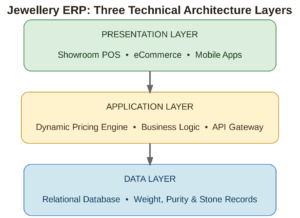
In Synergics Jewellery ERP, HUID data is stored centrally and visible across all branches in real time. When a piece transfers between branches, its complete HUID record moves with it. Any branch can search by HUID and see the complete piece history regardless of its current location.
9. Does the customer invoice need to include the HUID number?
Yes. The BIS requirement is that the customer invoice for any HUID-hallmarked piece must include the HUID number. Synergics Jewellery ERP includes the HUID automatically on every GST-compliant invoice generated for a hallmarked piece, without requiring any manual step from billing staff.