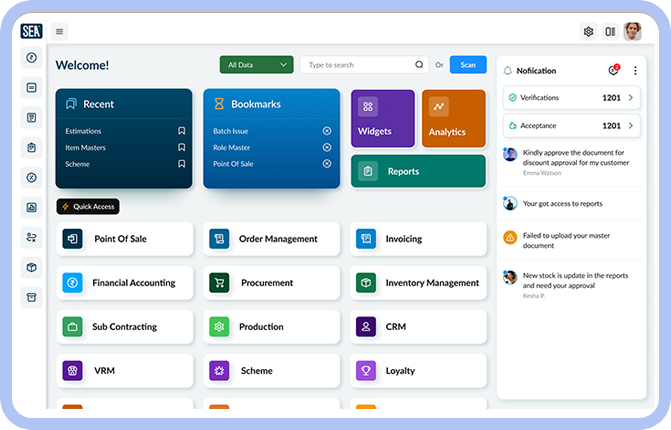
- A jewellery ERP isn’t one generic toolset. The same core capability, inventory, pricing, compliance, works differently depending on whether you run retail, wholesale, or manufacturing
- Retail leans on POS, CRM, and loyalty.
- Wholesale leans on bulk pricing and multi-location distribution. Manufacturing leans on job work, BOM, and wastage tracking.
- Most jewellery businesses actually run more than one of these at once, and that’s exactly where a purpose-built ERP earns its value over generic software.
- A full feature matrix below maps every capability across all three business types in one place.
Jewellery businesses rarely run in a straight line. A wholesaler often manufactures too. A retailer often takes in repair work that behaves like light manufacturing.
Understanding what a jewellery ERP actually does means looking past the marketing feature list and seeing how the same underlying capability shows up differently depending on which side of the counter, or the workshop, you’re standing on.
Core Jewellery ERP Feature Areas Explained
A jewellery ERP covers seven core capability areas across retail, wholesale, and manufacturing. The same underlying feature, inventory tracking, pricing, compliance, exists in all three, but what it actually needs to do changes depending on the business.
A retailer needs shelf-to-sale speed, where a wholesaler needs bulk-lot accuracy across buyers instead, and a manufacturer needs something different again: raw-to-finished traceability through every production stage.
This is exactly why customization matters more than a long feature list. A system that applies the same rigid inventory logic to a showroom, a distribution warehouse, and a production floor ends up serving none of them particularly well.
Genuine customization means each capability adapts to how that specific side of the business actually operates, not a generic template stretched to fit. The sections below break down each capability area and show exactly how it plays out for each business type.
1. Inventory & Traceability
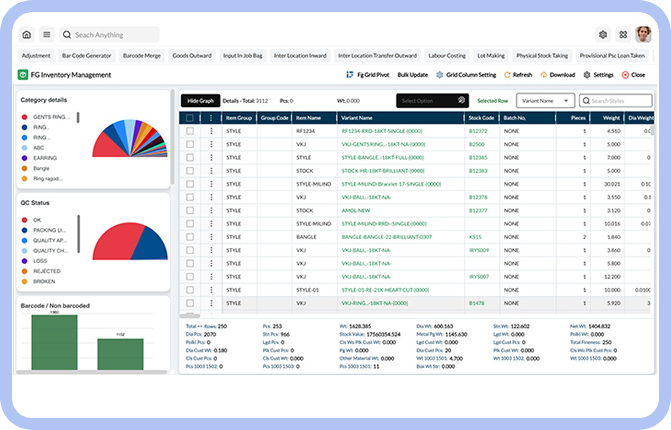
Every jewellery ERP tracks inventory by weight, purity, and design, using barcode or RFID to keep a physical piece and its digital record in sync. But what “traceability” actually needs to answer changes depending on the business.
Retail
For a retail store, traceability is about shelf-to-sale speed: knowing instantly what’s in which display case, at which location, and updating that the moment a piece sells or gets scanned for a stock take.
Wholesale
Wholesale operations need traceability at the lot level instead, tracking bulk stock moving between locations and buyers, with weighted-average valuation that stays accurate as lots combine and split.
Manufacturing
In manufacturing, traceability starts at raw material receipt and follows every gram through casting, setting, and polishing until it becomes a finished, sellable piece.
2. Pricing & Billing
Formula-driven, dynamic pricing is standard across all three business types, tied to live gold rates rather than fixed price lists. Where it diverges is in what the pricing actually needs to account for.
Retail
Retail billing handles the full complexity of a walk-in sale: split payments, old gold exchange, loyalty point redemption, and discount approvals, often all in the same transaction.
Wholesale
Wholesale pricing needs to flex per buyer relationship, supporting different pricing structures for different retail partners without manual recalculation for every order.
Manufacturing
Manufacturing pricing works backward from actual production cost, comparing what a piece cost to make against the pricing model used to sell it, and flagging drift before it erodes margin.
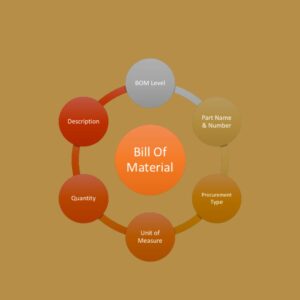
3. Style Master & Bill of Materials
Every business type relies on a style master, the record defining what a piece actually is. The depth of that definition is where retail, wholesale, and manufacturing part ways.
Retail
Retail style masters focus on cataloguing: images, videos, and searchable attributes that make a piece easy to find and sell, whether from stock or a design bank.
Wholesale
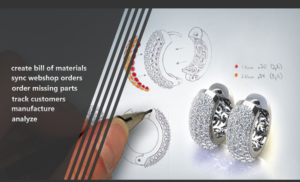
Wholesale masters need the same catalogue depth but at higher volume, supporting complex, hundred-row bills of material alongside simple, single-line definitions for standard pieces.
Manufacturing
Manufacturing style masters go furthest, defining multi-metal BOMs, centre stone and side stone breakdowns, and customer-specific specifications that drive the actual production process.
4. Production, Job Work & Karigar Management
Manufacturing owns this capability most directly, but it isn’t exclusive to it. Any business handling custom work or repairs runs a version of the same workflow.
Retail
Retailers use subcontractor and karigar tracking mainly for repairs and custom orders, linking a job to the customer’s order and tracking allowable wastage on that specific piece.
Wholesale
Wholesale operations often outsource manufacturing entirely, and need process-wise tracking that links outsourced work back to the originating order for accurate settlement.
Manufacturing
Manufacturing runs the full production cycle natively: job cards, wax to casting to finishing, with wastage benchmarked and tracked at every individual stage, not just the final output.
5. Customer & Vendor Relationships
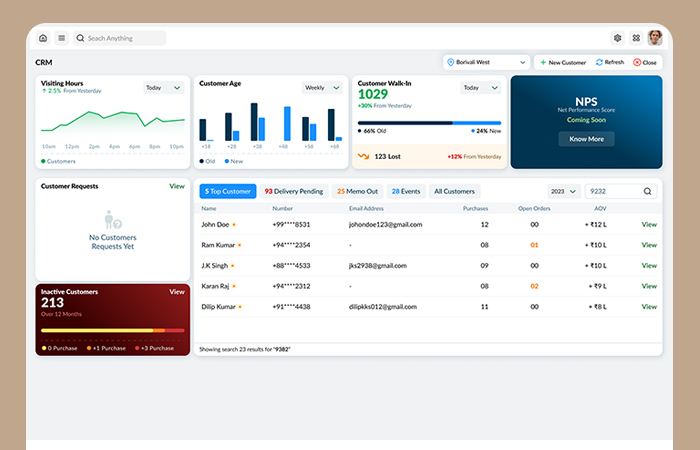
Every business type manages relationships, but who the “customer” actually is changes the whole shape of this capability.
Retail
Retail CRM is genuinely customer-facing: birthdays, anniversaries, purchase history, and loyalty tiers that turn a single sale into a long-term relationship.
Wholesale
Wholesale relationship management centers on buyers and vendors instead, tracking payables, receivables, and multi-currency ledgers across ongoing trading relationships.
Manufacturing
Manufacturing relationship management runs toward suppliers, with vendor ratings and purchase order tracking that keeps raw material sourcing reliable and cost-effective.
6. Multi-Location, Franchise & Financial Control
Growth past a single location is where generic software typically breaks down, and where a purpose-built jewellery ERP earns its keep.
Retail
Retail chains need real-time stock transfers between branches, consolidated location-wise profit and loss, and franchisee management for businesses that operate through partner-owned stores.
Wholesale
Wholesale operations need the same multi-location visibility applied to distribution rather than retail footfall, with branch-level accounting that rolls up into one consolidated picture.
Manufacturing
Manufacturers scaling across production units need financial control that ties actual production cost, not budgeted cost, into the same books used for the rest of the business.
7. Compliance & Security
BIS hallmarking, GST, and role-based access aren’t optional in any part of the jewellery trade, but the specific compliance burden looks different by business type.
Retail
Retail compliance centers on point-of-sale accuracy: HUID captured and printed correctly on every customer invoice, with GST calculated automatically at the counter.
Wholesale
Wholesale compliance adds multi-currency GST handling and documentation that needs to satisfy both domestic and, often, export requirements.
Manufacturing
Manufacturing compliance starts earlier in the chain, tracking hallmarking submission and HUID assignment for pieces before they even reach a retail floor.
Full Feature Matrix: Retail vs Wholesale vs Manufacturing
| Feature | Retail | Wholesale | Manufacturing |
| POS and Billing | Full POS with split payments, loyalty | Order-based billing, not counter POS | Not applicable |
| CRM and Loyalty | Full CRM with loyalty tiers | Buyer relationship tracking | Limited, supplier-focused |
| Inventory Management | Shelf-level, barcode/RFID | Lot-level, bulk movement | Raw-to-finished traceability |
| Style Master and BOM | Catalogue-focused | High-volume, complex BOM | Full multi-metal, multi-stone BOM |
| Job Work and Karigar Management | Repair and custom orders only | Outsourced manufacturing tracking | Full production cycle |
| Pricing Rules | Consumer-facing dynamic pricing | Buyer-specific tiered pricing | Cost-based, post-production pricing |
| Procurement | Retail stock replenishment | Bulk raw material and finished goods | Raw material and semi-finished goods |
| Multi-Location Support | Yes, with franchisee management | Yes, distribution-focused | Yes, across production units |
| Financial Accounting | Full, with branch accounting | Full, with multi-currency ledgers | Full, tied to production costing |
| Barcode and RFID | Yes | Yes | Yes |
| BIS Hallmarking and HUID | Point-of-sale compliance | Multi-currency GST and export docs | Submission and HUID assignment |
| Repair Management | Yes, full lifecycle | Yes | Not typically applicable |
| E-commerce Integration | Yes | Limited | Not applicable |
| Memo and Consignment | Customer and vendor memo | Vendor and buyer memo | Job work consignment |
Synergics Jewellery ERP: All Three, One Platform
Most of what’s described above exists in some form across generic ERP platforms, retrofitted with jewellery terminology bolted on top.
Synergics Jewellery ERP works the other way. It’s cloud-based from the ground up, and every capability, retail, wholesale, and manufacturing, is configured around how your specific business actually operates, not forced into a one-size-fits-all template.
That customization matters in practice. A business running retail and manufacturing together doesn’t need two disconnected systems reconciled by hand. It needs one platform where a piece moving from the workshop to the showroom carries its full history, cost, and compliance data with it automatically.
Synergics serves 150+ jewellery businesses across 9 countries, including CaratLane, Angara, Muthoot Exim, Browns, and Hazoorilal, and holds SOC 2 Type II certification alongside a CARE SME 3 rating.
The company’s work has also been covered by the Economic Times and Business Today, recognition that reflects the depth of what’s actually running behind the scenes at these implementations, not just a features page.
Why This Matters More Than a Generic Feature List
Generic ERP platforms treat these capabilities as one-size-fits-all modules with customization layered on top. A jewellery-specific system built from the trade’s actual operational requirements, the way retail, wholesale, and manufacturing genuinely differ in daily practice, delivers something a generic platform simply can’t retrofit convincingly.
Most jewellery businesses don’t fit cleanly into one category anyway. A manufacturer who also runs a showroom needs retail-grade CRM alongside full production tracking. A wholesaler who takes on custom orders needs job work management most wholesale software never considered.
This is exactly why the capabilities above need to work together in one connected system, not as separate tools bolted onto each other.
Conclusion
The real test of a jewellery ERP isn’t how long its feature list runs. It’s whether each capability actually reflects how retail, wholesale, and manufacturing genuinely operate, not a generic template with jewellery terminology added on top.
Synergics Jewellery ERP builds every capability above around the way jewellery businesses actually work, across all three sides of the trade.
Not sure which combination of retail, wholesale, and manufacturing features your business actually needs? Talk to the Synergics team and we’ll map it to how your operation really runs.
FAQs
1. What’s the difference between retail, wholesale, and manufacturing jewellery ERP features?
Retail features centre on point-of-sale, CRM, and loyalty. Wholesale features centre on bulk pricing, multi-location distribution, and buyer relationships. Manufacturing features centre on job work, bill of materials, and production-stage wastage tracking. Most jewellery ERPs, including Synergics, support all three together.
2. Can one jewellery ERP handle retail, wholesale, and manufacturing at the same time?
Yes, in a properly built system. Many jewellery businesses operate across more than one category, manufacturing and retailing, or wholesaling and taking custom orders, and a connected ERP handles all of it from shared inventory and financial data instead of separate disconnected tools.
3. How does inventory tracking differ between retail and manufacturing?
Retail inventory tracking focuses on shelf-level visibility and fast stock takes at the point of sale. Manufacturing inventory tracking follows raw material through casting, setting, and finishing until it becomes a sellable finished piece, with wastage tracked at every stage along the way.
4. Why does wholesale pricing work differently from retail pricing in a jewellery ERP?
Wholesale pricing needs to flex per buyer relationship, supporting different pricing structures for different retail partners without manual recalculation for every single order placed. Retail pricing is generally consumer-facing and more standardized, though still tied to live gold rates and formula-based rules.
5. Does BIS hallmarking compliance work the same way across retail, wholesale, and manufacturing?
No. Manufacturing compliance starts with hallmarking submission and HUID assignment before a piece is finished. Retail compliance centres on capturing that HUID correctly at the point of sale. Wholesale compliance adds multi-currency GST and export documentation on top of both.
6. What should a growing jewellery business look for in ERP features as it scales?
Multi-location support that consolidates reporting rather than fragmenting it, financial accounting that ties actual costs to the books accurately, and role-based access control that keeps sensitive data protected as more staff and locations get added to the system.