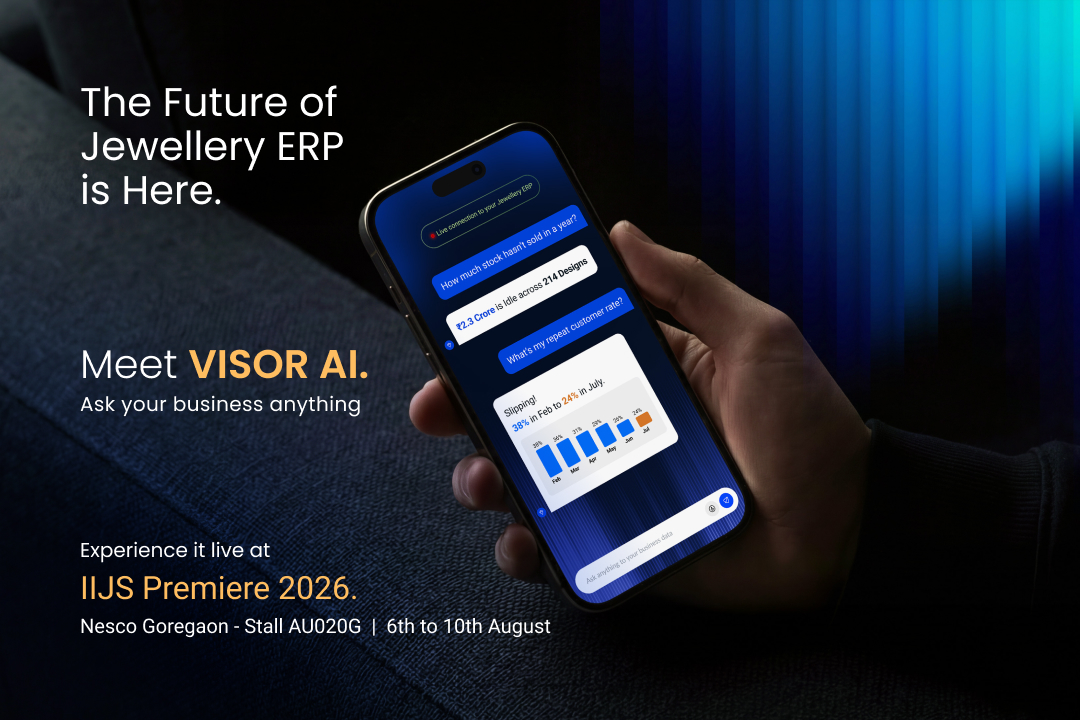

Jewellery ERP software has moved a long way past basic billing and inventory tracking. As jewellery businesses push for greater efficiency, faster decisions, and better customer experiences, a handful of real technology shifts are reshaping what a jewellery ERP is expected to do.
Here’s what’s actually changing, and what it means for retailers, manufacturers, and wholesalers specifically.
1. AI and Conversational Business Intelligence
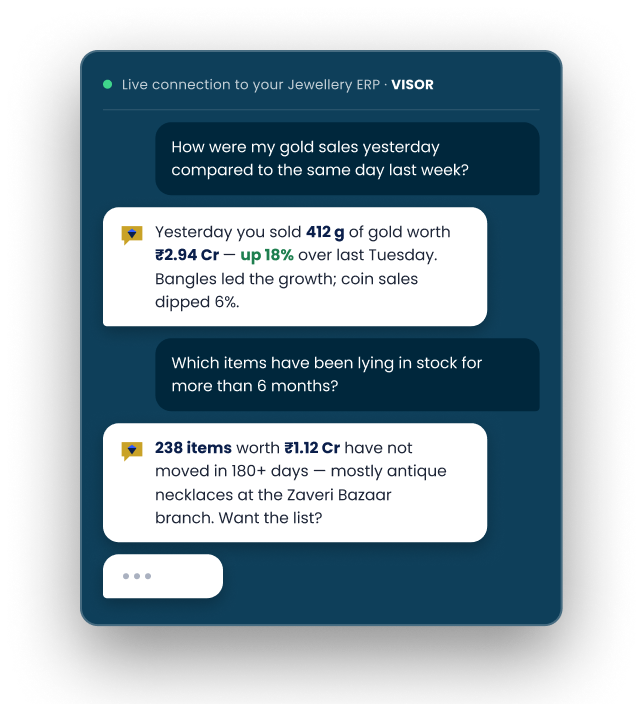
Artificial intelligence in jewellery ERP has moved past predictive restocking alerts into something more direct: being able to ask your business a question and get a real answer, instantly, in plain language.
This is exactly the gap VISOR, Synergics’ conversational AI assistant for jewellery businesses, is built to close. VISOR connects to your existing jewellery ERP, including but not limited to Synergics, through a secure, read-only channel, and answers real business questions the way you’d ask a trusted manager: which designs to reorder, how much gold is sitting with a karigar and for how long, which category is dragging sales down this month. No reports, no waiting on one MIS person, no dashboard built around last quarter’s questions.
For jewellery businesses specifically, this matters more than in most industries. A jewellery ERP holds enormous operational detail, weight, purity, wastage, job cards, making charges, but getting a straight answer out of it has traditionally meant waiting on a report built for a different question.
AI that can actually converse with that data, rather than just visualize it, is a real shift, not an incremental one.
2. Cloud-Based, Multi-Branch Jewellery ERP
Cloud deployment has become close to standard for jewellery ERP software, and for good reason. For a business running multiple showrooms, a manufacturing unit, and a wholesale operation under one roof, cloud access means owners and managers can check stock, sales, and job status from anywhere, not just from a terminal in one location.
It also lowers the upfront cost of scaling to a new branch, since there’s no separate on-premise setup required for every new location.
3. Big Data and Real Business Analytics
Modern jewellery ERPs increasingly go beyond static sales reports into real-time analytics: dead stock value, making-charge realization by category, karigar-wise wastage trends, and branch-level inventory turnover. The shift is from reports you request to insight that’s simply available.
This is a big part of what makes tools like VISOR useful in practice, drawing on a curated library of 220-plus jewellery-specific business questions spanning retail, manufacturing, and finance, rather than a handful of generic sales charts.
4. Stronger Security and Compliance Built In
Jewellery businesses handle uniquely sensitive data: customer financial details, high-value transaction records, and compliance documentation for GST and hallmarking.
Modern jewellery ERP platforms are building in stronger security as standard, encrypted storage, role-based access controls, and automated backups, alongside better support for the specific compliance jewellery businesses actually need to maintain, not generic data protection frameworks borrowed from unrelated industries.
5. Mobile and Remote Access for Owners, Not Just Staff
Mobile access used to mean a stripped-down app for sales staff. Increasingly, it means real operational visibility for owners specifically.
A daily WhatsApp business briefing, for instance, sales, collections, and stock alerts delivered automatically each morning, is a small feature with an outsized effect: owners see the health of their business before they’ve even reached the showroom, instead of waiting for someone to compile it.
6. User-Centric Design for Non-Technical Teams
Jewellery ERP has historically demanded real training to use well. The trend now is toward interfaces that require none: plain-language queries instead of menus and filters, customizable dashboards suited to a showroom manager’s needs versus a workshop supervisor’s, and built-in support that answers questions on the spot.
The underlying principle is straightforward: an owner shouldn’t need training to understand their own business.
7. IoT and Connected Tracking on the Workshop Floor
Internet of Things integration is showing up in jewellery ERP through smarter RFID and barcode tracking, connecting physical stock movement, gold issued to karigars, items moving through polish or setting, directly to the software in real time.
This closes a gap that’s cost jewellery manufacturers for years: metal that’s technically tracked on paper but effectively invisible on the workshop floor until a reconciliation report surfaces a loss that’s already happened.
Conclusion
The common thread across all of these trends is the same: less waiting, less manual reconciliation, and more direct access to what’s actually happening in the business right now.
Jewellery ERP software is moving from a system of record you check periodically to a system you can genuinely talk to and trust in the moment. Businesses that adopt these capabilities early aren’t just keeping up with technology, they’re making faster, better-informed decisions than competitors still working from yesterday’s report.
Curious what this looks like for your business? See VISOR answer a real question live, from actual jewellery data, in seconds.
FAQs
1. What are the biggest trends in jewellery ERP software right now?
Conversational AI for direct business questions, cloud-based multi-branch access, real-time analytics beyond static reports, stronger built-in security and compliance, owner-focused mobile access, simplified interfaces that need no training, and IoT-connected tracking on the workshop floor.
2. What is VISOR and how is it different from a typical jewellery ERP dashboard?
VISOR is a conversational AI assistant built by Synergics that connects to your existing jewellery ERP and answers business questions in plain English, instantly. Unlike a dashboard, which shows what someone predicted you’d want to see, VISOR answers the specific question you have right now, without needing a report requested or a menu navigated.
3. Does VISOR only work with Synergics Jewellery ERP?
No. VISOR is built to work with any jewellery ERP or billing software, not only Synergics, connecting through a secure, read-only channel without requiring any migration or change to how your team already works.
4. How is AI actually being used in jewellery ERP today, beyond marketing language?
Concretely: natural-language business queries, demand forecasting for high-value inventory, karigar-wise wastage tracking, dead stock identification, and making-charge realization analysis, all drawing on real transaction data rather than generic industry benchmarks.
5. Why does mobile access matter more for jewellery business owners specifically?
Because jewellery businesses run on daily-moving numbers, gold rates, footfall, stock alerts, that lose relevance quickly. A daily briefing delivered directly to an owner’s phone means decisions can be made before the business day even starts, rather than after someone compiles a report.
6. Is my data safe if I connect an AI assistant like VISOR to my jewellery ERP?
Tools like VISOR are designed to connect through a strictly read-only channel, meaning they can read business data to answer questions but cannot modify, delete, or write to it. Your data stays in your existing database under your control.