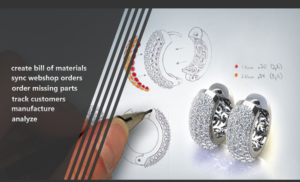

- Jewellery repair management software tracks every repair from check-in to completion, with barcode tagging and automated customer updates.
- It works best as part of a full workshop management system, alongside job tracking, material control, and billing.
- Look for real-time inventory visibility, CAD integration, and GST-compliant billing as core requirements, not add-ons.
- Security matters as much as features, given the value of what a workshop handles daily.
- Synergics Jewellery ERP combines repair management with the rest of workshop and business operations in one platform.
What Is Jewellery Repair Management Software?
Jewellery repair management software tracks a repair job from the moment a customer hands over a piece to the moment it’s returned. It assigns a unique barcode or RFID tag to the item, records its condition and repair history, and sends automated updates as the job moves through each stage.
On its own, this solves a real problem. Built into a full jewellery workshop management system, it works alongside job tracking, material control, and billing, so a repair job and a custom order run through the same connected process instead of two separate ones.
Why Workshops Need Dedicated Repair and Job Management
Jewellery workshops handle craftsmanship, repairs, and raw material tracking all at once, often for the same customer within the same visit. As the industry continues adopting digital tools to stay competitive, generic task-tracking software increasingly falls short of what a jewellery-specific workflow actually requires.
A dedicated system, like the workshop tools built into Synergics Jewellery ERP, keeps every piece accounted for from intake through delivery. That matters more here than in most trades, since the items involved carry real financial and sentimental value for the customer standing across the counter.
Key Features of Jewellery Repair Management Software
1. Order and Job Management
Every piece needs a structured path through your workshop. Look for:
- Job tracking that assigns tasks to specific artisans and shows real-time progress
- Custom order processing that captures detailed specifications for bespoke work
- Deadline management with automated reminders ahead of due dates
2. Repair Tracking and Customer Communication
This is the core of repair management specifically. A strong system should maintain a full repair history for every piece, so staff have complete context the moment a returning customer walks in. Barcode tagging assigns each item a unique identifier the moment it’s checked in, which removes the guesswork that comes with handwritten tags or loose paper tickets.
Automated customer notifications close the loop on the experience. Customers get updated on repair status without needing to call and ask, and that alone measurably improves how a repair interaction feels from the customer’s side.
3. Raw Material and Inventory Control
Repairs and custom work both consume material, and that needs tracking just as tightly as new production. Useful capabilities include:
- Real-time stock updates for precious metals, gemstones, and supplies
- Supplier management with vendor details and automated restocking alerts
- Usage reports that reveal consumption patterns over time
Automation That Improves Workshop Efficiency

1. CAD and Design Workflow
Computer-aided design plays a real role in modern jewellery work, including in repairs that involve reconstruction or redesign. A capable system should integrate directly with CAD tools, keep version history for design iterations, and support approval workflows between designer and client without emailing files back and forth.
2. Employee Performance and Task Allocation
Managing a team of artisans well means assigning work by actual skill and availability, not guesswork. The system should track work hours for fair compensation and generate performance analytics that make training and staffing decisions easier to justify with data.
3. Billing and Financial Management
Financial transactions around repairs and custom orders need to stay accurate and transparent. Automated invoicing, multi-currency support for international clients, and built-in expense tracking all reduce the manual reconciliation that eats up time at month-end.
Security and Compliance

1. Data Protection
A workshop handles valuable customer and design data alongside physical inventory. Encryption for stored and in-transit data, automatic cloud backups, and role-based access control together protect against both cyber threats and simple internal error.
2. Regulatory Compliance
Tax and compliance requirements apply directly to repair and job work billing. A capable system should calculate GST automatically, including the distinct rates for gold value and making charges, and keep ethical sourcing and regulatory records ready for review.
Choosing the Right Jewellery Repair Management Software
A few criteria matter more than a long feature checklist:
- Scalability. Can it grow with your business as order volume increases?
- User-friendliness. Is the interface intuitive for every employee, not just the tech-comfortable ones?
- Customization. Can it adapt to your specific workshop’s workflow?
- Integration. Does it sync with tools you already use, including barcode and RFID systems?
Feature Comparison
|
System Feature |
Synergics Jewellery ERP |
Standard ERP |
Basic Workshop Software |
|
Job Tracking and Workflow |
Advanced |
Basic |
Limited |
|
Material Inventory |
Real-time |
Real-time |
Manual |
|
Repair Management |
Integrated |
Add-on |
Partial |
|
CAD Integration |
Yes |
No |
No |
|
Barcode/RFID Support |
Yes |
Limited |
No |
|
Employee Performance |
Detailed analytics |
Basic |
No |
|
GST Compliance |
Automated |
Automated |
Manual |
|
Customization |
High |
Medium |
Low |
|
Mobile Access |
Yes |
Limited |
No |
|
Customer Portal |
Yes |
No |
No |
Why Synergics Jewellery ERP for Repair Management
Synergics Jewellery ERP connects repair management to the rest of your workshop and business operations, including karigar job tracking, material control, and billing, rather than treating repairs as an isolated add-on module. The platform serves 150+ jewellery businesses across 9 countries and holds SOC 2 Type II certification, built specifically for a trade where the details genuinely matter.
Conclusion
A well-built jewellery repair management system reduces errors, speeds up turnaround, and keeps customers informed without extra manual effort from your staff. Paired with strong inventory tracking, job management, and compliance features, it becomes the backbone of a workshop that runs smoothly instead of one that’s constantly catching up.
Ready to see repair tracking connected to your full workshop operation? Book a free demo with the Synergics team.
FAQs
1. What is jewellery repair management software?
Jewellery repair management software is a system that tracks repair jobs from intake to completion, using barcode or RFID tags, status updates, and repair history records. It’s typically part of a broader workshop management system covering job tracking, materials, and billing together.
2. Why does a jewellery workshop need specialized repair management software?
Workshops handle high-value items requiring precise tracking. Manual processes lead to lost items, missed deadlines, and frustrated customers. Specialized software provides real-time job tracking, accurate material usage records, automated deadlines, GST compliance, and clearer customer communication throughout the repair process.
3. How does barcode tagging work in repair management software?
Each item receives a unique barcode or RFID tag at check-in, linking it to a digital record of its condition, repair history, and current status. Staff scan the tag at each stage, and the system updates status automatically as work progresses.
4. What features should I look for in a jewellery repair management system?
Look for job tracking, deadline management, real-time material inventory, barcode-based repair tracking, automated customer notifications, CAD integration for redesign work, employee performance tracking, automated billing, and built-in GST compliance. Security features like encryption and role-based access matter just as much.
5. How does CAD integration help with jewellery repairs?
CAD integration lets designers upload and modify designs directly within the system, useful for repairs that involve reconstruction or redesign work. It keeps version history for design iterations, supports client approval workflows, and calculates material and cost implications directly from the design.
6. Does jewellery repair management software handle GST and tax compliance?
Yes. A capable system calculates GST automatically on gold value and making charges separately, since these carry different rates under Indian tax rules. It also generates compliant invoices, supports e-invoicing, and prepares audit-ready reports without manual reconciliation.
7. What security features matter most in workshop management software?
Data encryption protects sensitive customer and design information, while automatic cloud backups guard against data loss. Role-based access control restricts sensitive data to authorized staff, and activity auditing tracks who accessed or modified records, which matters for accountability.
8. How do I choose the right jewellery repair management system?
Start by identifying your workshop’s actual pain points and must-have features. Check that the system can scale with your business, confirm the interface is genuinely easy to use, request a demo with real scenarios, verify integration with your existing tools, and compare total cost of ownership rather than just upfront price.
9. Is cloud-based workshop management secure for high-value jewellery data?
Yes, when built by a reputable provider. Look for strong encryption for data in transit and at rest, regular independent security audits, automatic backups to redundant servers, and access controls like IP whitelisting. These protections matter more here given the value of the data involved.
10. What’s the difference between workshop management software and retail jewellery software?
Workshop software focuses on production, repairs, and job tracking for artisans and supervisors on the production floor. Retail jewellery software focuses on sales, billing, and customer management for store staff. Many jewellery businesses need both, connected through one shared system.
11. Can workshop management software handle both wholesale and retail repair orders?
Yes, in a well-built system. Wholesale orders get bulk processing and wholesale pricing, while retail orders handle individual customer repairs and custom designs through storefront integration. Both share the same centralized inventory and reporting, keeping pricing and stock data consistent across the business.
12. How does inventory tracking software support jewellery repair workshops?
It gives real-time visibility into gold, silver, diamond, and gemstone stock used in repairs, tracks karat and purity across categories, and calculates wastage during rework. Supplier performance tracking and automated reorder alerts keep repair materials available without manual monitoring.