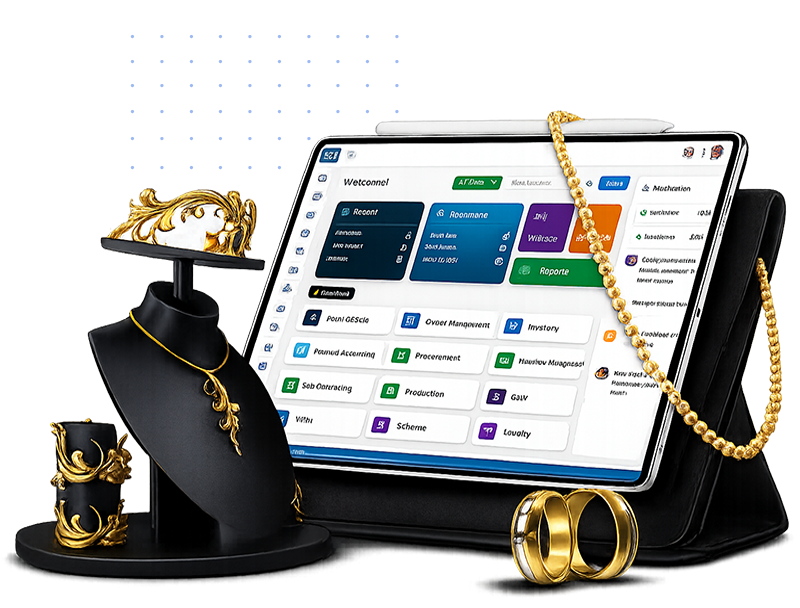
- Karigar metal balance tracking shows exactly how much gold or silver is currently out with each artisan, across every open job, at any moment.
- Most jewellery businesses can’t answer this question instantly. They can only reconstruct it after checking multiple paper registers.
- Real-time tracking matters most during high-volume periods, when dozens of jobs move between workshop and karigars at once.
- Synergics Jewellery ERP updates each karigar’s running balance the moment metal moves, in either direction.
What Is Karigar Metal Balance Tracking?
Karigar metal balance tracking answers one specific question.
How much gold or silver does a given artisan currently hold, across every job assigned to them right now?
This is different from tracking a single job. A busy karigar often has several pieces in progress at once. Metal balance tracking adds all of that up into one running number, updated the moment material moves in either direction.
Why “Total Metal Out” Is a Number Most Businesses Can’t Answer Instantly
Ask a manufacturing manager how much gold currently sits with karigars across the whole workshop, right now. In a manual system, this question usually can’t be answered on the spot. It takes checking multiple job cards or paper registers, one karigar at a time.
That delay is the real risk. Metal is the single biggest asset a jewellery manufacturer holds outside of finished stock. A business that can’t see its total exposure across every artisan, at any given moment, is running blind on its own most valuable inventory.
How Real-Time Balance Tracking Actually Works
1. Issue Tracking
Every time metal goes out to a karigar, the system logs the exact weight, purity, and job it’s tied to. This creates a digital record the moment the handoff happens, not a note added later from memory.
2. Running Balance Per Karigar
The system adds up everything currently issued to that karigar, across every open job, into one live number. A manager can check this balance for any artisan at any time, without waiting for a stock take or a phone call to the workshop floor.
3. Reconciliation at Return
When a piece comes back, the system compares the metal returned against what was issued. The balance updates automatically, and the difference gets logged as production loss for that specific job.
Why This Matters More During Busy Season
Wedding season and festive periods push far more jobs through a workshop at once. Dozens of pieces move between the shop and multiple karigars within the same week, sometimes the same day.
This is exactly when a manual system falls furthest behind. A paper register that’s manageable at low volume becomes unreliable fast once job counts spike. Real-time tracking doesn’t get slower under load. It just keeps updating as fast as metal actually moves.
What This Looks Like Without Real-Time Tracking
A manual workshop typically discovers metal discrepancies in one of two ways. Either a monthly stock reconciliation surfaces a gap nobody can explain, or a specific karigar’s balance gets questioned only after a dispute already starts.
Both situations put the business in a reactive position. The metal is already gone, in some sense, by the time anyone notices something is off. Real-time balance tracking moves that detection point much earlier, often before a discrepancy has a chance to grow.
How Synergics Tracks Karigar Metal Balances
Synergics Jewellery ERP updates each karigar’s running balance the instant metal moves, whether that’s a new issue, a partial return, or a full job completion. A manager can pull up any artisan’s current balance in seconds, without checking a single paper record.
This connects directly to the job card and wastage tracking already built into the platform, and feeds the same data used for wastage benchmarking across the workshop.
Conclusion
A running metal balance per karigar sounds like a small detail until a business actually needs the number and can’t get it quickly. Real-time tracking turns a question that used to take a phone call and a paper search into something a manager can check on a screen, any time, for any artisan.
Want to see live karigar metal balances for your own workshop? Book a free demo with the Synergics team.
FAQs
1. What is karigar metal balance tracking?
It’s a running total of how much gold or silver a specific artisan currently holds, across every job assigned to them. The system updates this balance the moment metal is issued or returned, giving a manager an instant, accurate number at any time.
2. Why can’t most jewellery businesses answer this question quickly?
In a manual system, each job’s metal record lives on its own paper register or job card. Adding these up for one karigar, across every open job, takes time and manual checking. There’s no single number available on demand.
3. How does real-time tracking help during high-volume periods?
Wedding and festive seasons push far more jobs through a workshop at once. A manual system that’s manageable at low volume becomes unreliable under that load. Real-time tracking keeps updating automatically, no matter how many jobs move at once.
4. What happens when a karigar returns a finished piece?
The system compares the metal returned against what was originally issued for that job. The karigar’s running balance updates automatically, and any difference gets logged as production loss tied to that specific piece.
5. Does metal balance tracking replace job card management?
No, it works alongside it. Job cards track the details of an individual piece. Metal balance tracking adds every open job for a given karigar together, giving a manager one live number instead of several separate job-level records.