
TLDR: A Jewellery ERP system built for retail does far more than track inventory. It manages stock by metal type, weight, and purity, handles customer repair orders, automates pricing based on live gold rates, and keeps your showroom and back office in sync. If your current software cannot do these things, you are leaving money on the table and creating problems your staff has to fix manually every day. This guide covers the features that matter most and why cutting corners on any of them costs more than the software itself.
Running a jewellery retail store is operationally more complex than running almost any other type of retail business. You are managing products priced in grams, not units. Your stock value changes daily with commodity markets. Customers return for repairs, resizing, and customization. And a single pricing error or inventory discrepancy can erase the margin on an entire transaction.
Generic retail software was not designed for any of this. That is precisely why jewellery-specific ERP systems exist, and why the features inside them matter so much. Retailers who have switched to purpose-built jewellery software Dubai consistently report faster counter operations, fewer stock discrepancies, and significantly better margin visibility compared to running their business on spreadsheets or general-purpose POS systems.
What Is a Jewellery ERP and Why Does It Differ From Regular Retail Software?
A Jewellery ERP is an enterprise resource planning system designed specifically for the operational and financial requirements of jewellery retail businesses. Unlike standard retail software, it handles weight-based inventory, metal purity tracking, making charge calculations, live gold rate integration, and customer order management for repairs and custom pieces.
Standard retail software tracks quantities. Jewellery ERP tracks weight, purity, design, stone details, making charges, and real-time metal value simultaneously. That distinction drives every feature difference covered in this guide.
Feature 1: Weight-Based Inventory Management
Every jewellery retailer needs inventory management that tracks stock in grams and carats, not just pieces and SKUs. This is the baseline requirement, and many generic systems fail here immediately.
A proper jewellery ERP tracks:
- Gross weight, net weight, and stone weight separately for every item
- Metal purity (18K, 22K, 24K, 925 silver, platinum, etc.)
- Individual piece history from purchase or manufacture through to sale
- Stock by product category, metal type, design code, and supplier
- Wastage and loss tracking during manufacturing or repair
Without weight-based tracking, your inventory valuation is inaccurate by definition because the value of jewellery items is calculated on metal weight and purity, not purchase cost alone. A system that only counts pieces cannot give you a real picture of what your showroom floor is worth at today’s metal prices.
Feature 2: Live Gold and Silver Rate Integration
Jewellery pricing is not static. Metal prices move daily, and your ERP system needs to reflect those changes in real time or on a scheduled update basis so that counter staff are always quoting accurate prices.
A good jewellery ERP integrates with live commodity rate feeds and automatically recalculates:
- Item selling prices based on current metal rates
- Stock valuation for reporting and accounting
- Cost of goods for new purchase orders
- Profitability calculations that account for daily rate fluctuations
Without this integration, your staff either memorize rates and manually calculate prices at the counter (which causes errors and slows service) or they work from outdated rate cards (which either cuts your margins or overcharges customers). Neither outcome is acceptable when a proper system solves the problem automatically.
Feature 3: Customer Order and Repair Management
Repair and custom order management is where many retail jewellery businesses lose track of jobs, miss deadlines, and frustrate loyal customers. An ERP system designed for jewellery retail handles the full lifecycle of a repair or custom order from intake to delivery.
Key capabilities in this module:
- Job card creation with before-and-after condition notes and photos
- Stone and metal weight recorded at intake to prevent disputes on return
- Technician assignment and workshop status tracking
- Estimated and actual delivery date management
- Automated customer notifications when jobs are ready
- Pricing breakdown showing labour, material additions, and any stone work separately
For high-volume showrooms handling dozens of repairs weekly, this module alone justifies the cost of switching from a manual or generic system. Lost repair tags, missing stones, and missed delivery promises are reputational risks that a proper system eliminates.
Feature 4: Multi-Branch and Centralized Stock Control
Retail jewellery businesses with more than one location face a specific challenge that generic software almost never handles well: stock visibility and transfers across branches.
A jewellery ERP built for multi-branch operations gives head office and store managers:
- Real-time visibility of stock at every location
- Inter-branch transfer requests and approvals
- Centralized pricing and product catalog management
- Branch-level sales reporting with consolidated head office dashboards
- Stock reconciliation tools that flag discrepancies before they become accounting problems
The retail jewellery software built by Synergics Solutions is specifically designed with multi-branch operations in mind, which is a critical differentiator for growing jewellery retailers who plan to expand beyond a single showroom.
For businesses in the Gulf region specifically, where jewellery retail groups often operate multiple showrooms across different Emirates or cities, centralized control with branch-level operations is not a luxury feature. It is a fundamental operational requirement.
Feature 5: Integrated Accounting and VAT Compliance
Jewellery retail has specific accounting requirements that standard bookkeeping modules do not handle cleanly. Metal purchases, making charges, stone costs, and selling prices all need to be tracked separately to give accurate gross margin reporting by product category.
A jewellery ERP with integrated accounting handles:
- Automatic journal entries for sales, purchases, and returns
- Separate cost tracking for metal, stone, and labour components
- VAT calculation and reporting configured for local tax requirements
- Supplier payment management and aging reports
- Customer layaway and installment payment tracking
- Gold loan and metal-on-account transactions common in Middle Eastern markets
For retailers operating in the UAE and the wider Gulf region, VAT compliance is a non-negotiable requirement, and a system that generates VAT reports automatically from sales transactions saves significant time at each tax period.
Feature 6: Customer Relationship and Purchase History Management
The best jewellery retailers build long-term relationships with customers who return for anniversaries, birthdays, and milestone purchases year after year. An ERP system with a proper customer module makes it possible to leverage those relationships systematically rather than relying entirely on individual staff knowledge.
Customer management features worth prioritizing:
- Full purchase history with item details, weights, and prices
- Repair and order history linked to the customer record
- Preference notes (favourite metals, styles, stone preferences)
- Birthday and anniversary reminders for proactive outreach
- Loyalty points or reward tracking
- Customer-specific pricing tiers for wholesale or VIP accounts
When a customer walks into your showroom and your staff can immediately see their purchase history, recall their preferences, and remind them of an upcoming anniversary, the conversion rate and average transaction value both increase significantly. This is not a nice-to-have feature. It is a direct revenue driver.
Feature 7: Barcode and RFID Tagging for Stock Accuracy
Physical stock counts in a jewellery showroom are time-consuming and error-prone without the right tagging and scanning infrastructure. A modern jewellery ERP supports both barcode and RFID-based item tracking, which transforms stock audits from a day-long manual process into a much faster automated one.
With RFID integration specifically:
- Individual items are tagged and scanned without a line-of-sight requirement
- Full showroom stock counts can be completed in a fraction of the time of manual counts
- Missing items or discrepancies are flagged immediately during scanning
- Tray-level or display-level stock organization is maintained automatically
Barcode-based systems offer a more cost-effective entry point with most of the operational benefits, and virtually all modern jewellery ERP systems support barcode label printing and scanning as a standard feature.
Feature 8: Role-Based Access and Security Controls
Jewellery retail involves high-value stock, sensitive customer data, and financial transactions. An ERP without proper role-based access controls creates unnecessary risk.
A properly secured jewellery ERP provides:
- Role-based permissions that limit what each staff member can view or modify
- Audit logs that record every transaction, edit, and deletion with user and timestamp
- Manager approval workflows for discounts above a defined threshold
- Cashier blind close procedures that prevent manipulation of end-of-day figures
- Separate access levels for counter staff, managers, and head office
These controls are especially important in showrooms where multiple staff members share access to the same system throughout the day.
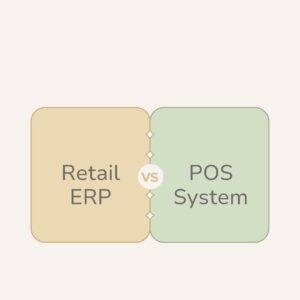
Comparison: Generic Retail POS vs Dedicated Jewellery ERP
| Capability | Generic Retail POS | Jewellery ERP |
|---|---|---|
| Inventory tracking | Quantity-based | Weight, purity, and quantity |
| Pricing engine | Fixed or percentage markup | Live metal rate plus making charge |
| Repair order management | Not available | Full lifecycle job card system |
| Multi-branch stock visibility | Basic or limited | Real-time centralized control |
| Customer purchase history | Basic transaction log | Full item-level history with preferences |
| VAT and accounting | General bookkeeping | Jewellery-specific cost component tracking |
| Stock audit tools | Manual count support | Barcode and RFID scanning |
| Access controls | Basic user logins | Role-based permissions with audit logs |
How to Evaluate a Jewellery ERP Before You Buy
Choosing the right system is a significant investment and the wrong choice is expensive to undo. Before committing to any platform, work through this evaluation process.
Step 1: List your current operational pain points in writing. Weight errors, pricing delays, repair tracking, stock discrepancies, whatever your team complains about most.
Step 2: Confirm the software handles weight-based inventory natively, not through workarounds in a generic platform.
Step 3: Ask specifically about live metal rate integration and how frequently rates update.
Step 4: Request a demo focused on your actual workflows, not the vendor’s scripted demo path.
Step 5: Speak with existing customers in your market segment, ideally retailers with similar store sizes and product mixes.
Step 6: Confirm implementation support, staff training, and post-go-live support are included or clearly priced.
The purpose-built jewellery software from Synergics Solutions covers all eight feature areas covered in this guide and is built specifically for jewellery retail operations across the Middle East and South Asian markets, with implementation support tailored to local business requirements.
Frequently Asked Questions
What makes a jewellery ERP different from a standard retail POS system?
A jewellery ERP tracks inventory by weight, metal purity, and stone details rather than just units and SKUs. It integrates live gold and silver rates into pricing calculations, handles repair and custom order job cards, and provides jewellery-specific accounting with separate cost component tracking. Standard retail POS systems are not designed for any of these requirements.
How does live gold rate integration work in a jewellery ERP?
The system connects to a commodity data feed or allows manual rate entry on a scheduled basis. When metal rates update, the system automatically recalculates selling prices, stock valuations, and cost of goods across all affected items. Counter staff always see current prices without needing to perform manual calculations or consult rate cards.
Can a jewellery ERP handle both retail and wholesale operations?
Yes, most purpose-built jewellery ERP systems support both retail and wholesale transaction types, with different pricing structures, payment terms, and reporting for each customer category. Customer-specific pricing tiers and bulk order management are standard features in systems designed for jewellery businesses that operate at both levels.
How long does implementation typically take for a jewellery retail ERP?
Implementation timelines vary based on the number of branches, the volume of existing stock data to migrate, and the complexity of custom workflows required. Single-store implementations typically take four to eight weeks from kickoff to go-live. Multi-branch rollouts with significant data migration can take three to six months. A phased approach starting with one location often reduces risk and accelerates overall adoption.
Is jewellery ERP software suitable for small single-store retailers?
Yes. While larger multi-branch retailers gain the most from centralized control features, single-store jewellery retailers benefit significantly from accurate weight-based inventory, live pricing, repair management, and customer history features. The operational improvements and reduction in manual errors typically justify the investment even for smaller operations.
What support should I expect after a jewellery ERP goes live?
Expect initial hypercare support for the first two to four weeks post-go-live, covering real-time assistance as staff encounter new workflows. Ongoing support should include a helpdesk channel, regular software updates, and access to training resources for new staff. Ask specifically about support response times and whether the vendor has local support presence in your region before signing any contract.
How does a jewellery ERP handle VAT compliance for UAE retailers?
A properly configured jewellery ERP generates VAT-compliant invoices, tracks input and output tax separately, and produces summary reports formatted for UAE Federal Tax Authority filing requirements. The system should handle the 5% standard VAT rate applicable to jewellery sales and support any applicable exempt or zero-rated transaction categories relevant to your product mix.