Key Takeaways
- Jewellery ERP architecture is how data moves between manufacturing, wholesale, and retail functions, from raw material to finished sale, within one connected system.
- The real value of an ERP isn’t any single module, it’s the handoffs between them: BOM feeding job cards, job cards feeding inventory, inventory feeding billing.
- Disconnected systems create specific, predictable failures: stock mismatches, pricing lag, and manual reconciliation that eats staff time.
- The same core architecture applies across manufacturing, wholesale, and retail, with each business type using a different slice of the same connected data.
Introduction
A finished piece of jewellery carries information from several different places before it ever reaches a customer: the metal and stone specifications from a bill of materials, the labour and wastage recorded during job work, the weight and purity confirmed at finishing, and the price calculated against the day’s gold rate at the counter.
If any of that information lives in a separate, disconnected system, something eventually goes wrong, a stock count that doesn’t match reality, a price quoted against yesterday’s rate, a repair job nobody can locate.
Jewellery ERP architecture is how these pieces connect, the specific handoffs between manufacturing, wholesale, and retail functions that determine whether a business runs on one accurate picture of its data, or several disconnected ones that occasionally happen to agree.
Table of Contents
- What Is Jewellery ERP Architecture?
- Why One Connected System Beats Separate Tools
- What Are the Technical Layers of Jewellery ERP Architecture?
- The Manufacturing-to-Retail Value Chain
- How Data Flows Between Departments
- What Breaks When Architecture Is Disconnected
- How Architecture Prevents Real Failures at Scale
- How This Applies to Your Business Type
- What Modules Fit Which Business Type?
- Why Synergics Jewellery ERP (Formerly SEA)
- Frequently Asked Questions
What Is Jewellery ERP Architecture?
Jewellery ERP architecture is the structure that connects a business’s core functions, product design, procurement, manufacturing, inventory, sales, and finance, so data created in one place flows automatically to everywhere else it’s needed, instead of being re-entered manually at each step.
A design’s bill of materials feeds directly into a karigar’s job card. A completed job card feeds directly into inventory. A sale at the counter feeds directly into financial reporting. Each handoff happens without someone retyping the same numbers into a different system.
Why One Connected System Beats Separate Tools
Separate tools force manual reconciliation at every handoff, a manager checking whether the production system’s numbers match the billing system’s numbers, by hand, after the fact. One connected system removes that step entirely, since there’s only one number to begin with.
This matters most at the points where jewellery businesses lose real money: a design change that doesn’t reach the workshop, a completed job that doesn’t reach inventory, a sale that doesn’t reach accounting until someone notices the gap. Each of these is a data handoff that failed, not a training problem or a staff error, a structural one.
What Are the Technical Layers of Jewellery ERP Architecture?
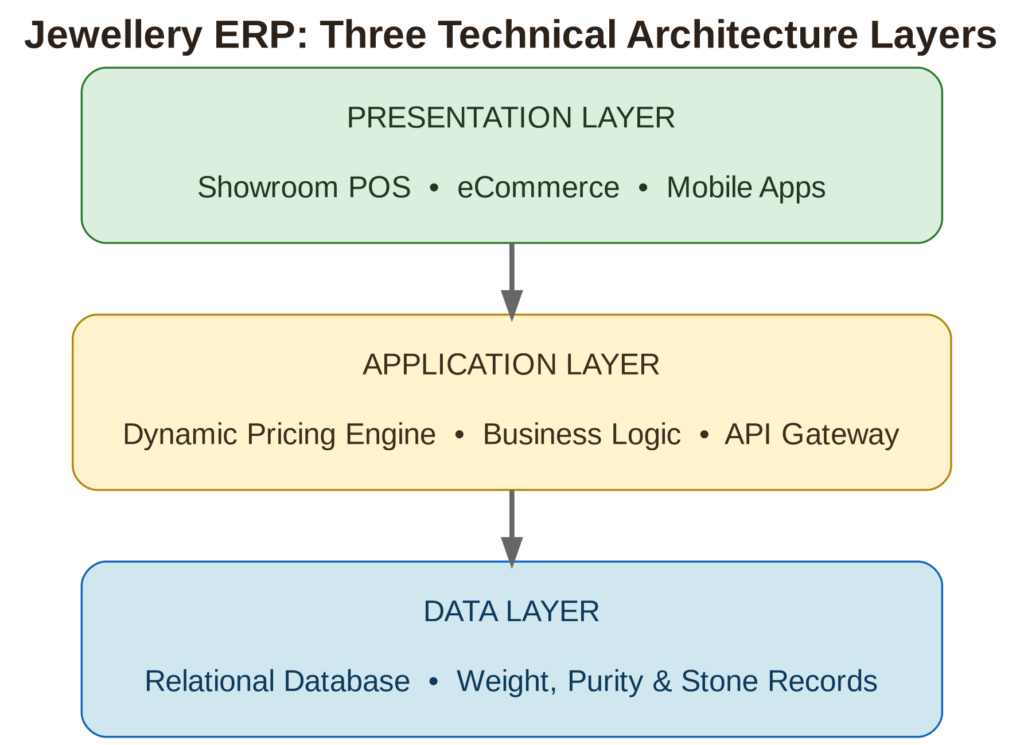
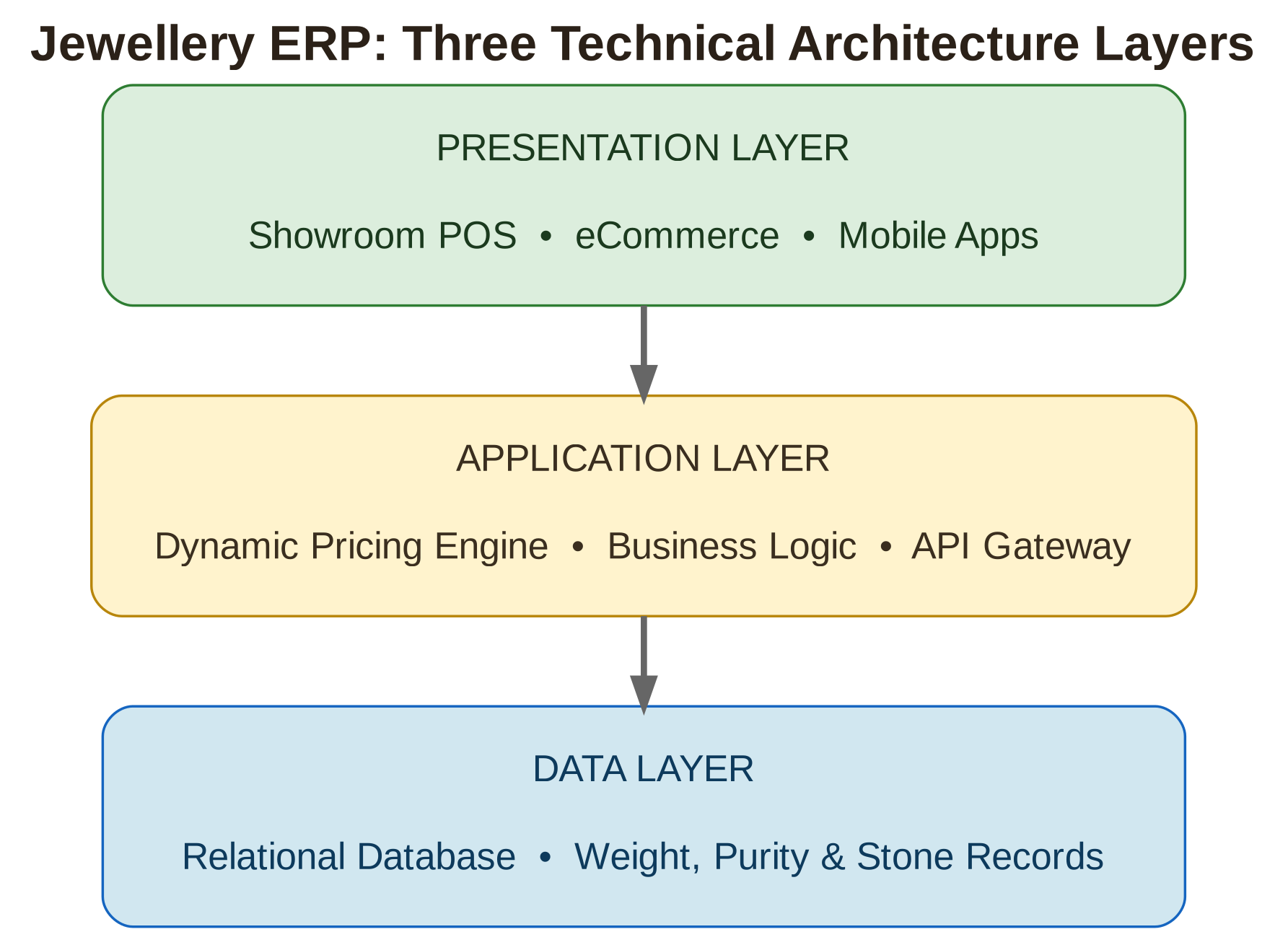
Jewellery ERP architecture typically runs on three technical layers: a presentation layer handling POS, eCommerce, and mobile access; an application layer running business logic like live rate pricing; and a data layer storing inventory in a database built for jewellery’s specific attributes, not simple product quantities.
- Presentation layer – Showroom POS, often built to keep working offline during a connectivity drop, eCommerce integration reflecting real-time stock availability, and mobile apps for store managers and field sales reps.
- Application layer – A dynamic pricing engine syncing continuously with live bullion rates, recalculating prices by weight, purity, and margin, alongside an API layer that routes retail billing traffic separately from heavier manufacturing analytics.
- Data layer – A relational database maintaining strict transaction accuracy for high-value goods, where a single item record links to gross weight, net weight, and fine weight, plus a separate stone record for carat, clarity, colour, cut, and certificate number.
The Manufacturing-to-Retail Value Chain
A piece of jewellery moves through a predictable sequence before it reaches a customer, and each stage generates data the next stage depends on.

1. Design and BOM – A design’s bill of materials defines exact metal weight, purity, and stone specifications.
2. Procurement – Raw material gets purchased against that BOM, tracked from vendor to inventory.
3. Manufacturing and Job Work – Karigars receive material against the job card, with wastage tracked against tolerance.
4. Finished Goods – Completed pieces enter inventory with confirmed weight, purity, and cost.
5. Wholesale Distribution – Pieces move to wholesale partners under memo, consignment, or outright sale terms.
6. Retail Sale – A piece sells at the counter, priced against the live gold rate, with the sale updating inventory and customer records simultaneously.
This chain represents data that needs to travel automatically. When it doesn’t, the business is left reconstructing what should have been recorded once, at the source.
How Data Flows Between Departments
The value chain shows the stages. What actually determines whether a business runs smoothly is what happens at each handoff between them, the exact moment data needs to move from one department to the next without anyone re-entering it.
- BOM to job card – A design’s material specifications transfer directly to the karigar’s job card, so the artisan works from the same numbers the design was costed against.
- Job card to inventory – A completed piece’s confirmed weight and wastage update inventory automatically. If a karigar returns less fine gold than the permitted tolerance, the system calculates the financial recovery or labour deduction owed, without a manager working it out by hand.
- Inventory to billing – A piece’s live-rate value applies automatically the moment it’s sold, so the counter price always matches current stock valuation.
- Billing to accounting – Every sale posts to financial records the instant it happens, not batched and reconciled at the end of the day or week.
- CRM to every customer touchpoint – A customer’s purchase history and preferences stay available whether they’re at the counter, on a repair visit, or redeeming a gold savings scheme.
Each of these handoffs is a place where disconnected systems typically break down, and where a connected architecture removes the break entirely.
What Breaks When Architecture Is Disconnected
Disconnected systems fail quietly, not dramatically. Stock shows available when it’s already sold elsewhere, quotes reflect yesterday’s gold rate, production wastage never reaches costing, and the same customer or transaction gets typed into two systems that slowly stop matching each other.
| Failure Point | What Happens | Real Cost |
| Stock mismatches | Inventory shows a piece as available when it’s already sold elsewhere or sitting in a repair queue | Lost sales, customer frustration, wasted staff time chasing down stock |
| Pricing lag | A quote reflects a gold rate that was current when someone last updated it manually | Margin loss on every transaction priced against a stale rate |
| Lost production data | A job card’s actual wastage never reaches costing | The next similar design gets quoted against inaccurate numbers |
| Duplicate data entry | The same customer, product, or transaction gets typed into two or three systems | Growing chance the numbers stop matching across systems |
| Delayed financial visibility | Sales and production data reach accounting days after the fact | Decisions get made on numbers that are already stale |
None of these failures show up as one dramatic event. They show up as a slow accumulation of small inaccuracies that eventually cost real time to untangle, or get discovered only during an audit.
How Architecture Prevents Real Failures at Scale
Two specific safeguards keep jewellery businesses from losing stock or sales during the moments that matter most: a branch transfer in progress, and an internet outage at the counter.
- Inter-branch transfer custody lock – When a piece moves between branches, the system locks it digitally the moment the transfer starts. It can’t be billed at the sending branch or the receiving branch until the receiving branch confirms it’s actually arrived.
- Hybrid and edge deployment – Core data lives on a central cloud server, but a local showroom or manufacturing plant can run a lightweight local database that keeps billing functional during an outage, syncing back automatically once the connection restores.
The custody lock stops a piece from getting billed twice, once at each branch, during a transfer. Hybrid deployment stops a lost internet connection from shutting down the billing counter entirely.
How This Applies to Your Business Type
The same core architecture applies across every jewellery business, but which stage matters most to you depends on what you actually do. A retailer, manufacturer, and wholesaler each lean on a different part of the same connected chain, and a business running more than one function draws on several parts at once.
1. If you’re a retailer
The finished goods and retail sale stage matters most
Live rate pricing, CRM, and omnichannel sync determine whether a customer gets an accurate quote and a consistent experience across every branch.
See our complete guide to jewellery ERP for retail for this stage in full depth.
2. If you’re a manufacturer
The design, procurement, and job work stage matters most.
BOM accuracy, karigar tracking, and wastage control determine whether a piece’s actual cost matches what it was quoted against.
3. If you’re a wholesaler
The finished goods and wholesale distribution stage matters most.
Multi-tier pricing, vault inventory, and memo or consignment terms determine whether stock moving between parties stays accurately tracked and settled.
4. If you run more than one function
Retail alongside manufacturing, for instance, you draw on multiple stages of the same chain at once. This is exactly where a single connected architecture matters most, since a disconnected setup would mean reconciling data across functions manually instead of letting it flow automatically between them.
What Modules Fit Which Business Type?
Beyond the value chain stages, specific modules map to specific business needs. This table shows which modules matter most depending on what your business actually does.
| Module | What It Handles | Best Fit |
| Procurement and old gold | Buyback evaluation, purity melting calculations, raw bullion sourcing | Wholesalers and retailers |
| Advanced inventory | Individual item tracking by barcode, QR, or RFID, including stone-level detail | All business types |
| Billing and POS | Metal weight × live rate, plus stone value, making charges, and tax, calculated together | Retail showrooms |
| Karigar management | Job work tracking, artisan labour logs, material loss, and settlement | Manufacturers |
| Financial and schemes | Gold savings schemes, advance bookings, general ledger compliance | Retail chains |
Why Synergics Jewellery ERP (Formerly SEA)
Synergics Jewellery ERP (Formerly SEA) is built as one connected system across the full value chain, not separate modules stitched together after the fact. That distinction matters most exactly where disconnected architecture tends to fail.
- One platform, every stage. Design, procurement, manufacturing, inventory, wholesale, retail, and finance run on the same underlying data, so a BOM change reaches the job card, and a completed job reaches inventory, without manual re-entry.
- Built for businesses running more than one function. A business that manufactures and retails, or wholesales and manufactures, works from one connected architecture rather than reconciling separate systems by hand.
- VISOR draws on the whole chain. Because VISOR sits above every module, it can answer a question that spans stages, like which design’s actual production cost is running highest, not just a single department’s data.
- A verified track record at scale. 19+ years building jewellery-specific architecture, serving 150+ businesses across 9 countries, with SOC 2 Type II certification backing the infrastructure this connected system runs on.
Whichever stage of the value chain matters most to your business right now, the architecture underneath it is the same one running the rest of your operations, not a separate system you’ll eventually need to reconcile with everything else.
Bringing It All Together
Jewellery ERP architecture isn’t a technical detail, it’s the difference between a business that runs on one accurate picture of its data and one that’s constantly reconciling several disconnected pictures by hand. Whether your business leans on the manufacturing end of the chain, the retail end, or both, the same connected architecture underneath determines how much manual work disappears.
Curious how this would apply to your specific business? Talk to the Synergics team about your setup.
Frequently Asked Questions
1. What is jewellery ERP architecture?
Jewellery ERP architecture is the structure that connects a business’s core functions, design, procurement, manufacturing, inventory, sales, and finance, so data created in one place flows automatically to everywhere else it’s needed.
2. Why does connected architecture matter more for jewellery than other retail?
A single piece carries weight, purity, and cost data that needs to stay accurate from design through to sale. Disconnected systems create specific failure points, like pricing lag or lost production data, that generic retail architecture doesn’t need to account for.
3. What’s the difference between jewellery ERP architecture for retail versus manufacturing?
Retail architecture centers on the finished goods to retail sale stage, live pricing, CRM, and billing. Manufacturing architecture centers on design through job work, BOM accuracy and wastage control. Both run on the same underlying system, just drawing on different stages of it.
4. What happens when jewellery ERP systems stay disconnected?
Stock mismatches, pricing lag, lost production data, duplicate data entry, and delayed financial visibility all become recurring problems, each one a data handoff that failed to happen automatically.
5. Can one system handle both manufacturing and retail architecture together?
Yes, and it should. A business running both functions needs the same connected data flowing between them, a BOM feeding a job card, a completed piece feeding retail inventory, rather than reconciling two separate systems manually.
6. How does Synergics Jewellery ERP (Formerly SEA) handle this architecture?
Synergics runs design, procurement, manufacturing, inventory, wholesale, retail, and finance on one connected platform, with VISOR able to answer questions that span multiple stages of the value chain at once.
7. What are the technical layers of jewellery ERP architecture?
Three layers: a presentation layer for POS, eCommerce, and mobile access; an application layer running pricing logic and business rules; and a data layer storing inventory with jewellery-specific attributes like weight, purity, and stone detail.
8. How does jewellery ERP prevent a piece from being billed at two branches at once?
An inter-branch transfer custody lock activates the moment a piece moves between locations, so it can’t be billed at either branch until the receiving branch confirms it has arrived.
9. What happens to billing if the internet goes down at a showroom?
With hybrid or edge deployment, a local database keeps billing functional during an outage, then syncs back to the central system automatically once the connection restores.