- Jewellery retail software needs to handle live metal pricing, individual piece tracking, custom orders, and repairs natively, not as manual workarounds.
- CRM, manufacturing integration, and comprehensive reporting turn transaction data into real business decisions.
- AI-powered analytics is now a genuine differentiator: instant answers to business questions, not just static reports.
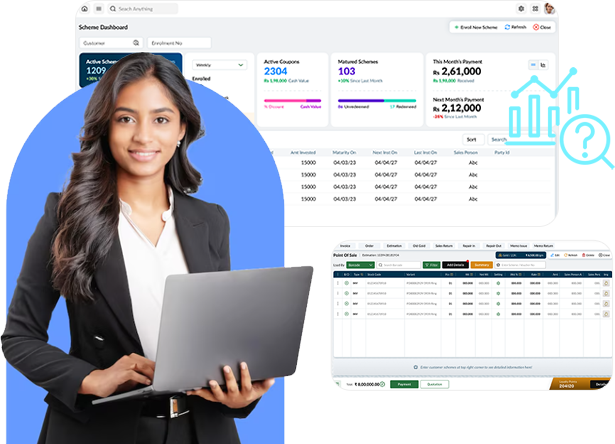
- Synergics Jewellery ERP delivers all eight features as standard, built specifically for the operational complexity jewellery retail actually involves.
Jewellery retail is one of the most operationally complex categories in retail. A single transaction can involve live metal pricing, stone specification matching, custom order management, layby or EMI terms, warranty documentation, and loyalty points, all at once. The software handling that transaction needs to understand every one of those elements natively. It shouldn’t require the salesperson to manage the complexity manually while the system records only the final outcome.
Most jewellery retailers discover this gap the hard way. They implement a general retail system because it handles point of sale, inventory, and basic accounting. Then they discover the inventory tracking doesn’t work at the individual piece level jewellery requires. Pricing doesn’t update with metal rates. The custom order workflow doesn’t exist. And reporting can’t tell them which categories are actually profitable versus which are simply turning over. Knowing what to look for before choosing software closes that gap before it costs you.
Why Feature Selection Matters More Than Price When Choosing Jewellery Retail Software
The total cost of jewellery retail software includes more than the license fee. It includes the cost of every operational gap the software fails to fill. Failing to handle live metal pricing loses money on every transaction during a commodity price movement. Missing unique item tracking creates inventory discrepancies that require costly reconciliation. And without integrated customer management, a business quietly loses the repeat purchase and referral revenue long-term client relationships generate.
These are the hidden costs purpose-built software eliminates. Live metal rate integration, unique item tracking with QR and barcode support, and customer management that captures every interaction all play a part.
The Top 8 Features Jewellery Retail Software Must Have
Jewellery retail software needs to handle live metal pricing, individual piece tracking, custom orders, repairs, customer relationships, manufacturing, AI-powered insights, and detailed reporting, all natively. The eight features below produce the most measurable business outcomes, and should be non-negotiable in any jewellery software evaluation.
Feature 1: Real-Time Metal Rate Integration and Dynamic Pricing
The most financially critical feature in any jewellery retail software is live metal rate integration, applying updated commodity prices to retail pricing automatically. Gold, silver, and platinum prices move daily, sometimes significantly within a single trading session. A business updating pricing manually is perpetually selling at yesterday’s costs.
Real-time metal rate integration means:
- Spot price feeds from recognized commodity exchanges update the system automatically
- Retail prices for metal-weight-based items adjust within defined margin parameters, without manual intervention
- Point-of-sale quotes always use the current metal cost as their basis
- Historical pricing records stay intact, so every past transaction’s margin can be audited accurately
The financial impact shows up fastest during rapid price movement. A business selling 50 gold pieces at a price calculated before an overnight rate increase gives away real margin on every single one. Our guide to live pricing integration covers exactly how this works in practice.
Feature 2: Individual Item Tracking With Unique Identification
Standard retail software tracks inventory by product category and quantity. Jewellery can’t be managed that way, since no two pieces are truly identical, even sharing the same product description. Two rings classified as the same style may carry different metal weights, different stone grades, and different cost prices.
A proper jewellery POS assigns every individual piece a unique identifier at stock entry. That identifier follows the piece through display, customer examination, repair, consignment, and sale. At any moment, the system reports exactly where each piece is and how long it’s been in stock. It also shows what the piece cost, and its current market value at today’s metal rates.
Benefits of unique item tracking in practice:
- Stocktake accuracy improves dramatically, since every piece has a tracked identity
- Slow-moving items become visible through item-age reports, instead of hiding inside category averages
- Consignment management becomes fully auditable at the piece level
- Loss prevention strengthens, since tracking gaps surface immediately, not at quarterly reconciliation
Our guide to barcode and RFID inventory covers how this identification actually gets captured and scanned.
Feature 3: Custom Order and Job Management Workflow
Custom jewellery orders represent some of the highest-margin, most operationally complex work any retail jewellery business handles. A bespoke engagement ring involves design consultation, stone selection, metal specification, pricing approval, manufacturing instructions, production tracking, quality inspection, and final delivery with certification.
Managing this in a purpose-built system, rather than email chains and paper job cards, produces measurable improvements in delivery accuracy and customer satisfaction. Our guide to jewellery order management software covers this workflow in depth.
A proper custom order module handles:
- Digital capture of design specifications at consultation, with no transcription errors reaching manufacturing
- Customer approval recorded for every significant specification and pricing decision
- Workshop job cards generated directly from the order, with no manual reformatting
- Real-time production status visible to the retail team, without a call to the workshop
- Automated customer notification the moment a piece is ready for collection
Feature 4: Integrated Repair and Alteration Tracking
Repair work is a consistent revenue stream for most jewellery retailers. It’s frequently the weakest part of systems not built specifically for jewellery. A repair booked at the counter should generate a digital job that tracks the piece through the workshop. It should notify the customer automatically the moment it’s ready. Our guide to jewellery repair management software covers exactly what this should include.
What integrated repair tracking prevents:
- Lost pieces that were never correctly tagged into the workshop system
- Customer service failures when counter staff can’t confirm status without a physical search
- Missed collection notifications leaving repaired items uncollected for weeks
- Revenue leakage from repairs invoiced without reference to the original quoted price
For retailers running both retail and manufacturing, connecting repair to the same system that manages custom orders and sales matters. It gives complete visibility across every production commitment at once.
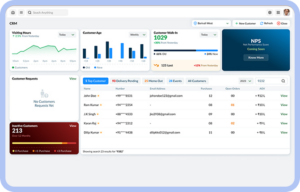
Feature 5: Customer Relationship Management Designed for Jewellery Retail
Jewellery retail is a repeat purchase and referral business, where long-term relationships drive a disproportionate share of revenue. A customer who buys an engagement ring, returns for wedding bands, and comes back for anniversary gifts represents real, ongoing value. Eventually they buy for a child’s milestone too, ten transactions across twenty years, not one transaction in the system. Our guide to jewellery CRM software covers this in full.
A jewellery-specific CRM captures:
- Complete purchase history with occasion context, not just transaction records
- Metal and stone preferences accumulated across multiple visits
- Anniversaries, birthdays, and other dates that enable proactive outreach
- Family relationship data connecting household members to shared purchase history
- Loyalty balance and redemption history
The difference between jewellery CRM and a generic loyalty program is context. Generic programs record points. Jewellery CRM records the story of a family’s relationship with your business.
Feature 6: Manufacturing Integration for In-House Production Operations
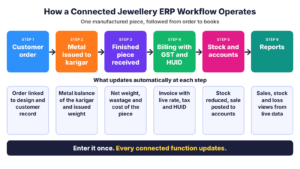
Jewellery businesses with in-house manufacturing need retail order management and production management to run as one system, not separate tools exchanging data manually. When a custom order placed at the counter automatically generates a workshop job with all specifications intact, that matters. The error rate at that critical handoff drops close to zero.
Synergics’ retail software connects natively to the manufacturing module and karigar job tracking. Data created during a retail consultation flows directly into production, with no re-entry or verbal handoff.
Manufacturing integration delivers:
- Accurate job costing, capturing actual material consumption and labor time per order
- Real-time production capacity visibility, supporting accurate delivery promises at the counter
- Raw material depletion tracked automatically as jobs consume stock
- Quality checkpoint recording, creating a verifiable history per piece
Feature 7: AI-Powered Business Analytics
Most jewellery retail software stops at static reports someone has to interpret. AI-powered analytics changes that by answering a direct question instantly, instead of waiting for a report to get built. Synergics includes VISOR, a conversational AI assistant that draws on over 220 jewellery-specific business questions to respond in plain English.
Ask which designs sold best last month, or which branch is underperforming on margin. Get the answer immediately, instead of waiting for someone to build the report. VISOR also connects to any jewellery ERP, not exclusively Synergics, through a secure, read-only channel. It delivers a daily WhatsApp briefing summarizing sales, collections, and stock alerts each morning.
Feature 8: Comprehensive Reporting That Answers Business Questions Automatically
Reporting determines whether management decisions get made on evidence or intuition. A system that produces transaction records without real business intelligence leaves interpretation to whoever has the least time to do it well.
The reports that matter most for jewellery retail:
- Category profitability by actual realized margin, not just turnover or gross sales
- Individual item age analysis, catching slow-moving stock before it becomes a write-off
- Salesperson performance by both volume and margin contribution
- Customer lifetime value by segment, quantifying retention versus acquisition
- Metal and stone cost variance between budgeted and actual rates
- Custom order pipeline by delivery commitment and payment stage
For businesses running manufacturing too, integrated reporting across retail and production matters. It gives a complete performance picture that separate systems can’t deliver. Our guide to jewellery analytics software covers this in depth.
Jewellery Retail Software Feature Evaluation Checklist
Generic retail software and purpose-built jewellery software diverge sharply once you look past basic point-of-sale functions. The table below compares both directly, feature by feature, so you can see exactly where a generic system falls short and where jewellery-specific software actually delivers.
| Feature | Generic Retail Software | Purpose-Built Jewellery Software |
| Live metal rate integration | Rarely available | Core functionality |
| Individual item tracking | SKU quantity only | Piece-level unique identification |
| Custom order management | Not available | Dedicated workflow module |
| Repair job tracking | Not available | Integrated with retail counter |
| Jewellery-specific CRM | Generic loyalty only | Occasion and preference history |
| Manufacturing integration | Requires third-party tools | Native retail-to-production connection |
| AI-powered analytics | Not available | Conversational, instant business answers |
| Business intelligence reporting | Basic sales reports | Category, margin, and item-level analysis |
Choosing Software That Closes the Gaps, Not Creates Them
The right jewellery retail software isn’t the one with the longest feature list. It’s the one that handles the operational complexity your business actually runs on. Live metal pricing, individual piece tracking, custom orders, repairs, and real customer relationships all need to work natively, not as an afterthought. Synergics Jewellery ERP delivers all eight features above as standard, built specifically for the gaps generic software leaves unfilled.
Curious how these eight features would work for your specific showroom? Talk to the Synergics team about your current setup.
FAQs
1. What is the single most important feature to evaluate when choosing jewellery retail software?
Live metal rate integration is the most financially critical feature, since it affects margin on every transaction. A system without real-time pricing either requires constant manual updates that create error risk, or sells at incorrect margins during commodity price movements.
2. How does Synergics jewellery software handle Indian market-specific requirements like hallmarking and GST?
Synergics Jewellery ERP is built with Indian jewellery market requirements as a core design consideration. This includes GST-compliant invoicing, HUID and hallmarking records, and making charge structures matching Indian retail conventions.
3. Is purpose-built jewellery software significantly more expensive than adapting a general retail system?
Total cost typically favors purpose-built software once you account for the full picture. Adapting a general system requires customization that often costs more than the license difference. It still doesn’t handle jewellery-specific needs natively, and breaks with every system update.
4. How long does it take staff to learn jewellery retail software effectively?
This depends on your team’s size and how many modules you’re rolling out at once. The interface is designed around jewellery retail workflows, matching terminology staff already know. Synergics provides structured onboarding training as part of implementation, with a clear timeline confirmed before you commit.
5. Can the software handle multiple showrooms with different inventory pools and pricing?
Yes. Synergics supports multi-location operations with location-specific inventory visibility and consolidated group-level reporting. Pricing rules can be configured at either the group or location level, depending on whether pricing is standardized or varies by market.
6. Does jewellery retail software include AI-powered analytics?
Most generic and even jewellery-adjacent platforms don’t yet. Synergics includes VISOR, a conversational AI assistant that answers direct business questions instantly, alongside standard reporting, a genuine step beyond static dashboards.