Key Takeaways
- Jewellery ERP for retail is software built for weight-based inventory, daily gold rate updates, and purity-wise stock, replacing generic POS and spreadsheets.
- Retailers are adopting it now because rate inconsistency, billing speed, and disconnected loyalty data cost real money at scale.
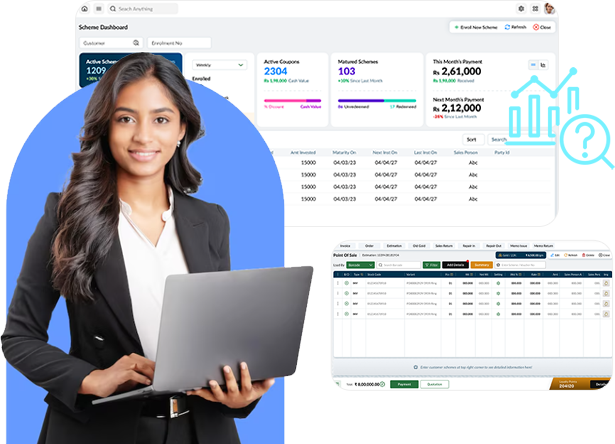
- Core modules include POS and billing, inventory, CRM, gold savings schemes, repair management, and omnichannel sync.
- AI-powered analytics is now a real differentiator, with tools like VISOR answering business questions instantly instead of waiting on a report.
- Check for purity and weight fields, live rate integration, independent certifications, and genuine scalability before choosing a platform.
- Synergics Jewellery ERP (Formerly SEA) delivers all of this, verified by 19+ years of experience, 150+ businesses across 9 countries, and coverage in Forbes India, Times of India, and CNBC-TV18.
Introduction
A jewellery retail counter runs on data that generic retail software was never built to hold: gross weight, net weight, karat purity, a gold rate that can move more than once in a trading day, and HUID hallmarking records tied to every single piece. None of this maps cleanly onto a standard POS system built around SKU and quantity.
Jewellery ERP for retail is business management software built around these exact requirements, gram-level precision, live metal rate application, purity tracking, and GST-compliant billing, unified with customer management and reporting in one platform. It replaces the combination most jewellery retailers still run on: a billing tool for transactions, a separate register for gold savings schemes, and a spreadsheet trying to reconcile stock across branches that were never built to talk to each other.
Table of Contents
- What Is Jewellery ERP for Retail?
- Why Are Retailers Adopting Jewellery ERP Now?
- How Is AI Changing Jewellery ERP for Retail?
- What Are the Core Modules of Jewellery ERP for Retail?
- How Does Jewellery ERP for Retail Actually Work?
- What Should You Look For in Jewellery ERP for Retail?
- Should You Choose Cloud or On-Premise Jewellery ERP for Retail?
- How Does Jewellery ERP for Retail Connect to Your Business Ecosystem?
- What Should Multi-Branch Retailers Consider?
- What Mistakes Should You Avoid During Implementation?
- Why Choose Synergics Jewellery ERP for Retail?
- How Does Synergics Compare to Generic Retail Software?
- Frequently Asked Questions About Jewellery ERP for Retail
What Is Jewellery ERP for Retailers?
Jewellery ERP for retail is software built to run a jewellery showroom: accurate billing, real-time stock across branches, and instant access to a customer’s purchase history and loyalty balance the moment they walk in. It’s the retail-specific application of jewellery ERP software, built around the counter, not the workshop.
A retail jewellery ERP system tracks every price against today’s gold rate, every piece by weight and purity, and generates GST and HUID records automatically with each sale.
See our retail software page for the full feature set.
Why Are Retailers Moving to ERP Now?
Retailers are adopting jewellery ERP now because staying on spreadsheets and generic POS software carries a real, measurable cost: rate inconsistency across branches undersells margin, slow billing during peak footfall loses walk-in sales, and disconnected customer data means repeat customers get treated like strangers.
1. Daily gold rate volatility makes manual pricing a real liability
Gold and silver prices can move more than once in a trading day, and a retailer updating rates by hand risks selling at yesterday’s price on every transaction until it’s caught.
2. Multi-branch consistency has become a real competitive requirement
A customer quoted different prices at two branches loses trust fast, and jewellery ERP for multi-store retail keeps every location working from the same live rate and stock data automatically.
3. Compliance requirements have gotten more demanding
GST-compliant billing and HUID hallmarking documentation are baseline expectations now, and generating them manually at scale introduces real audit risk.
4. Billing speed directly affects conversion during peak hours
When gold rate, making charges, and GST calculate automatically at the counter, a transaction that used to take several manual steps becomes a single lookup, reducing queue time when it matters most.
5. Stock audits stop being a multi-day exercise
Jewellery inventory software with barcode or RFID tracking turns a stocktake into a scan, surfacing discrepancies immediately instead of weeks later.
6. Digital-first competitors have raised the baseline
Retailers competing against omnichannel jewellery brands can’t afford online and offline inventory running as two disconnected systems reconciled by hand.
How Is AI Changing Jewellery ERP for Retail?
AI in retail has shifted from a marketing buzzword to a genuine expectation. A few years ago, “AI-powered” meant a recommendation engine or a chatbot. Today, retailers expect AI-powered jewellery ERP to answer real operational questions instantly, not just automate a customer-facing widget.
Most jewellery ERP platforms still describe “AI-powered analytics” as static dashboards with predictive charts, useful, but still something a manager has to interpret manually.
What “AI-powered” typically still means:
- Static dashboards with pre-built charts
- Predictive demand forecasting from historical trends
- Scheduled, automated report generation
- Chatbot-style customer support widgets, not internal business tools
Synergics answers this differently with VISOR, a conversational AI assistant built specifically for jewellery businesses, part of what makes Synergics Jewellery ERP (Formerly SEA) a genuinely modern jewellery ERP for retail rather than a legacy system with an AI feature bolted on.
What a retailer can actually ask VISOR:
- Which branch is underperforming this month, and why
- Which designs sold best last week across all locations
- What today’s stock variance looks like after the last audit
- How this month’s sales compare to the same period last year
- Which customers are due for a gold savings scheme maturity reminder
VISOR answers these instantly, in plain English, and sends a daily WhatsApp business briefing summarizing sales, collections, and stock alerts each morning. It also connects to any jewellery ERP, not just Synergics, through a secure, read-only channel.
For a retailer evaluating jewellery ERP with AI capabilities, the real distinction is simple: does “AI-powered” mean a dashboard with charts, or an assistant that actually answers the question you ask it.
What Are the Core Modules of Jewellery ERP for Retail?
Jewellery ERP for retail is built around six core modules: POS and billing, inventory with purity and weight tracking, CRM, gold savings schemes, repair management, and omnichannel sync.
See our retail software page for full retail-specific depth.
1. POS and Billing
Billing needs to happen in seconds, not minutes, even during peak footfall. A jewellery-specific POS splits every calculation automatically at the counter, rather than requiring a staff member to work through each one manually.
- Gross weight, net weight, and stone weight or carat calculated separately
- Making charges applied as fixed or per-gram, plus wastage percentage
- Live gold and silver rate applied to every quote
- GST and old gold exchange value calculated and adjusted against the invoice
- Real-time inventory update the moment a sale completes
See our complete guide to jewellery POS software for the full breakdown.
2. Inventory: Purity, Weight, and Daily Rate Precision
Generic retail software tracks a SKU and a quantity. Jewellery inventory needs to track far more than that for every single piece, since two visually identical items can carry entirely different value.
- Gross weight, net weight, and karat purity as core fields per piece
- Stock value recalculated automatically as the live gold and silver rate moves
- Piece-wise, weight-wise, and value-wise tracking across every location
- Raw material, work-in-progress, and finished goods tracked separately
Our complete guide to jewellery inventory and tracking software covers this in full depth.
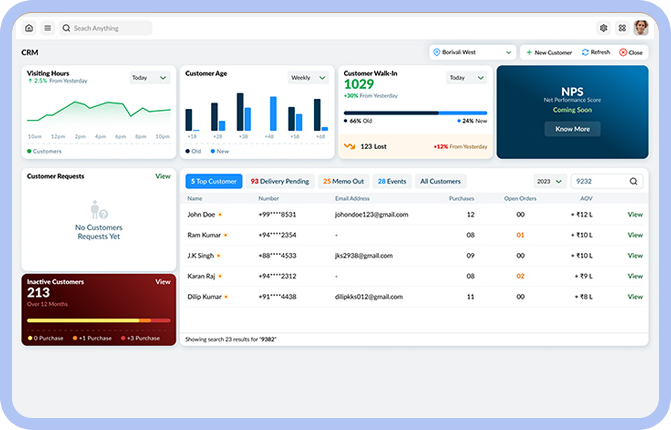
3. CRM and Customer Management
A jewellery CRM needs to hold more than a name and a phone number, since repeat purchases and referrals drive a disproportionate share of jewellery retail revenue.
- Complete purchase history with occasion context, not just transaction records
- Metal, karat, and stone preferences accumulated across visits
- Anniversaries, birthdays, and other dates for proactive outreach
- Loyalty point balance and redemption history, visible at any branch
See our complete guide to jewellery CRM software.
4. Gold Savings Schemes
Gold savings schemes are one of the strongest retention tools in Indian jewellery retail, and one of the easiest to manage badly on paper.
- Instalment schedules and SMS payment reminders run automatically
- Maturity alerts sent in advance, redemption applied at the counter
- Real-time visibility into total outstanding scheme liability across every plan
- Personalized promotions triggered by scheme participation and tenure
Our gold savings scheme software page covers configuration and reporting in full.
5. Repair Management
Repair work is a consistent revenue stream that’s frequently mismanaged without dedicated tracking.
- Digital job tracks the piece from drop-off through the workshop to delivery
- Labour charges and replaced stone or metal cost calculated automatically
- Status updates visible to counter staff without a workshop phone call
- Automatic customer notification the moment the piece is ready
See our complete guide to jewellery repair management software.
6. Omnichannel and eCommerce Sync
A retailer selling online and in-store needs both channels reflecting the same reality, not two systems reconciled manually at the end of the day.
- Inventory and pricing sync in real time, not on a batch schedule
- Direct integration with marketplaces like Amazon and Flipkart
- No overselling risk between online listings and physical stock
- One consolidated view of sales across every channel
Our Web Connect software covers this integration in full depth.
How Does Jewellery ERP for Retail Actually Work?
The real value of jewellery ERP for retail isn’t any single module, it’s how they connect. A sale doesn’t just update a POS screen, it updates inventory, customer history, and financial records simultaneously, across every branch and channel.
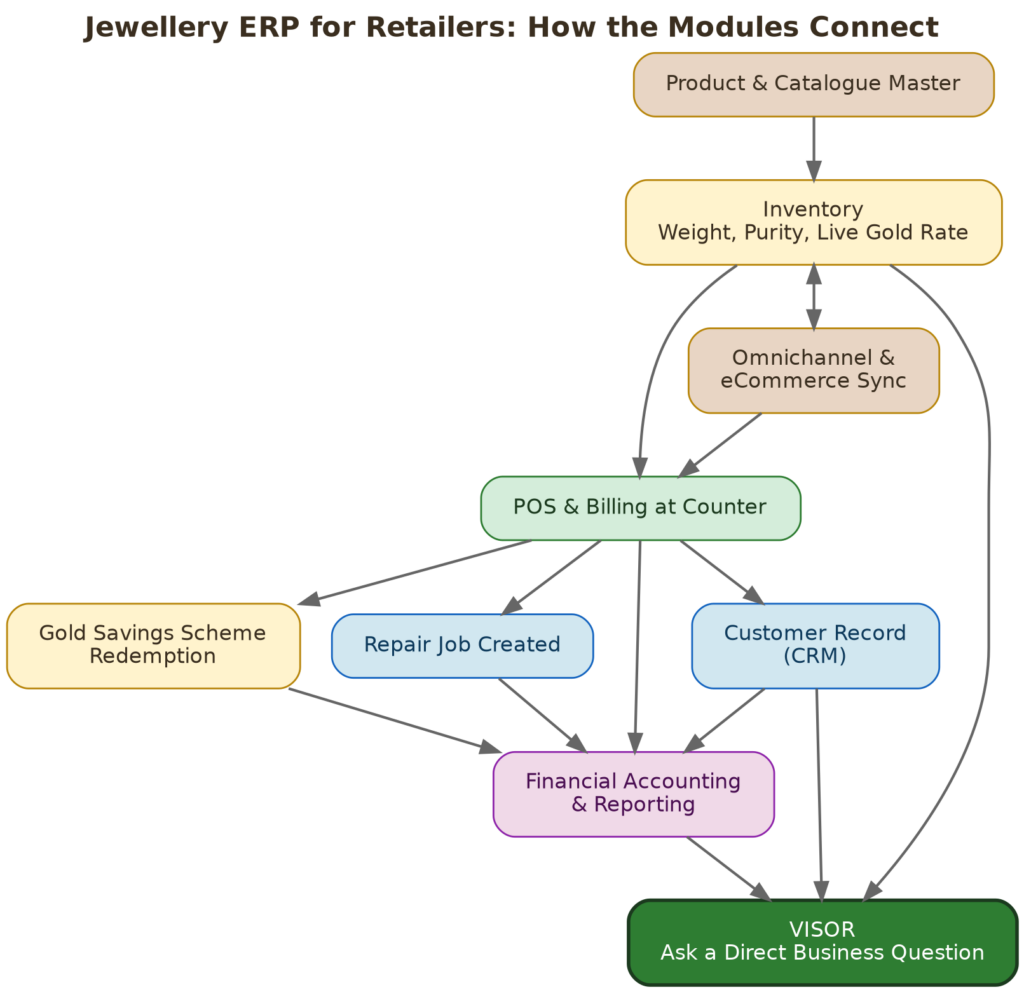
A piece enters through the product and catalogue master, carrying its weight, purity, and design details. Inventory applies the live gold rate continuously, whether the piece sits in a tray or lists online.
When a sale happens at the POS counter, the CRM record, any gold savings scheme redemption, and a repair job if relevant all update simultaneously, flowing into financial accounting automatically.
VISOR sits above all of it, drawing on this same connected data to answer a direct business question instantly.
What Should You Look For in Jewellery ERP for Retail?
Whichever platform you’re evaluating, not just Synergics, these are the capabilities worth checking before you commit, and the specific questions worth asking any vendor about each one.
| Capability | Why It Matters | What to Ask a Vendor |
| Purity and weight as core fields | Generic SKU-and-quantity tracking can’t represent jewellery accurately | Are gross weight, net weight, and purity built-in fields, or a workaround? |
| Live gold and silver rate integration | Manual rate updates risk selling at yesterday’s price | Does pricing update automatically, or does staff enter rates by hand? |
| Independent security certification | Your ERP holds sensitive financial and customer data | Is the platform SOC 2 Type II certified, not just Type I, or self-declared secure? |
| Genuine multi-branch scalability | A system that works for one store may not scale cleanly to ten | Can you see a real example of the platform running at your target scale? |
| AI that answers questions, not just reports | Dashboards still require manual interpretation | Can you ask a direct business question and get an instant answer, or only a chart? |
| Real integration depth | Disconnected online and offline inventory creates overselling risk | Does eCommerce sync happen in real time, or on a scheduled batch? |
| Transparent onboarding and support | Implementation timelines and support quality vary enormously between vendors | What does onboarding actually involve, and what happens if something breaks? |
Should You Choose Cloud or On-Premise Jewellery ERP for Retail?
For most growing retailers, cloud-based jewellery ERP is the better fit, since it gives real-time visibility across every branch without local servers at each location. On-premise still suits a single, standalone store with strict internal data policies, but it doesn’t scale cleanly once a second branch enters the picture. (52 words)
A retailer’s core value proposition depends on consistency, the same price, the same stock visibility, no matter which branch a customer walks into. Cloud infrastructure makes that automatic; on-premise requires actively syncing data between locations, reintroducing the manual reconciliation jewellery ERP exists to eliminate.
- Real-time stock and pricing visibility across every branch, not a nightly sync
- Faster rollout when opening a new location, no local server setup required
- Access from anywhere, useful for management checking performance outside store hours
- Automatic backups and security patching handled at the infrastructure level
For the full, honest breakdown of both models, see our complete cloud vs. on-premise comparison.
How Does Jewellery ERP for Retail Connect to Your Business Ecosystem?
A retail jewellery ERP needs to connect cleanly to the hardware on your counter and the channels you sell through, RFID and barcode systems for physical stock accuracy, and eCommerce platforms for online sales, both syncing in real time.
- Every piece carries a unique, scannable identity, turning a full showroom stocktake into minutes of scanning instead of hours of manual counting
- Online and in-store inventory and pricing stay in sync in real time, so a sale on either side updates stock everywhere immediately
- Direct integration with marketplaces like Amazon and Flipkart keeps listings accurate without duplicate data entry
For marketplace and eCommerce integration specifics, see our Web Connect Page.
What Should Multi-Branch Retailers Consider?
Running multiple showrooms introduces questions a single-store retailer never has to answer: how stock moves between branches, whether pricing stays centralized or varies by location, and how franchise structures affect what data each location can see. (38 words)
- Inter-branch stock transfers need a clear digital record, not a phone call and a hope both branches update correctly
- Pricing can stay centralized for brand consistency or vary by location for regional positioning, and the system needs to support both
- Franchise store managers typically need their own branch’s data visible, without necessarily seeing company-wide margins
- Leadership needs a consolidated, aggregated view, while a store manager needs a focused view of just their own location
For the full, dedicated breakdown of multi-branch and franchise-specific considerations, see our complete guide to multi-branch jewellery ERP.
What Mistakes Should You Avoid During Implementation?
Even the right jewellery ERP can underperform if implementation goes wrong. These are the mistakes retailers run into most often, and each is avoidable with the right approach going in.
- Over-customizing in the first phase, recreating old manual workflows instead of adopting standard, jewellery-specific processes
- Skipping proper staff training, which pushes staff back toward manual workarounds that undermine the system’s accuracy
- Not assigning a champion user per branch, so every question routes back to a central contact instead of local support
- Delaying data cleanup before migration, carrying duplicate or outdated records into the new system in a new format
- Treating go-live as the finish line, when ongoing training and periodic workflow review matter well beyond initial rollout
Why Choose Synergics Jewellery ERP for Retail?
Synergics Jewellery ERP (Formerly SEA) is built specifically for the jewellery trade, and built to fit a business at any stage, a single growing showroom, a multi-branch regional chain, or a multi-country enterprise, on the same underlying platform.
A verified track record. Synergics has spent 19+ years building software exclusively for the jewellery industry, now serving 150+ businesses across 9 countries with over 25,000 active users. The platform runs cloud-native on AWS with an Oracle database.
Independently verified security. Synergics holds SOC 2 Type II certification, alongside VAPT penetration testing certification, a CARE SME 3 rating, and VPAT accessibility certification.
Multi-store architecture, built in. Centralized inventory and pricing across every branch, inter-branch stock transfers, and consolidated reporting are core to the platform, not an add-on module bolted onto a single-store design.
Hardware mastery for retail counters. Native barcode and RFID integration turns a full showroom stocktake into minutes of scanning, with automatic price retrieval and variance flagging built into the same workflow as billing.
VISOR, live today. VISOR answers direct business questions instantly, in plain English, drawing on over 220 jewellery-specific queries, and sends a daily WhatsApp briefing summarizing sales, collections, and stock alerts.
Recognized across mainstream and industry press. Synergics and its founders have been featured in Forbes India, named a Top Emerging Business Leader by Times of India, and covered by CIO Insider. Founder Vivek Das won the ET Global Indian Leaders Award 2022.
How Synergics resolves the pressures covered earlier in this guide:
- Daily rate volatility – live gold and silver rate integration applied automatically across every branch
- Multi-branch inconsistency – centralized, real-time inventory and pricing from one connected system
- Compliance risk – GST-compliant billing and HUID hallmarking generated automatically with every transaction
- Disconnected customer data – a unified CRM record accessible to any staff member at any branch
- Omnichannel pressure – Web Connect, syncing inventory and pricing between physical and online channels in real time
Proven across a genuine range of business sizes, from independent, growing showrooms to some of India’s largest jewellery names, including CaratLane, Angara, Muthoot Exim, Browns, Hazoorilal, and Candere.
How Does Synergics Compare to Generic Retail Software?
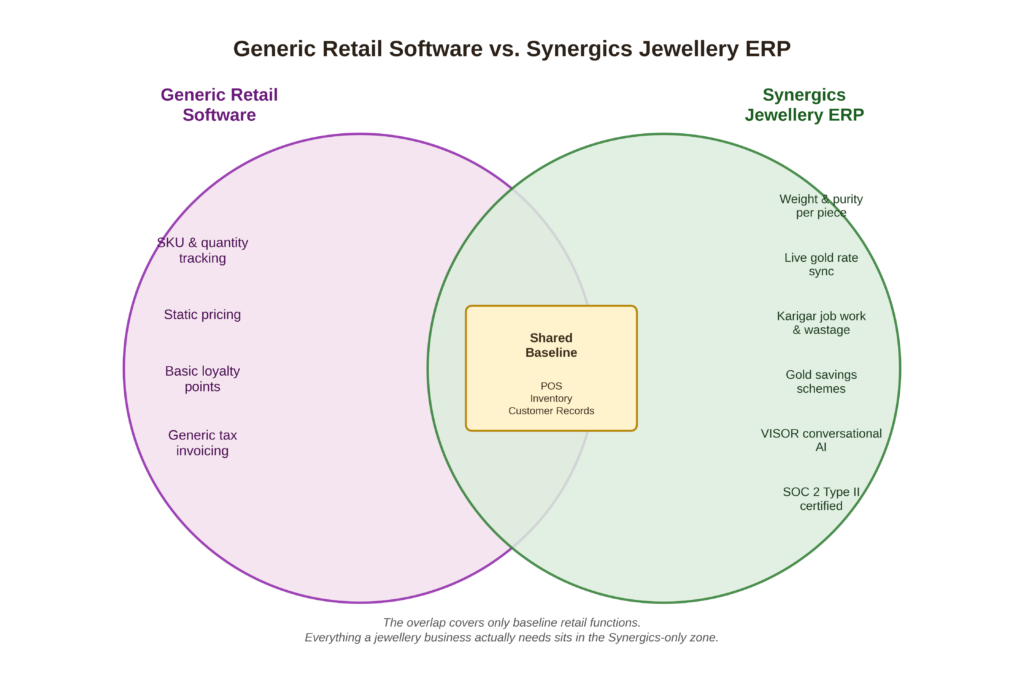
Generic retail software and jewellery-specific ERP diverge sharply once you look past basic point-of-sale functions. The table below shows exactly where a generic system falls short for a jewellery business, and where jewellery-specific software actually delivers.
| Capability | Generic Retail Software | Jewellery-Specific ERP |
| Inventory tracking | SKU and quantity only | Gross weight, net weight, and karat purity per piece |
| Pricing | Static, manually updated | Live gold and silver rate applied automatically |
| Compliance | Generic tax invoicing | GST-compliant billing with HUID hallmarking documentation |
| Customer management | Basic loyalty points | Purchase history, metal preferences, gold savings schemes |
| Repair tracking | Not typically available | Dedicated workflow with automatic cost calculation |
| Multi-branch support | Manual reconciliation between locations | Centralized, real-time inventory and pricing |
| AI-powered insight | Basic sales reports | Conversational AI answering direct business questions |
| Security certification | Rarely independently verified | SOC 2 Type II, VAPT, and other formal certifications common |
The pattern across every row is the same: generic software treats jewellery as a category of general retail, while purpose-built jewellery ERP treats the trade’s specific complexity, weight, purity, daily rate volatility, compliance, as the foundation the entire platform is built around.
Bringing It All Together
The right jewellery ERP for retail treats weight, purity, and daily rate volatility as core to how it works, not a workaround bolted onto generic retail software. It scales from a single showroom to a multi-branch operation, connects to the hardware and channels you actually sell through, and answers your questions directly instead of leaving you to read a dashboard.
Curious how this would work for your specific showroom or chain? Talk to the Synergics team about your current setup.
Frequently Asked Questions About Jewellery ERP for Retail
1. What is jewellery ERP for retail?
Jewellery ERP for retail is software built for weight-based inventory, daily gold and silver rate updates, and purity-wise stock tracking, combining billing, inventory, and customer management into one connected system rather than separate spreadsheets and generic POS tools.
2. How is jewellery ERP different from generic retail software?
Generic retail software tracks items by SKU and quantity alone. Jewellery ERP treats gross weight, net weight, and karat purity as core fields for every piece, and applies live gold and silver rates automatically to pricing.
3. Does jewellery ERP support multiple branches?
Yes, a genuine jewellery ERP for multi-store retail supports centralized, real-time inventory and pricing across every branch, along with inter-branch stock transfers and consolidated reporting.
4. What should I check before choosing a jewellery ERP vendor?
Confirm purity and weight are built-in fields, verify live rate integration and independent security certification like SOC 2 Type II, and ask to see the system running at a scale similar to your own business.
5. Does jewellery ERP include AI-powered analytics?
The strongest platforms do. Synergics includes VISOR, a conversational AI assistant that answers direct business questions instantly, a genuine step beyond the static dashboards most jewellery ERP platforms still rely on.
6. Is jewellery ERP suitable for a single showroom, or only large retail chains?
Both. A genuinely scalable platform fits a single growing showroom with full POS and inventory control, and scales into centralized, multi-branch management as the business grows.
7. How does jewellery ERP handle GST and hallmarking compliance?
GST-compliant invoices and HUID hallmarking documentation generate automatically with every transaction, keeping every sale audit-ready without manual reconciliation.
8. How much does jewellery ERP cost?
Pricing typically depends on business size, number of users and locations, and the specific modules needed. Most vendors provide a transparent quote after understanding your specific setup.