
- Multi-branch jewellery ERP gives one centralized system for inventory, customer data, and finances across every store, instead of disconnected setups per location.
- Without it, businesses face stock discrepancies, disjointed customer experience, inefficient procurement, and inaccurate financial consolidation.
- Look for centralized inventory, unified CRM, integrated procurement, multi-tax compliance, and branch-wise analytics with AI-powered insights.
- Synergics Jewellery ERP supports jewellery businesses running stores across India and internationally, including brands like CaratLane and Hazoorilal.
Why Does Multi-Branch Management Matter in the Jewellery Industry?
Jewellery businesses scaling past one location face real complications fast. Inventory accuracy across stores, per-branch sales visibility, consistent pricing, and real-time financial consolidation all get harder at once. A traditional POS or disconnected software setup can’t handle this reliably once you’re managing more than one store.
Each outlet handles high-value inventory, delivers a unique customer experience, and often follows region-specific pricing or tax rules. What growing jewellery brands need is centralized visibility with local flexibility, the core promise of a genuine multi-branch ERP system.
What Challenges Do Jewellery Businesses Face Without Multi-Branch ERP?

Running multiple stores without centralized ERP creates four recurring problems: stock discrepancies, disjointed customer experience, inefficient procurement, and inaccurate financial consolidation. Each compounds as you add locations.
1. Stock discrepancies. Without real-time stock updates, branches unknowingly oversell or understock items. Reconciliation becomes manual and error-prone, especially for high-value items like diamonds, solitaires, or gold ornaments.
2. Disjointed customer experience. Loyalty points, past purchases, and preferences often don’t travel between branches. That breaks customer trust and quietly erodes brand value.
3. Inefficient procurement and reordering. Without consolidated demand forecasts, each branch places its own orders. That means poor vendor negotiation, inconsistent pricing, and stock hoarding.
4. Inaccurate financial consolidation. Separate books per branch, across taxation and ledger entries, increase errors, audit risk, and reconciliation time.
What Is Multi-Branch Management in a Jewellery ERP?
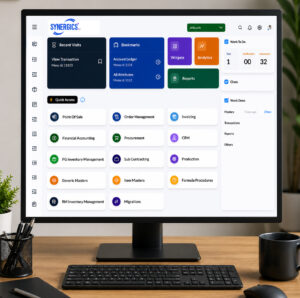
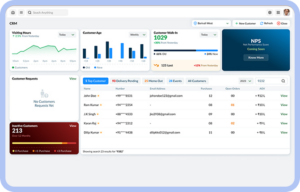
Multi-branch management lets a jewellery business monitor every location from one central dashboard. Data stays shared and unified, instead of siloed across per-store systems. Store managers keep local autonomy for daily transactions, while leadership gets consolidated, data-backed visibility.
Specifically, it enables:
- Monitoring operations across all branches from a central dashboard
- A unified inventory and customer database
- Branch-specific user roles, access controls, and workflows
- Centralized financials with branch-wise reporting
- Seamless inter-branch transfers and centralized procurement
What Features Should You Look for in Multi-Branch Jewellery ERP?
The strongest multi-branch jewellery ERP systems combine location-based inventory, role-based access, unified CRM, integrated procurement, multi-tax compliance, and AI-powered branch analytics. Here’s what each actually needs to deliver.
1. Does It Offer Centralized Inventory with Location-Based Access?
Yes, this should be non-negotiable. Whether it’s bulk gold bars in a warehouse or customized pieces at a store, the system needs location-wise tracking. That means a stock ledger per branch, stone and metal lot tracking, RFID or barcode-based inward and outward entries, and a real-time inter-branch stock transfer module. Our guide to barcode and RFID inventory covers how this works in practice.
2. Does It Support Role-Based Access for Each Branch?
It should. Each branch runs its own workflows and staff hierarchy. The system needs store-wise user roles, access control by module and pricing, and remote access with logging for real accountability.
3. Does It Unify CRM Across All Stores?
Yes, and this matters more than it sounds. Customers shop at whichever outlet is convenient, not always the same one. A centralized CRM needs to share purchase history, unify loyalty points, and support region-wise marketing. Our guide to jewellery CRM software covers this in full.
4. Does It Handle Procurement Across Branches?
It should consolidate purchasing needs from every location into one process. That means centralized vendor negotiation, standardized quality checks, auto-generated purchase orders based on reorder levels, and a Goods Inward Note at the branch level. This directly reduces overstocking and dead stock.
5. Does It Support Multi-Tax, Multi-Currency, and Compliance?
Yes, if you operate across states or countries. That means support for GST, VAT, and local taxes, plus auto-ledger postings by regional rule. Multi-currency support for imports or exports, and BIS certification tracking, round out what every location’s records need.
6. Does It Provide Branch-Wise Analytics and AI-Powered Insights?
The best systems go beyond static reports. Sales comparisons by branch, product, and team, profitability by location and consolidated, audit trails, and daily MIS dashboards are the baseline. Synergics adds VISOR, a conversational AI assistant. Ask a direct question, like which branch is underperforming this month, and get an instant answer, instead of waiting on a report to get built.
How Do You Compare Multi-Branch Jewellery ERP Solutions?
Whichever platform you’re evaluating, not just Synergics, use this as a checklist. Each row names the capability, why it actually matters at scale, and the specific question worth asking any provider before you commit.
| Capability | Why It Matters at Scale | What to Ask a Provider |
| Location-based inventory | Prevents stock mismatches as branches multiply | Is inventory tracked per branch in real time, or reconciled manually overnight? |
| Role-based access | Keeps accountability clear as staff count grows | Can access be restricted by branch, module, and pricing individually? |
| Unified CRM | Customers shop across branches, not just one | Does customer history follow the customer, or stay locked to one store? |
| Consolidated procurement | Prevents each branch from ordering independently | Are purchase orders generated from combined, cross-branch demand? |
| Multi-tax and multi-currency | Essential once you operate across states or countries | Does the system handle GST, VAT, and multi-currency natively, or need a workaround? |
| AI-powered branch analytics | The difference between a static report and an instant answer | Can you ask a direct business question and get an answer, not just a dashboard? |
What Are the Benefits of Multi-Branch Jewellery ERP?
The core benefits are real-time inventory accuracy, unified customer experience, centralized financial control, better staff accountability, efficient purchasing, and faster, data-driven decisions.
| Benefit | Impact on Business |
| Real-time inventory accuracy | Prevents stockouts and duplicate purchases |
| Unified customer experience | Higher satisfaction and repeat business |
| Centralized financial control | Clean audit trails and faster closings |
| Better staff accountability | Role-wise access and performance tracking |
| Efficient purchase management | Reduced costs and better vendor relationships |
| Data-driven decision making | Faster responses to market trends and sales dips |
How Does Multi-Branch ERP Connect Retail and Manufacturing?

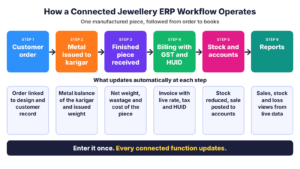
A truly effective system links the full jewellery lifecycle, from production through retail to after-sales service, not just branches to each other. Integrating retail demand with manufacturing schedules helps brands avoid both overproduction and delayed fulfillment.
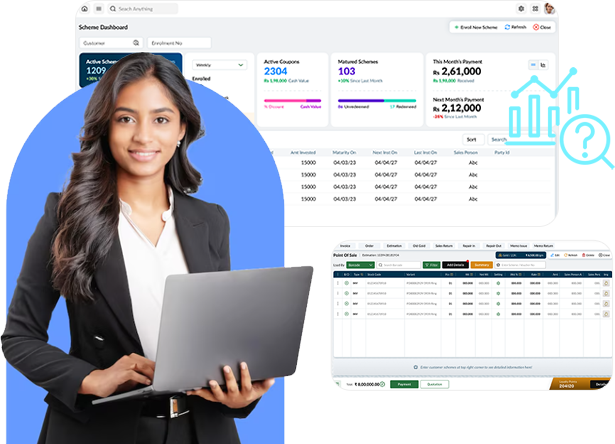
For retail stores, this means POS billing, offers and loyalty programs, sales executive performance tracking, live pricing tied to gold rate movement, and repair and service modules.
For manufacturers, this means BOM generation, job order creation and approval, wastage tracking, vendor-wise costing, and order completion timeline tracking.
Is Cloud ERP Better for Multi-Branch Jewellery Operations?
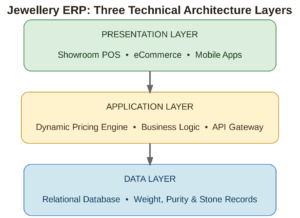
For most growing, multi-location businesses, yes. Cloud-based jewellery ERP gives access from any device. It also reduces upfront infrastructure costs, and rolls out to new branches faster than an on-premise setup requires. See our full cloud vs. on-premise comparison for the honest tradeoffs of both.
Cloud deployment specifically offers auto-backups and real security layers. It also integrates more seamlessly with mobile apps, CRM tools, and analytics dashboards than most on-premise setups manage.
What Mistakes Should You Avoid When Implementing Multi-Branch ERP?
The five most common mistakes are over-customizing too early and inadequate training. No local champion users, skipping mobile integration, and delayed data cleaning round out the list.
| Mistake | Solution |
| Customizing too much too early | Stick to standard workflows in the first phase |
| Inadequate training across stores | Provide role-based sessions with documentation |
| No champion users at each branch | Assign superusers to own adoption and support locally |
| Skipping mobile integration | Use mobile access for staff and remote operations |
| Delayed data cleaning and migration | Start with clean product, stock, and customer masters |
Running Every Branch From One System, Not Twenty
Multi-branch operations are a sign of real growth, but they demand real discipline too. Jewellery is a high-value, intricate, regionally sensitive product line, and generic software falls short of that complexity fast.
Synergics Jewellery ERP supports jewellery businesses running stores across India and internationally. That includes brands like CaratLane, Angara, Muthoot Exim, Browns, and Hazoorilal, serving 150+ businesses across 9 countries in total. Whether you’re running 3 outlets or planning 30, a purpose-built multi-branch ERP gives you 360° visibility and better purchasing decisions. Every location gets a consistent customer experience, not just the flagship store.
Want to see centralized, multi-branch visibility working across your own stores? Talk to the Synergics team about your specific setup.
FAQs
1. What is multi-branch management in a jewellery ERP system?
It allows a business to monitor all branch operations from a central dashboard. This includes shared inventory and customer data, branch-specific user roles, consolidated financials, and real-time inter-branch stock transfers.
2. What are the biggest challenges of running multiple jewellery stores without ERP?
Stock discrepancies from manual reconciliation are the first. Disjointed customer experience, inefficient procurement from independent branch ordering, and inaccurate financial consolidation across separate ledgers round out the list.
3. How does multi-branch jewellery ERP improve customer experience?
A unified CRM shares complete purchase history, loyalty points, and preferences across every branch. Any staff member at any location can personalize service and maintain a consistent brand experience, no matter which store the customer visits.
4. What inventory features does a multi-branch jewellery ERP need?
Location-wise stock ledgers, stone and metal lot tracking, and RFID or barcode-based movement recording matter most. Real-time inter-branch transfers, automated reorder triggers, and centralized purchase order generation complete the picture.
5. How does jewellery ERP handle different tax rules across states or countries?
It supports GST, VAT, and local tax structures simultaneously, with auto-ledger postings based on regional rules. Multi-currency support and BIS certification tracking apply per location as well.
6. Does multi-branch jewellery ERP include AI-powered analytics?
The strongest platforms do. Synergics includes VISOR, a conversational AI assistant that answers direct business questions across every branch instantly, alongside standard MIS dashboards and consolidated reporting.
7. What are the most common mistakes when implementing multi-branch ERP?
Over-customizing the system in the first phase is the most common. Inadequate training, missing local superusers, skipping mobile integration, and delaying data cleaning before go-live round out the list.
8. Is cloud-based jewellery ERP better for multi-branch operations?
For most growing, multi-location businesses, yes. Cloud ERP provides access from any device, reduces upfront infrastructure investment, and rolls out to new branches faster than on-premise systems typically allow.
9. How does multi-branch ERP connect retail and manufacturing operations?
It links retail branch demand directly to manufacturing production schedules. BOM generation and job order creation connect with retail inventory needs, and finished goods move to retail branches without manual data re-entry.