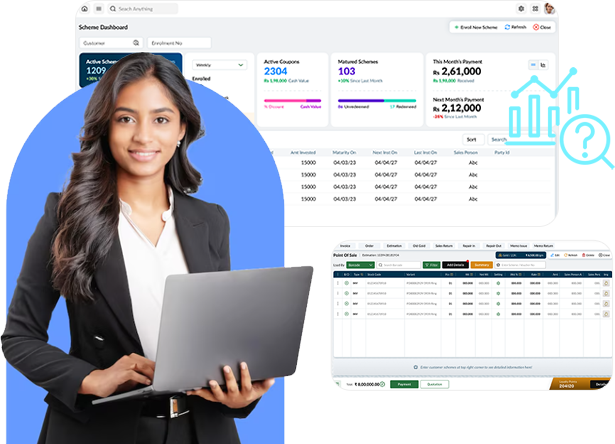
Choosing jewellery ERP software is not simply about comparing features or selecting a vendor. It is about understanding how your business operates, identifying where processes break down, and deciding whether you need individual software or a connected system.
Table of Contents
- What Is Jewellery ERP, and How Is It Different From Jewellery Software?
- What Problem Are You Trying to Solve in Your Jewellery Business?
- Do You Need Individual Jewellery Software or a Complete Jewellery ERP System?
- How Do Your Business Processes Connect From Start to Finish?
- Which Jewellery ERP Capabilities Does Your Business Model Require?
- Which Features Are Essential, and Which Can Wait?
- How Should You Evaluate Jewellery-Specific Features?
- Which Compliance and Core Jewellery Requirements Must the ERP Handle?
- What Reporting and Business Visibility Will You Need?
- What Should You Check About Security, Hosting, and Access?
- What Is the Total Cost of Jewellery ERP Software?
- Can the Jewellery ERP Adapt to Your Business and Future Needs?
- What Should You Know About Implementation, Training, and Support?
- Which Questions Should You Ask During a Jewellery ERP Demo?
- How Can You Compare Jewellery ERP Vendors Objectively?
- Why Consider Synergics Jewellery ERP for Your Business?
- Frequently Asked Questions About Choosing Jewellery ERP Software
What Is Jewellery ERP, and How Is It Different From Jewellery Software?
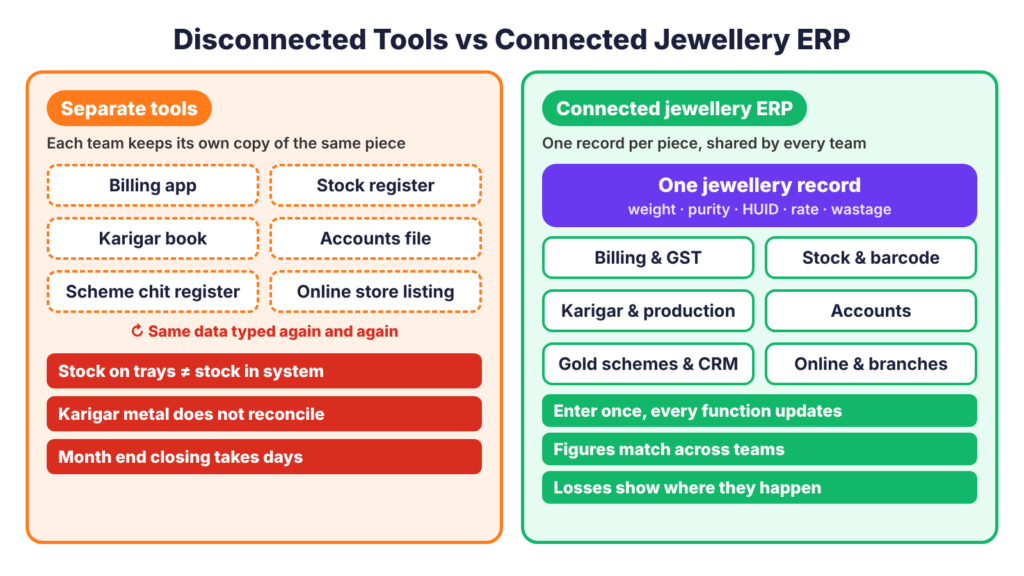
Jewellery ERP is a connected business system that manages purchasing, production, inventory, sales, customers, and accounting on one set of jewellery data. Jewellery software is a broader term that also covers single tools for one task, such as billing or stock. The difference lies in whether the functions share data.
Jewellery software may solve one task, such as billing, inventory, or customer management. A jewellery ERP connects those functions, so a sale updates stock, accounts, and reports at once. It also records what generic ERP cannot: gross, net, and stone weight, purity, wastage, making charges, live metal rates, and HUID on every item.
| Type | What it does |
| Jewellery software (single tool) | Handles one function, such as billing or stock, and depends on other systems for the rest. |
| Jewellery ERP | Connects the functions you select on shared jewellery data, so records stay consistent across teams. |
| Generic ERP | Tracks quantity and price, so weight, purity, wastage, and hallmarking need workarounds. |
Looking for providers to compare? See Best Jewellery ERP Software in India: Top 11 Providers Compared.
What Problem Are You Trying to Solve in Your Jewellery Business?
Before comparing jewellery ERP software, identify the operational problems you want to address. This helps you distinguish between a specific software requirement and a wider business need that may involve inventory, sales, production, accounting, and other connected processes.
Start by documenting the problems your team faces every day. Look beyond the immediate inconvenience and consider its effect on other departments.
| Current challenge | What you may need |
| Billing takes too long or requires repeated manual calculations | Jewellery billing or POS software |
| Stock records do not match physical inventory | Jewellery inventory management software |
| Production material and finished goods are difficult to track | Jewellery manufacturing software |
| Customer information is spread across different records | Jewellery CRM software |
| Wholesale orders, pricing, and inventory are difficult to coordinate | Jewellery wholesale software |
| Teams enter the same information into multiple systems | An integrated jewellery ERP system |
| Management cannot get a consistent view of sales, inventory, and operations | Connected reporting and business management capabilities |
These problems may initially appear unrelated. However, if one issue affects another, the underlying requirement may be broader than a single software application.
For example, an inventory discrepancy may not originate in the inventory department. It could result from a purchase that was not recorded correctly, a production movement that was not updated, or a sale that did not reflect the latest stock position.
Ask yourself:
- Which processes create the most manual work?
- Where do errors or delays occur repeatedly?
- Which teams depend on the same information?
- Do employees have to maintain separate spreadsheets to complete their work?
- Does solving one problem create additional work for another department?
Your answers will help determine the scope of the software you need.
Do You Need Individual Jewellery Software or a Complete Jewellery ERP System?
The distinction matters because individual software can solve a specific problem, while a jewellery ERP system is designed to connect multiple business processes. The right choice depends on how your operations interact, not simply on how many features you want.
When is individual jewellery software enough?
A specialized application may be sufficient when your requirement is limited to one process and your existing systems already manage the rest of your business effectively.
For example, a single showroom that needs a better billing interface may not need to replace every system it currently uses. Similarly, a business may need a standalone tool for a particular task if that task does not depend heavily on other departments.
Individual software may be appropriate when:
- You have one clearly defined problem.
- Other business processes are working reliably.
- Your existing systems exchange information accurately where required.
- You do not need broader process visibility.
- The cost and effort of a wider implementation would not deliver enough additional value.
When should you consider a complete jewellery ERP system?
A connected jewellery ERP system becomes more relevant when multiple departments depend on shared data and one transaction affects several processes.
For example, a jewellery order may involve customer requirements, material availability, procurement, production, job work, finished-goods inventory, billing, and accounting. Managing each step separately can make it difficult to maintain consistent records throughout the process.
Consider a jewellery ERP system when:
- The same information is entered into multiple applications.
- Inventory, sales, production, and accounting records frequently differ.
- Teams cannot easily trace a transaction from its beginning to its completion.
- You operate across multiple locations or business functions.
- You need consistent reporting across departments.
- Your current software requires repeated manual reconciliation between systems.
- Your current applications are becoming difficult to manage as operations grow.
The important distinction is that a complete jewellery ERP system does not mean you must purchase or activate every available module. It means selecting the modules your business needs and connecting the relevant processes through a shared system.
What is the practical difference?
| Decision factor | Individual software | Connected jewellery ERP |
| Primary purpose | Solves a specific operational problem | Connects multiple business processes |
| Scope | Limited to a defined function | Covers selected functions across the business |
| Data flow | Depends on available integrations and processes | Designed to connect relevant processes |
| Reporting | Usually focused on its own function | Can provide a broader view when the relevant data is connected |
| Best suited for | Isolated requirements | Interdependent operations |
Decision rule: If the problem is isolated, evaluate specialized software first. If the problem extends across departments, evaluate jewellery ERP software that can manage the connected workflow.
The objective is not to buy the largest possible software package. It is to select a system that supports the business processes you need, connects the right information, and avoids unnecessary complexity.
How Do Your Business Processes Connect From Start to Finish?
A jewellery ERP buying decision should follow the movement of information, materials, orders, and money through your business. Mapping these connections helps you identify which processes must work together and which can remain separate.
Do not start by selecting modules from a feature list. Start by mapping how your business actually operates.
For a jewellery manufacturer, a typical workflow may involve:
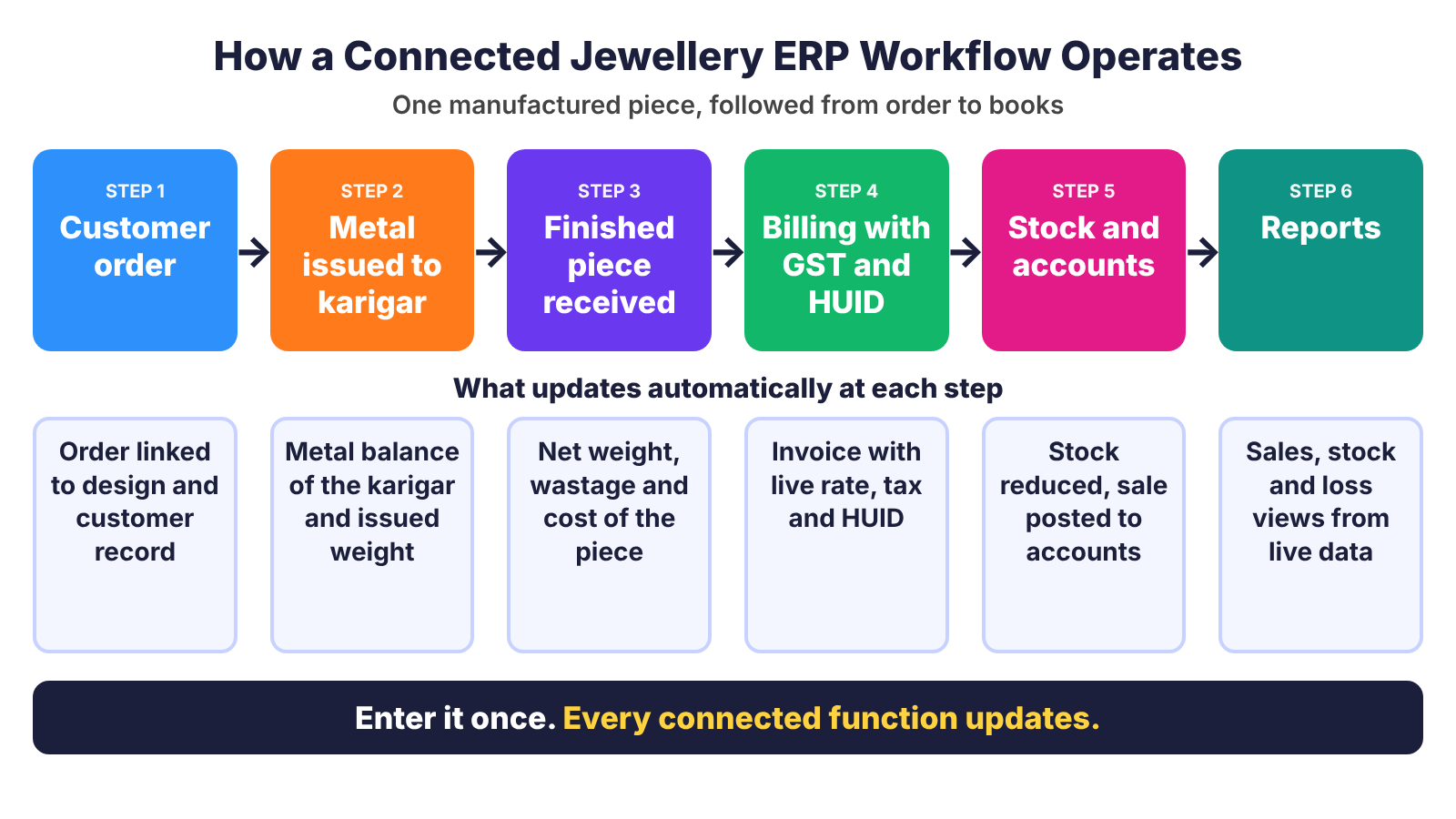
Customer order → Material planning → Procurement or inventory allocation → Production → Karigar or job work → Finished-goods receipt → Sales or dispatch → Accounting and reporting
For a retailer, the flow may be different:
Procurement → Inventory receipt → Cataloging and stock management → Customer selection → Billing → Inventory update → Accounting and reporting
A wholesaler may focus more on:
Procurement or production receipt → Inventory allocation → Customer-specific pricing → Order processing → Dispatch → Party balances and accounting
These are illustrative workflows. Your actual process may differ depending on your business model, product categories, and operating practices.
Ask yourself:
- Where does each transaction begin?
- Which department handles it next?
- What information must move with it?
- Which records need to update automatically or through a defined process?
- Where do employees currently re-enter or reconcile information?
- Which steps require management approval or additional checks?
The purpose of this exercise is to define the workflow you want the software to support. It also gives you a practical framework for evaluating vendor demonstrations.
Which Jewellery ERP Capabilities Does Your Business Model Require?
Retailers, manufacturers, and wholesalers have different operational priorities. A useful jewellery ERP selection process begins with your primary business model, then accounts for any additional activities your business performs.
If you are a jewellery retailer
Retail jewellery businesses typically need to coordinate inventory, customer transactions, billing, and financial records. Businesses with multiple showrooms may also need better visibility across locations.
Evaluate capabilities such as:
- Retail POS and billing
- Jewellery inventory management
- Product and catalog management
- Customer relationship management
- Barcode and RFID compatibility
- Repair management, where applicable
- Gold savings scheme management, where applicable
- Multi-store and franchise management, where applicable
- Financial accounting and reporting
Questions to ask:
- Can the system manage jewellery inventory using the attributes relevant to your products, such as weight and purity?
- Can the billing process access the information it needs without unnecessary manual entry?
- Can you track inventory movements between locations if your business operates multiple stores?
- Can customer information be used across the relevant sales and service processes?
- Can the system support the repair or scheme workflows your business actually uses?
Read the related guide: Jewellery ERP for Retail: The Complete Guide
If you are a jewellery manufacturer
Manufacturers need visibility into production, material movement, job work, and finished goods. The buying decision should focus on whether the jewellery ERP can track these processes in the way your workshop operates.
Evaluate capabilities such as:
- Production planning
- Bill of materials (BOM) management
- Process management
- Material issue and receipt
- Work-in-progress tracking
- Karigar and job work management
- Wastage and loss tracking
- Production costing
- Finished-goods receipt
- Inventory and financial reporting
Questions to ask:
- Can material be tracked as it moves through production stages?
- Can you record material issued to and received from karigars?
- Can the system record process-wise wastage or loss?
- Can production records connect with inventory and costing?
- Can the workflow be configured to reflect your actual manufacturing process?
Do not evaluate manufacturing software only by the number of production features listed. Test whether it can represent the real movement of materials and work through your factory.
Read the related guide: Jewellery Manufacturing Software ERP: The Complete Guide
If you are a jewellery wholesaler
Wholesale businesses often need to coordinate bulk orders, inventory, customer-specific pricing, catalogs, and reporting. The required capabilities will depend on how you sell, manage stock, and fulfill orders.
Evaluate capabilities such as:
- Wholesale order management
- Inventory management
- Product cataloging
- Barcode and RFID compatibility
- Customer relationship management
- Job work management, where applicable
- Financial accounting
- Scheduled MIS reporting
- Custom report building
- eCommerce integration, where required
Questions to ask:
- Can the system support your order processing workflow?
- Can you manage the pricing structures your customers require?
- Can stock information be accessed by the teams that need it?
- Can you generate the reports used to manage your wholesale operations?
- Can job work and subcontracting be managed if they form part of your business?
Read the related guide: Jewellery Wholesale ERP: The Complete Guide
What if your business combines retail, wholesale, and manufacturing?
Some jewellery businesses perform more than one of these functions. In such cases, choosing software for only one department may leave other important processes disconnected.
List every business activity you perform, then identify which activities share inventory, orders, customer information, production records, or financial data. Evaluate whether a connected jewellery ERP can support the required workflows without forcing you into unnecessary modules.
Which Features Are Essential, and Which Can Wait?
A long feature list does not necessarily indicate a better jewellery ERP system. Separating essential requirements from optional and future needs helps you compare vendors objectively and avoid paying for capabilities your business will not use.
Create three requirement groups before scheduling vendor demonstrations.
| Priority | Meaning | Example |
| Must have | Required to run an essential business process | Inventory tracking or retail billing |
| Should have | Valuable, but a workable alternative currently exists | A custom report used by management |
| Future need | May become important as the business grows | Additional location or business-function support |
Your priorities should come from your process map, not from a vendor’s product presentation.
For example, a manufacturer that frequently issues material to karigars should treat material issue, receipt, and job work tracking as essential requirements. A retailer with several stores may prioritize multi-location inventory visibility and consolidated reporting.
Ask yourself:
- Which capabilities are necessary from day one?
- Which problems must the new system solve immediately?
- Which existing processes can continue without creating data inconsistencies?
- Which future requirements are realistic within your business plan?
- Which features would be useful but are not worth delaying implementation for?
This list becomes the basis of your vendor scorecard. It also helps prevent demonstrations from being driven by impressive but irrelevant features.
7. How Should You Evaluate Jewellery-Specific Features?
Jewellery operations have requirements that may not be handled adequately by generic business software. Evaluate how each system supports the product attributes and workflows relevant to your business, rather than relying on general statements about inventory or production management.
Use the following checklist to guide your evaluation.
| Capability | What to verify |
| Inventory management | Can it record and manage the product details your business needs, including relevant weight, purity, category, and location information? |
| Product and catalog management | Can your team organize product information and maintain the catalogs required for your operations? |
| Order management | Can the system follow an order through the steps your business uses? |
| Procurement | Can purchasing records connect with the inventory process? |
| Manufacturing | Can it support the production planning and material movement workflows you use? |
| Karigar and job work | Can material issue, receipt, process tracking, and relevant wastage records be maintained? |
| Retail POS and billing | Can it support your billing process and the transaction details your business requires? |
| Wholesale management | Can it support your order volumes, pricing arrangements, and stock processes? |
| Barcode and RFID | Can the system work with the scanning approach and hardware you intend to use? |
| CRM | Can the relevant customer information be maintained and accessed by the appropriate teams? |
| Repair management | Can it record and track repairs if your business offers repair services? |
| Financial accounting | Can financial records connect with the business processes you need to account for? |
| Reporting and analytics | Can it provide the operational reports your team needs to make decisions? |
| eCommerce integration | Can it connect with the eCommerce platform or workflow your business uses? |
Do not assume that every jewellery business needs every capability. Select the features that fit your business model and verify how they work in the proposed configuration.
Important: Ask vendors to demonstrate each critical requirement using a realistic business scenario. A feature name on a website is not proof that the workflow will work as you expect.
Which Compliance and Core Jewellery Requirements Must the ERP Handle?
A jewellery ERP must handle hallmarking, tax, metal, and scheme requirements that generic software does not cover. These include HUID and BIS hallmarking records, GST invoicing, live metal rates, old gold exchange, wastage accounting, gold savings schemes, and lab-grown diamond disclosure. Verify each one in a demo using your own data.
| Requirement | What to verify |
| HUID and BIS hallmarking | Can the system store the HUID against each piece and carry it to the invoice? Read our HUID guide. |
| GST invoicing | Can one invoice handle metal value, making charges, and stones with the correct tax treatment? |
| Live metal rates | Do rate changes update quotes and invoices automatically? |
| Old gold exchange | Can the system value exchanged metal by purity and adjust the bill? |
| Wastage and loss | Does it record wastage at each production stage and show the loss in weight and cost? |
| Gold savings schemes | Can it track chits, installments, maturity, and the outstanding liability? |
| Lab-grown diamonds | BIS IS 19469:2025 reserves the word “diamond” for natural stones and requires full disclosure terms for lab-grown ones. Can the system keep natural and lab-grown stock separate and print the correct term on tags and invoices? Read our lab-grown diamond guide. |
Add these items to your must-have list and your vendor scorecard.
What Reporting and Business Visibility Will You Need?
Reports should answer the questions your team needs to make decisions. Before choosing jewellery ERP software, identify the information required by owners, managers, finance teams, store staff, and production teams, then verify how the system provides it.
Start by listing your regular business questions.
- Which products or categories need attention?
- What inventory information do managers review regularly?
- Which production or job work processes need monitoring?
- What sales and financial information is required?
- Which reports are prepared manually today?
- Do different teams need different reporting views?
Then ask vendors to demonstrate the relevant reports using sample data. Check whether the report provides the information you need, how frequently it can be generated, and whether the fields or format can be configured.
Where analytics or AI assistants are offered, evaluate them as separate capabilities. For example, Synergics’ VISOR is a conversational AI assistant designed to answer business questions by connecting to an existing jewellery ERP through a secure, read-only channel. Confirm the supported data sources and questions relevant to your proposed setup.
A useful reporting evaluation focuses on practical answers, reliable underlying data, and the effort required to obtain those answers.
What Should You Check About Security, Hosting, and Access?
Jewellery ERP software may hold sensitive business information, including inventory, transactions, customer records, and financial data. Before choosing a vendor, understand where your data is hosted, how access is managed, and what security evidence the vendor can provide.
Ask each vendor to explain:
- Whether the solution is cloud-based, on-premises, or offered through another deployment model.
- How users receive access and how permissions are managed.
- What backup and recovery arrangements are available.
- How data is protected in transit and at rest.
- Which security certifications or assessments the vendor holds.
- Whether the vendor can provide supporting documentation for relevant claims.
- How data can be retrieved if you change systems or end the agreement.
Do not treat a general statement such as “secure software” as sufficient evidence. Ask for details that apply to the product, hosting arrangement, and service being offered to your business.
Compare vendors against the same questions so that your final decision reflects verifiable information rather than marketing language.
What Is the Total Cost of Jewellery ERP Software?
The purchase price is only one part of the cost of jewellery ERP software. A fair comparison should include implementation, configuration, integrations, training, ongoing support, and any recurring charges that apply to your proposed setup.
Request a written quotation that separates the following costs.
| Cost category | What to clarify |
| Software license or subscription | Is the fee recurring, one-time, or based on users or another measure? |
| Implementation | What activities are included in the quoted price? |
| Configuration and customization | Which changes are included, and which are charged separately? |
| Data migration | Is transferring existing records included? |
| Integrations | Are required connections with other systems included? |
| Hardware | Will you need additional scanners, devices, or other equipment? |
| Training | How many sessions are included, and who will receive training? |
| Support and maintenance | What support is included, and what incurs additional fees? |
| Future changes | How are new users, locations, or requirements priced? |
Compare the expected cost over the same period for every vendor. A lower initial quote may not be the more economical option if essential configuration, integrations, or support are excluded.
Also consider the internal time your team will spend preparing data, testing workflows, attending training, and adjusting processes during implementation.
Can the Jewellery ERP Adapt to Your Business and Future Needs?
Jewellery businesses differ in how they buy, manufacture, track, sell, and service products. The software should fit the workflows your business needs, while giving you a clear understanding of which changes can be supported and at what cost.
During vendor discussions, ask:
- Can the system be configured for our existing business processes?
- Which settings can our team manage, and which require vendor assistance?
- Can required reports be configured?
- Can we add relevant modules later?
- What changes would be needed if we add a store, product category, or business function?
- Would those changes require additional licenses, implementation, or customization?
Avoid choosing a product simply because a vendor promises that it can do everything. Ask for examples of the specific configuration you need and request that the agreed scope be documented.
The objective is not to predict every future requirement. It is to choose a jewellery ERP that meets current needs and has a practical path for supporting expected changes.
What Should You Know About Implementation, Training, and Support?
A jewellery ERP system is useful only when your team can use it correctly in day-to-day operations. Understanding the implementation process before signing helps you prepare for data migration, workflow testing, training, and the transition from existing systems.
Ask the vendor to outline the proposed implementation plan.
- What information must your team provide before implementation?
- Who is responsible for preparing and validating existing data?
- Which business workflows will be configured and tested?
- How will the vendor check that the system meets your requirements?
- Who will train each team?
- What support is available after the system goes live?
- How are issues reported, prioritized, and resolved?
Ask for a clear division of responsibilities between your business and the vendor. Confirm the proposed milestones, deliverables, and acceptance criteria in writing.
A structured implementation plan also helps you identify dependencies before they become delays. This is particularly important when several departments need to adopt the jewellery ERP at the same time.
Which Questions Should You Ask During a Jewellery ERP Demo?
A product demonstration should help you validate your requirements, not simply introduce you to the software. Prepare a consistent list of questions and ask every vendor to demonstrate the same important workflows so that the comparison remains fair.
Test one transaction from start to finish
Having several modules in one product is not the same as having a connected business workflow. The key question is whether information moves reliably between the functions you select and whether your team can trace the relevant transaction across those functions.
For example, a jewellery manufacturing workflow may require material planning, production, karigar job work, finished-goods receipt, inventory updates, and costing to work together. If these processes are handled in separate systems, your team may still need to reconcile records manually.
During a demonstration, ask the vendor to show a complete transaction from start to finish.
Test a real workflow:
- Create or record a business transaction.
- Show how the relevant team processes it.
- Follow the information into the next connected process.
- Check which records update and which actions require manual intervention.
- Review the reports or records available at the end.
- Identify any integrations, extra modules, or configuration work required.
Ask the vendor to distinguish clearly between capabilities available in the proposed system, features that require configuration, and functions that depend on third-party integrations.
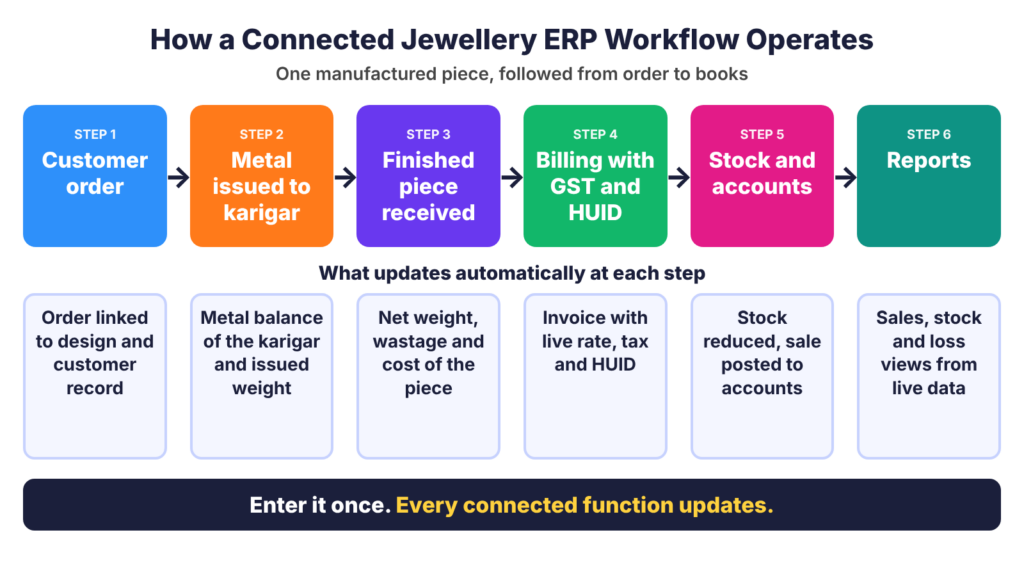
This evaluation helps you determine whether the proposed jewellery ERP will actually reduce disconnected work or simply move it into a new interface.
Use this checklist during each demonstration
Business fit
- Which of our required workflows does the proposed system support?
- Which capabilities are included in the quoted configuration?
- Which requirements need customization or third-party software?
Process connectivity
- Can you demonstrate one transaction across the relevant connected functions?
- Where is information updated automatically, and where is manual work required?
- What happens when a transaction changes or needs correction?
Jewellery-specific operations
- Can you demonstrate the inventory attributes and workflows relevant to our products?
- If we manufacture, can you demonstrate production and karigar job work?
- If we sell wholesale, can you demonstrate our order and pricing workflow?
- If we operate retail stores, can you demonstrate billing and the related inventory process?
Reporting and access
- Can you show the reports our team uses regularly?
- Can reporting be configured to meet our requirements?
- How are users, permissions, hosting, and data access managed?
Implementation and cost
- What is included in the implementation plan?
- What costs are excluded from the quotation?
- What training and support will be provided?
- Can you document the agreed scope before we sign?
Record each vendor’s answer, evidence, and any unresolved question. This will make your final decision easier to justify and reduce the risk of choosing a system based on a polished demonstration alone.
How Can You Compare Jewellery ERP Vendors Objectively?
Once you have evaluated the requirements, compare vendors against a common scorecard. A consistent method helps prevent a strong presentation, a long feature list, or a low initial price from outweighing the operational fit of the system.
The following scorecard is a starting point. Adjust the weightings to reflect your business priorities.
| Evaluation criterion | Suggested weight |
| Fit with essential business processes | 20% |
| Jewellery-specific capabilities | 15% |
| Compliance and hallmarking support | 10% |
| Connectivity between required processes | 15% |
| Ease of use for relevant teams | 10% |
| Configuration and future scalability | 10% |
| Implementation, training, and support | 10% |
| Total cost of ownership | 10% |
| Total | 100% |
Score each vendor on a consistent scale, such as 1 to 5, where 1 means the requirement is not adequately met and 5 means it is fully demonstrated and supported by evidence.
For every score, record the reason behind it. A vendor should not receive a high score simply because a feature appears in a brochure. The score should reflect how well the proposed system meets your requirement, what additional work is needed, and whether the vendor has demonstrated the capability.
Use the scorecard as a decision aid rather than an automatic winner-selection tool. A critical requirement that is not met may matter more than a high overall score.
Why Consider Synergics Jewellery ERP for Your Business?
Synergics Jewellery ERP is a cloud-based, customizable solution built for jewellery retailers, manufacturers, and wholesalers. It connects inventory, sales, manufacturing, orders, and accounting in one system, configured around your business workflows. With 19+ years of experience, Synergics serves 250+ jewellery businesses across 9 countries.
- Trusted by jewellery businesses: 25,000+ users, with clients including Browns and Angara.
- Security and technology: Built on AWS with an Oracle database, backed by SOC 2 Type II, VAPT assessments, and a CARE SME 3 rating.
- Industry recognition: Featured in Forbes India, CNBC-TV18, and Times of India, and recognized among CIO Insider’s Most Recommended ERP Solution Providers.
- Implementation and support: Assistance with data migration, configuration, training, onboarding, and ongoing support after implementation.
- Free personalized demo: Discuss your requirements, explore relevant jewellery ERP modules, and receive a custom quotation based on your business needs.
See how Synergics Jewellery ERP can fit your business. Request a Free Demo
Frequently Asked Questions About Choosing Jewellery ERP Software
These questions address common decisions jewellery business owners face when comparing software. Use them to clarify the scope of your requirements, understand what to verify with vendors, and decide whether individual software or a connected jewellery ERP system is the better fit.
1. How do I choose the right jewellery ERP software?
Start by mapping your business processes, identifying essential requirements, and determining where information needs to move between teams. Compare vendors on demonstrated workflow fit, jewellery-specific capabilities, implementation, support, and total cost rather than feature count alone.
2. Do small jewellery businesses need a complete jewellery ERP system?
Not always. A small business with one isolated software requirement and reliable existing systems may need only a specialized application. A connected jewellery ERP becomes more relevant when several processes depend on shared inventory, order, customer, or financial information.
3. What is the difference between jewellery software and jewellery ERP software?
Jewellery software may address a specific task, such as billing, inventory, or customer management. Jewellery ERP software is intended to connect selected business functions so relevant information can move across processes instead of being maintained separately.
4. Which modules should a jewellery ERP system include?
The required modules depend on your business model. Retailers may prioritize billing, inventory, and CRM. Manufacturers may need production, BOM, and job work management. Wholesalers may focus on orders, inventory, cataloging, and reporting. Choose modules based on actual requirements.
5. Can one jewellery ERP system support retail, wholesale, and manufacturing?
A jewellery ERP may support multiple business models, but you should verify the specific capabilities and configuration offered. Ask the vendor to demonstrate the workflows required by each part of your business and explain how the relevant records connect.
6. What should I check before buying jewellery ERP software?
Check essential workflows, jewellery-specific inventory requirements, process connectivity, reporting, access controls, implementation, training, support, integrations, and total cost. Ask vendors to demonstrate your critical use cases and document any limitations, additional costs, or customization requirements.
7. How much does jewellery ERP software cost?
The cost depends on the vendor’s pricing model, selected modules, users, configuration, integrations, implementation, training, and ongoing support. Request a written quotation with included and excluded items, then compare the expected total cost over the same period.
8. How long does it take to implement jewellery ERP software?
Implementation time depends on the scope, data migration, configuration, integrations, testing, and training required. Ask each vendor for a proposed timeline based on your actual workflows, responsibilities, milestones, and acceptance criteria rather than relying on a general estimate.
9. Can jewellery ERP software be customized for my business?
Some jewellery ERP systems support configuration or customization, but the extent varies by product and implementation. Ask which workflows and reports can be adapted, what requires development, how changes are priced, and whether the agreed requirements will be documented.
10. Should I choose jewellery ERP software based on the number of features?
No. A long feature list does not guarantee a good fit. Prioritize the capabilities your business needs, verify how the workflows operate, and compare vendors on evidence, process connectivity, implementation, support, and total cost.
11. What should I ask during a jewellery ERP demo?
Ask the vendor to demonstrate your essential workflows from start to finish. Verify how information moves between relevant functions, what requires manual work, which features need configuration or integrations, and what is included in the proposed price and implementation plan.
12. How do I know when my business has outgrown separate software?
Look for repeated data entry, inconsistent records, manual reconciliation, limited cross-department reporting, and difficulty tracing transactions between teams. If these issues arise because your processes depend on shared information, evaluate whether a connected jewellery ERP can address them.