Key Takeaways:
- Jewellery wholesale ERP, also called jewellery wholesale software, runs B2B trading: memo and consignment sales, buyer-wise pricing, vault inventory, and metal and cash balances with every party.
- Wholesalers switch because goods on approval, buyer-specific prices, and metal held by karigars are hard to track in spreadsheets.
- Core modules cover pricing rules, sales and orders, vault inventory, procurement, job work, catalogs, accounting, and reporting.
- Before choosing, check pricing flexibility, memo handling, party-wise metal ledgers, tax coverage for your countries, and security certification.
- Synergics Jewellery ERP (Formerly SEA) offers this with 19+ years of experience, 150+ businesses across 9 countries, and SOC 2 Type II certification.
Introduction
A wholesale jeweller’s business is a web of balances. Goods sit with a buyer on approval. Fine gold sits with a karigar. Cash is owed by a distributor, and every buyer has a different rate card. Accounting software records invoices and stock counts. It can’t hold a running metal balance for each party, or an approval that hasn’t become a sale yet.
Jewellery wholesale ERP is software built to run B2B jewellery trading, connecting memo and consignment sales, buyer-wise pricing, vault inventory by weight and purity, and metal and cash ledgers for every party in one system. It replaces the usual mix of an accounting package, spreadsheets for goods on approval, and phone calls to confirm what a karigar still holds.
Table of Contents
- What Is Jewellery Wholesale ERP?
- Why Are Jewellery Wholesalers Moving to ERP?
- How Does Jewellery Wholesale Software Handle Memo and Consignment Sales?
- How Does Multi-Tier Pricing Work in Jewellery Wholesale ERP?
- How Does It Track Metal Held by Karigars?
- What Are the Core Modules of Jewellery Wholesale ERP?
- How Does Jewellery Wholesale ERP Work?
- Can It Support Export and Multi-Currency Trading?
- What Compliance Checks Should Wholesalers Verify?
- How Is AI Helping Jewellery Wholesalers?
- What Should You Check Before Choosing Jewellery Wholesale ERP?
- Why Choose Synergics Jewellery ERP (Formerly SEA) for Wholesale?
- How Does It Compare to Spreadsheets and Accounting Software?
- Bringing Your Wholesale Operations Onto One System
- Frequently Asked Questions
What Is Jewellery Wholesale ERP?
Jewellery wholesale ERP is software that runs B2B jewellery trading. It sells to retailers and distributors on memo, consignment, or outright terms. It prices each buyer differently and tracks the metal, stones, and cash owed in both directions. Wholesale jewellery software also covers vault stock and karigar job work in the same system.
See the jewellery wholesale software page for the full feature set.
Why Are Jewellery Wholesalers Moving to ERP?
Wholesalers are moving to ERP because their most valuable assets, goods on approval and metal in other people’s hands, are the hardest to see. A spreadsheet shows what was sent, not what is still out, at what rate, or for how long.
- Goods on memo look like available stock until someone checks.
- Each buyer’s rates live in a separate sheet or in someone’s memory.
- Metal issued to karigars sits in registers that never reach costing.
How Does Jewellery Wholesale Software Handle Memo and Consignment Sales?
It records every piece sent on memo or consignment against the buyer and keeps it in your stock until approved. Approved pieces convert to an invoice. Returns and partial approvals update stock automatically, so you always know what is out, and with whom.
- Outright, consignment, and memo sales as separate transaction types
- Approvals, partial approvals, and returns without re-entering documents
- Transfers between locations with stock acknowledgement
See our guide to jewellery consignment software.
How Does Multi-Tier Pricing Work in Jewellery Wholesale ERP?
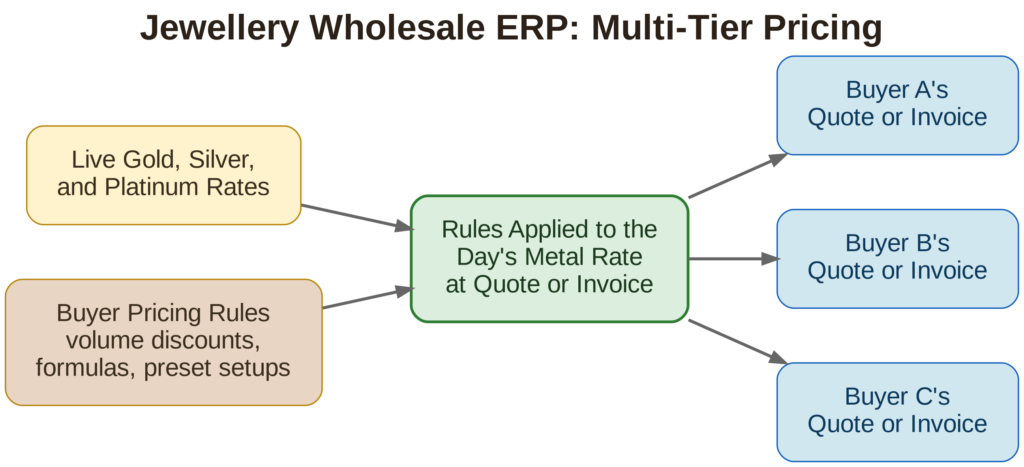
Each buyer or buyer group gets its own pricing rules, such as a volume discount or a formula combining metal rate and labor. The system applies those rules to the day’s metal rate at quote or invoice. Nobody recalculates by hand or shares a rate card over the phone.
How Does It Track Metal Held by Karigars?
Every issue of metal or stones to a karigar is recorded against a job. When the work returns, the system tallies finished weight, wastage, and labor charge. A running balance per worker shows what is outstanding and whether wastage stayed within the agreed limit.
Subcontracting can be full or partial, tracked process by process.
Our karigar management guide covers this in depth.
What Are the Core Modules of Jewellery Wholesale ERP?
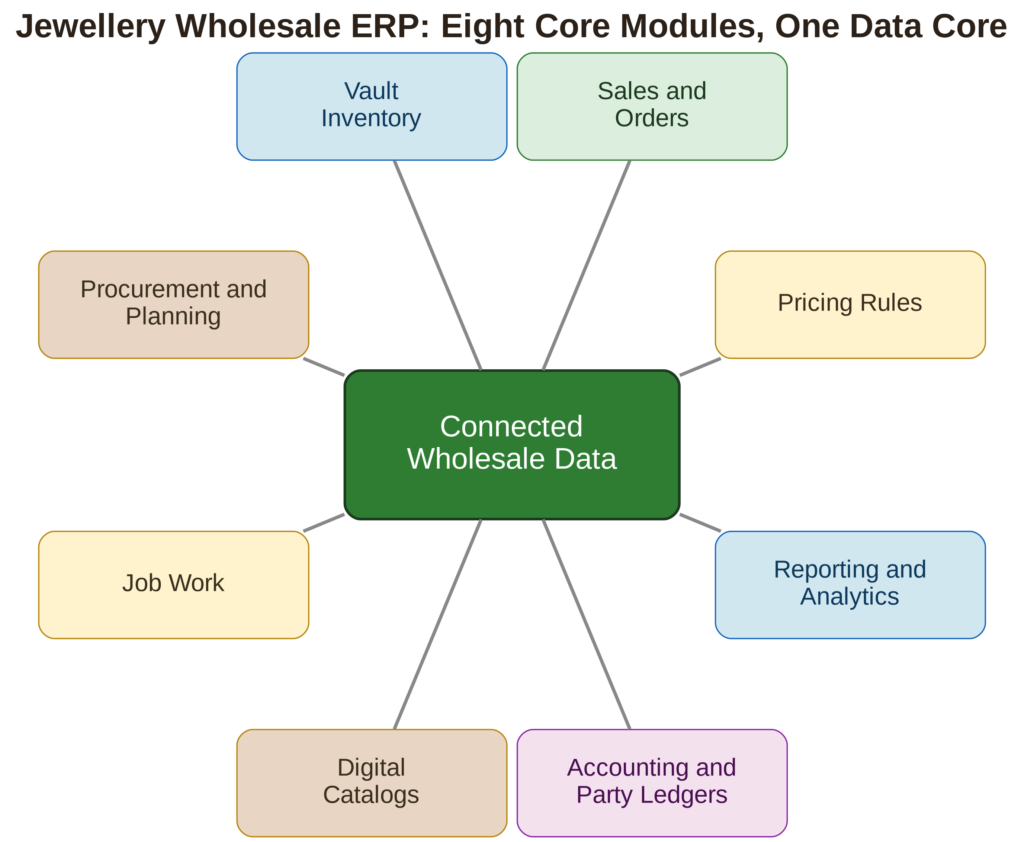
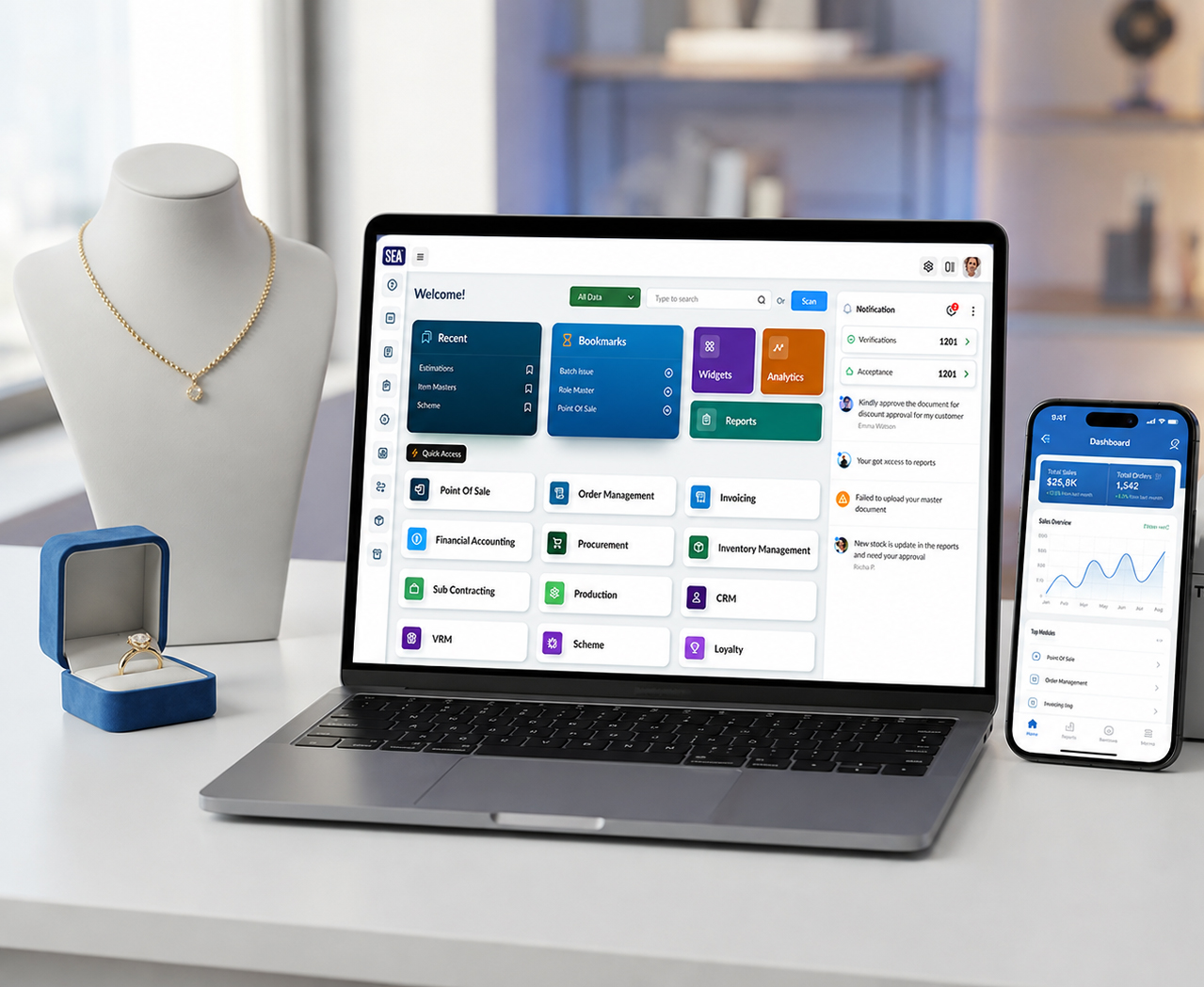
Jewellery wholesale ERP typically combines eight modules: pricing rules, sales and orders, vault inventory, procurement and planning, job work, digital catalogs, accounting with party ledgers, and reporting. Together they follow a piece from purchase to settlement. See the features page for every module across retail, wholesale, and manufacturing.
- Pricing Rules Set pricing through a pre-configured setup or fully custom rules built with a formula builder, so different buyers get different structures. When gold, silver, or platinum rates move, quotes and invoices recalculate against them, and pricing strategy can change overnight without waiting on a vendor.
- Sales and Order Management Handle outright, consignment, and memo sales alongside B2B orders, stock orders, and repair orders, booked separately for cleaner analysis. Invoices, memo approvals, memo returns, and sales returns run in the same system, and transfers between locations carry stock acknowledgement.
- Vault Inventory Track every piece, gram, and cent across raw materials, work in progress, and finished goods, viewable by location, by barcode, or across the whole vault. Stock is valued on a weighted-average basis, and customer goods stay traceable. Barcode and RFID stocktakes flag variances instantly and reprice on scan.
- Procurement and Material Planning Create purchase orders automatically or manually, with verification built in for controlled buying. Gold, silver, diamonds, and stones can be procured in carats and pieces. Planning compares incoming B2B orders against live vault stock and generates purchase requisitions for pure metal, alloys, and loose stones.
- Job Work and Subcontracting Run process-wise outsourced manufacturing linked to the originating order, with bulk issue and receipt against a running ledger. Allowable wastage is defined and tracked per job worker through to settlement, and subcontracting can be full or partial.
- Digital Catalogs and Order Capture Share digital lookbooks with party-wise pricing tiers, so each buyer sees their own rates, and capture bulk orders instantly. Design definitions carry images and videos, with bills of material ranging from a single line to a hundred rows.
- Accounting and Party Ledgers Built-in financial accounting covers branch-level accounting, approval rules, and profit and loss statements and balance sheets with drill-down, posted as transactions happen. Real-time payables, receivables, and metal balances sit on each party’s ledger, with multi-currency support for cross-border partners.
- Reporting and Analytics Scheduled reports on sales velocity, margins, and aging inventory reach your inbox or WhatsApp, and a custom report builder covers everything else. Location-wise profit and loss comes standard for traders running more than one branch.
How Does Jewellery Wholesale ERP Work?
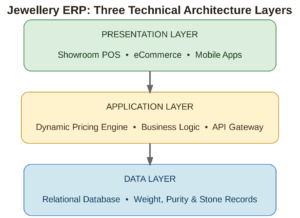
A wholesale order sets the pricing tier and draws stock from the vault. It leaves as a memo, consignment, or sale, and settles in cash or metal. Procurement and job work replenish the vault behind it, and every step posts to the ledgers automatically.
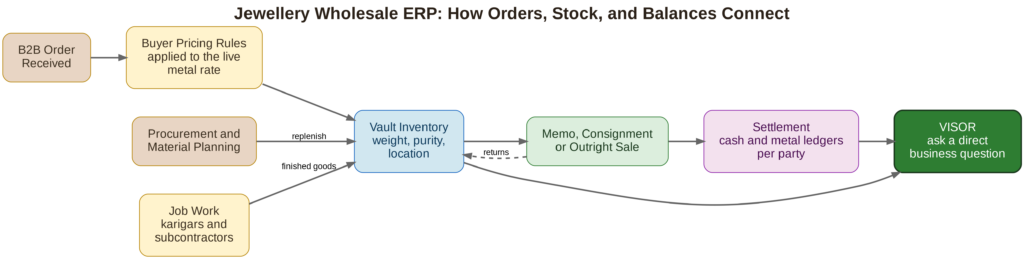
See Jewellery ERP Architecture for manufacturing and retail flows.
Can It Support Export and Multi-Currency Trading?
Yes, provided ledgers can be held in more than one currency and orders can arrive from buyers’ own systems. Look for multi-currency payables and receivables, and order imports from retail chains and B2B portals, so cross-border trades don’t run on separate spreadsheets.
What Compliance Checks Should Wholesalers Verify?
Compliance rules vary from country to country, so every wholesaler should review the requirements in each market it buys from and sells to before choosing software. Then confirm the system supports them: tax-compliant invoicing, records of metal sent to job workers, and hallmark or purity identifiers where the law requires them.
Common areas to review in any country:
- Tax invoicing and filing rules for domestic and cross-border sales
- Records of metal and stones sent to and received from job workers or subcontractors
- Hallmarking, purity, and traceability requirements for the pieces you sell
- Import and export documentation for international trade
In India, wholesalers typically look at:
- GST-compliant invoicing and return filing, covered in our GST guide
- Job work challans and Form ITC-04 reporting for goods sent to karigars, under Section 143 of the CGST Act (GJEPC guide to job work under GST)
- BIS hallmarking, with a HUID recorded for each hallmarked piece, covered in our HUID guide
Requirements change, so confirm current rules with your tax and compliance advisers.
How Is AI Helping Jewellery Wholesalers?
AI helps wholesalers turn trading data into answers without waiting on a report. Instead of digging through ledgers and stock sheets, a manager asks a question in plain language and gets a direct answer. Routine analysis, like spotting slow stock or unusual wastage, runs in the background.
Where AI helps most in wholesale:
- Answering everyday questions in plain language, such as which designs sold best or which buyers carry the largest balances
- Predicting stock demand, so purchasing follows what actually sells
- Flagging unusual karigar wastage against agreed limits
- Summarizing sales, collections, and stock movement on a phone each morning
- Reading trends across locations and buyers that a manual report would miss
How Synergics approaches it. Synergics combines AI-powered analytics for stock demand prediction and karigar wastage anomaly detection with VISOR, a conversational AI assistant for jewellery businesses. VISOR answers in plain English, draws on over 220 jewellery-specific business questions, sends a daily WhatsApp briefing, and works with any jewellery ERP. Scheduled MIS reports on sales velocity, margins, and aging inventory complete the picture.
What Should You Check Before Choosing Jewellery Wholesale ERP?
Check before you buy because this software will hold your balances, pricing, and metal records, and it is hard to change later. Decide by comparing each option against how you actually trade: what you make or distribute, who needs access, and which countries you serve. Choose the one that has these built in, not added as workarounds.
| Check | Why It Matters | What to Ask |
| Buyer-wise pricing | Rate cards drift when kept in sheets | Can each buyer or group have its own rules, applied to the live metal rate? |
| Memo and consignment | Goods on approval look like available stock | Are memo, consignment, and outright sales separate types, with partial approvals? |
| Party-wise ledgers | Wholesale runs on balances, not just invoices | Does each buyer and karigar carry a metal balance as well as a cash balance? |
| Manufacturing scope | Only some wholesalers make pieces | Do you need job cards and wastage limits, or only distribution? |
| Users and devices | Sales teams travel between cities | How many users need access, on which devices, and can reps take orders offline? |
| Tax and region coverage | Rules differ by country | Which countries’ tax and hallmark rules does billing support? |
| Accounting | Separate accounting means double entry | Is accounting built in, or does it connect to the package you already use? |
| Hosting | Multiple offices need shared, current data | Is it cloud or on-premise, and how do branches and reps connect? |
| Security certification | The ERP holds pricing and party data | Is it SOC 2 Type II, and can the vendor share the report? |
| Onboarding and support | Migration and training decide how smooth go-live is | What does onboarding involve, and who helps when something breaks? |
For hosting, see our cloud vs. on-premise comparison.
Why Choose Synergics Jewellery ERP (Formerly SEA) for Wholesale?
Synergics Jewellery ERP (Formerly SEA) is built specifically for the jewellery trade. It scales from a single trading desk to multi-location, multi-country operations on the same platform, so a growing wholesaler doesn’t have to change systems. For wholesalers, that comes down to the following.
- Wholesale workflows built in. Buyer-wise pricing rules with a formula builder, outright, consignment, and memo sales with approvals and returns, and stock transfers with acknowledgement across locations.
- Party-wise ledgers. Real-time payables, receivables, and metal balances with multi-currency support, plus tracking of customer goods and metal received.
- Karigar and job work control. Process-wise subcontracting, full or partial, with allowable wastage tracked per worker through to settlement.
- Vault stocktakes. Barcode and RFID scanning with handheld readers flags variances instantly and reprices on scan.
- B2B connectivity. Live stock and bulk order sync with B2B portals, direct order imports from retail chain stores, and digital lookbooks with party-wise pricing tiers.
- AI built in. VISOR, plus AI analytics for stock demand and karigar wastage anomalies, as covered above.
- Easy to adopt. A secure cloud platform with a self-guiding workflow, scaling from one trading desk to many offices and vaults.
- A verified track record. 19+ years, 150+ businesses across 9 countries, and 25,000+ users, on AWS with an Oracle database, backed by SOC 2 Type II, VAPT, and CARE SME 3.
- Recognition. Featured in Forbes India, named a Top Emerging Business Leader by Times of India, and listed in CIO Insider’s 2019 Most Recommended ERP Solution Providers.
Clients range from independent businesses to CaratLane, Angara, Muthoot Exim, Browns, Hazoorilal, and Candere.
How Does It Compare to Spreadsheets and Accounting Software?
Accounting software records invoices and stock counts, and spreadsheets fill the gaps by hand. Neither holds a running metal balance for each party, a memo that hasn’t become a sale yet, or a price that follows the day’s metal rate. The table shows where each falls short for a wholesaler.
| Need | Spreadsheets | Accounting Software (Typical) | Jewellery Wholesale ERP |
| Goods on memo | Separate sheet updated by hand | Recorded once invoiced, if at all | Recorded against the buyer, converted on approval |
| Buyer-wise pricing | Rate cards kept in files | One price list with manual overrides | Rules applied to the live metal rate |
| Metal balances | Registers kept apart from costing | Money ledgers, no native metal balance | Metal and cash balance per buyer and karigar |
| Stock accuracy | Manual counts | Quantity and value | Weight and purity per piece, scanned stocktakes |
| Karigar job work | Job registers | Often booked as purchases | Job cards, wastage limits, and settlement |
| Multi-location stock | Copies of files per branch | Depends on setup | Real-time transfers with acknowledgement |
| Reporting | Rebuilt by hand each time | Financial reports | Sales velocity, margins, and stock aging, scheduled |
| Export trading | Separate files per market | Multi-currency, not metal-aware | Multi-currency ledgers with metal balances |
Spreadsheets and accounting software still work for a small trading desk with few buyers and no job work. The gaps show as soon as goods go out on approval, metal sits with karigars, and prices vary by buyer. Those are balances of metal and stock, not just money. That is the point where a purpose-built system becomes hard to do without.
Bringing Your Wholesale Operations Onto One System
The right jewellery wholesale ERP treats memo goods, buyer-wise pricing, and metal balances as core to how it works, not as workarounds. It scales from a single trading desk to multi-location, multi-country trade. It connects to the scanners and portals you already use, and answers your questions directly instead of leaving you to read a report.
Curious how this would work for your trading desk and vault? Talk to the Synergics team about your setup, or book a free demo built around how you trade.
Frequently Asked Questions
1. What is jewellery wholesale ERP?
Jewellery wholesale ERP is software that runs B2B jewellery trading, combining memo and consignment sales, buyer-wise pricing, vault inventory, job work, and party-wise metal and cash ledgers in one system.
2. How is jewellery wholesale software different from accounting software?
Accounting software records invoices and stock counts. Jewellery wholesale software also holds a running metal balance per party, tracks goods on approval, and applies each buyer’s pricing rules to the day’s metal rate.
3. Is wholesale ERP different from retail or manufacturing ERP?
Yes. Retail ERP centers on the counter sale, manufacturing ERP on job cards and casting loss, and wholesale ERP on balances between parties. A platform covering all three suits businesses that trade across them.
4. Can it manage memo and consignment sales?
Yes. It records goods sent on memo or consignment against each buyer, supports partial approvals and returns, and converts approved pieces to invoices without re-entering the document.
5. Can different buyers have different prices?
Yes. Multi-tier pricing gives each buyer or group its own rules, applied to the day’s metal rate at quote or invoice, so no one recalculates by hand.
6. Does it track karigar metal and wastage?
Yes. Metal and stones issued to a karigar are recorded per job, and finished weight and wastage are checked against the agreed limit when the work returns.
7. What modules does jewellery wholesale ERP include?
Typically pricing rules, sales and orders, vault inventory, procurement and planning, job work, digital catalogs, accounting with party ledgers, and reporting, all working from the same data.
8. Is it suitable for exporters and multi-currency trading?
It can be, if ledgers run in multiple currencies and billing supports each market’s tax rules. Ask any vendor which countries and currencies it covers.
9. Should I choose cloud or on-premise?
Cloud suits teams spread across offices, vaults, and travelling reps, since everyone works from the same current data. On-premise suits a single office with strict data policies. Synergics runs on secure cloud infrastructure.
10. What compliance features should I check?
Rules vary by country. Check tax-compliant invoicing, job work records, and hallmark or purity identifiers where required, and ask which jurisdictions the vendor supports.
11. Does it include AI-powered analytics?
Some platforms do. Synergics includes AI analytics for stock demand and wastage anomalies, plus VISOR, a conversational assistant that answers business questions in plain English and sends a daily WhatsApp briefing.
12. Is it suitable for small wholesalers, or only large ones?
Both. A scalable platform fits a small trading desk and grows to multiple offices and vaults without a system change. Synergics runs one trading desk or many on the same platform.
13. How long does implementation take?
It depends on business size, the modules you need, and how much data must be migrated. A single office moves faster than a multi-location operation. Synergics confirms a clear timeline after understanding your setup, before you commit.
14. How much does jewellery wholesale ERP cost?
Pricing depends on business size, users, locations, and modules. Most vendors, including Synergics, quote transparently after understanding your setup.