
- Jewellery ERP is industry-specific management software built to handle the trade’s real complexities: metal purity, weight-based billing, karigar tracking, and hallmarking compliance.
- Generic ERP software works on an item-quantity-price model. Jewellery doesn’t fit that model, which is exactly why purpose-built software matters.
- A 10-point checklist below covers what to verify before choosing any jewellery ERP, not just Synergics.
- Synergics Jewellery ERP includes VISOR, a conversational AI assistant that answers business questions instantly, a genuinely different capability from the catalogue-photo or try-on “AI” features most competitors offer.
What Is Jewellery ERP?
Jewellery ERP is specialized business management software built to handle the trade’s specific complexities. This includes metal purity tracking, weight-based billing, gemstone categorization, karigar job work, and hallmarking compliance. It all lives in one connected platform covering manufacturing, inventory, retail, and finance.
Generic ERP systems weren’t built for this. A jewellery business runs on gram-level weight precision, daily-moving metal rates, and artisan-driven production. A standard retail or manufacturing ERP simply doesn’t model these realities correctly.
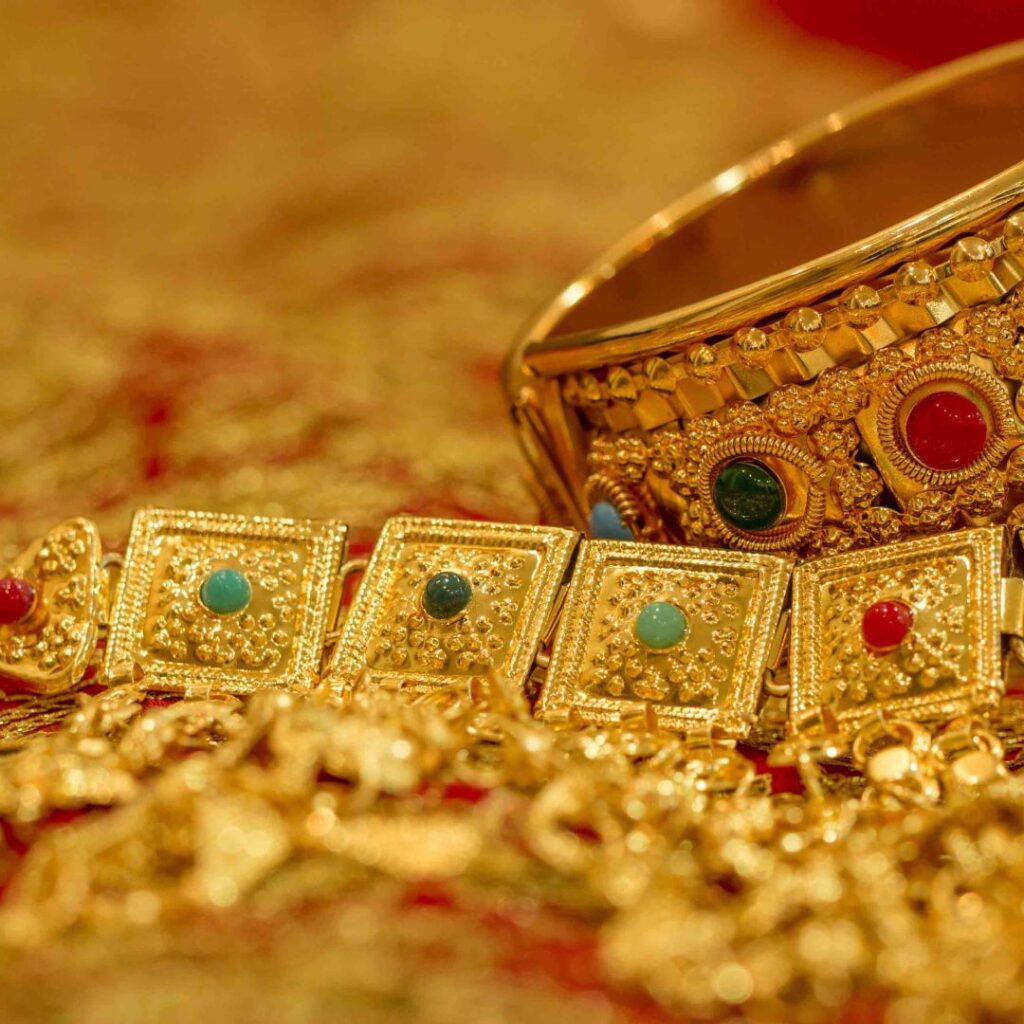
Why Generic ERP Software Doesn’t Work for Jewellery
Most accounting and ERP software runs on a simple model: item, quantity, price. Jewellery doesn’t work that way. A single piece carries gross weight, net weight, stone weight, purity, making charges, and a metal rate that can change more than once in a day.
Force that into a standard ERP, and the workarounds start. A spreadsheet tracks purity separately. Another one tracks wastage. Neither talks to the actual billing system. That’s exactly where stock counts stop matching reality, and where errors quietly compound over time.
A genuine jewellery ERP treats weight and purity as core data fields from day one, not a workaround bolted on afterward.
Core Features of Jewellery ERP Software
1. Purity, Weight, and Product Tracking
A jewellery ERP tracks gross weight, net weight, stone weight, and precise purity across gold, silver, and platinum. Every piece carries this data individually, not as a generic SKU with a single quantity field.
2. Karigar and Job Work Management
Job work sits at the centre of jewellery manufacturing. A proper system tracks metal issued to each karigar, what comes back, wastage against tolerance, and labour due for settlement, all tied to a specific job.
3. Live Metal Rate Integration
Gold and silver prices move throughout the trading day. A jewellery ERP applies current rates automatically to pricing and billing. Nobody needs to check and update a rate sheet by hand each morning.
4. Compliance and Billing
GST-ready invoices, barcode tags, and hallmarking documentation all need to generate correctly and consistently. A jewellery ERP builds this into every transaction, rather than treating compliance as a separate, manual step.
5. AI-Powered Business Insights
This is where most jewellery ERP platforms stop, and where the gap between vendors actually shows. Several platforms now advertise “AI” features: AI-generated catalogue photography, virtual try-on tools for customers, chatbot-style messaging. These are customer-facing and cosmetic. They don’t answer a business question.
VISOR, Synergics’ conversational AI assistant, works differently. Ask a real operational question in plain English, which designs sold best last month, which branch is underperforming on margin, and get an answer instantly, drawing on over 220 jewellery-specific queries. VISOR also sends a daily WhatsApp business briefing each morning, summarizing sales, collections, and stock alerts with simple red, green, and brown health signals, so an owner can assess the business before even opening a dashboard.
For the complete breakdown of every feature across retail, wholesale, and manufacturing, see our full jewellery ERP modules guide.
10 Must-Have Features to Check Before You Buy
Whichever platform you’re evaluating, not just Synergics, these are worth checking off before signing anything.
- Real-time metal rate management. Rates should pull automatically, not depend on someone updating a rate card by hand.
- Weight and purity as core fields. Gross weight, net weight, stone weight, and purity need to be built into every item record, not a custom workaround.
- Making charges and wastage calculation. Automatic rules, percentage-based, per-gram, or fixed, with checks that catch entry errors before billing.
- Karigar and job-work management. A dedicated module tracking metal issued, metal received, and wastage, not a manual register.
- Old metal exchange management. Purchase, refinery tracking, and resale handled with full transparency, not a side spreadsheet.
- GST-compliant billing. Accurate, audit-ready invoices generated automatically, with no manual reconciliation.
- Gold savings scheme management. Instalments, maturity, and redemption tracked automatically, since this drives real customer loyalty and is a common gap in generic software.
- Multi-branch support. Real-time, branch-wise stock and sales visibility from one place, not end-of-day manual consolidation.
- RFID and inventory accuracy. For high-value inventory, RFID adds a real layer of accuracy and shrinkage detection that barcode alone can’t match.
- Cloud, mobile, and WhatsApp access. Checking reports or approving an order without being physically in the store isn’t optional anymore.
Jewellery ERP vs. Traditional Jewellery Software
| Feature | Jewellery ERP | Traditional Jewellery Software |
| Purpose | Manages the complete business, from procurement to sales | Handles individual tasks like billing or inventory |
| Inventory Management | Real-time tracking with weight, purity, barcode, and multi-location support | Basic stock records with limited tracking |
| Manufacturing | Tracks karigar work, job orders, wastage, and production stages | Usually not available |
| Accounting | Integrated accounting with GST compliance and financial reporting | Often requires separate accounting software |
| Customer Management | Stores customer profiles, purchase history, and loyalty information | Limited customer records |
| Multi-Branch Management | Centralized management across multiple stores and warehouses | Difficult to manage multiple locations |
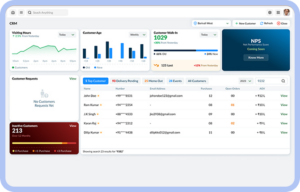
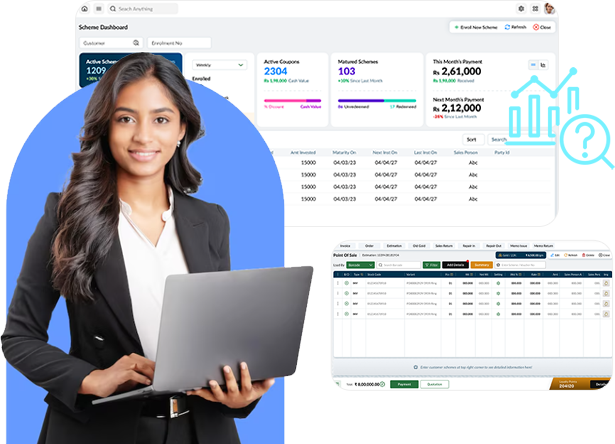
| Reporting & Analytics | Real-time dashboards, sales reports, inventory insights, profit analysis | Basic reports with limited business insight |
| Automation | Automates inventory, production, billing, and workflows | Mostly manual processes |
| Scalability | Built to grow with retail chains, wholesalers, and manufacturers | Suited mainly to small, single-location businesses |
Cloud vs. On-Premise: Which Should You Choose?
This comes up in nearly every evaluation. Cloud tends to fit better if you run multiple branches, want real-time visibility from anywhere, or need mobile access to billing and reports. On-premise can still make sense for a single location with strict internal data policies or unreliable internet access.
See our full cloud vs. on-premise comparison for the honest tradeoffs of both.
Questions to Ask Any Jewellery ERP Vendor
Before signing with any provider, get real answers to these:
- Does the vendor genuinely understand jewellery workflows, or are they adapting a generic retail ERP?
- Can the system scale from a single store to multi-branch without a full re-implementation?
- Is pricing transparent, or will module-by-module add-on costs surface later?
- What does onboarding and ongoing support actually look like, and how fast do they respond when something breaks during business hours?
- Can you see the system running on a live jewellery business, not just a scripted sales demo?
Popular Jewellery ERP Solutions in India
Several platforms serve the Indian jewellery trade today, each with a different focus. Jewellery ERP Software: The Perfect Solution for Your Business brings retail, wholesale, and manufacturing operations together on one connected platform, helping businesses manage processes more efficiently. Synergics Jewellery ERP supports all three areas, with conversational AI analytics through VISOR built in. While some providers focus primarily on retail billing and others on manufacturing job work, an integrated ERP approach can provide broader visibility and centralized control across the jewellery business.
For a full, detailed comparison of eleven leading jewellery ERP providers in India, see our complete jewellery ERP comparison guide.
Why Synergics Jewellery ERP
Synergics has spent over 19 years building software exclusively for the jewellery trade. It hasn’t adapted a generic platform after the fact. The company serves 150+ jewellery businesses across 9 countries, including CaratLane, Angara, Muthoot Exim, Browns, and Hazoorilal. It holds SOC 2 Type II certification alongside a CARE SME 3 rating.
VISOR is live today, not a future roadmap item, answering real business questions the moment they’re asked. Synergics’ work in jewellery technology has also been covered by the Economic Times and Business Today.
Bringing Your Jewellery Business Onto One System
Jewellery ERP isn’t just a software upgrade. It’s a shift in how the entire business runs, from the workshop floor to the showroom counter. Whether you manufacture, retail, or wholesale, the right platform brings karigar tracking, multi-branch inventory, GST billing, and customer management together in one place. Nothing stays scattered across disconnected tools.
New to evaluating jewellery ERP options? Talk to the Synergics team about what actually matters for a business like yours.
FAQs
1. What is jewellery ERP?
Jewellery ERP is specialized business management software that integrates jewellery-specific operations into one unified platform. This includes manufacturing, inventory tracking, accounting, retail, and customer management, built around the trade’s real requirements.
2. How is jewellery ERP different from traditional jewellery software?
Traditional jewellery software handles individual tasks like billing or basic inventory in isolation. Jewellery ERP integrates every department into one system, so a design update automatically updates costing, production, and sales data everywhere.
3. What are the core features of jewellery ERP?
Purity and weight tracking, karigar and job work management, live metal rate integration, and GST-ready billing form the core. Synergics adds a fifth layer most platforms lack: conversational AI analytics through VISOR.
4. What should I check before choosing a jewellery ERP vendor?
Confirm the vendor genuinely understands jewellery workflows, verify pricing is transparent rather than hiding add-on costs, and ask to see the system running on a live business, not just a scripted demo.
5. What are some popular jewellery ERP solutions in India?
Several platforms serve the Indian jewellery trade, each with a different focus. Synergics Jewellery ERP covers retail, wholesale, and manufacturing together with built-in AI analytics. Our full comparison guide reviews eleven leading options in detail.
6. Does jewellery ERP support AI-powered analytics?
Many platforms now offer customer-facing AI, like catalogue photography or virtual try-on. Synergics goes further with VISOR, a conversational assistant that answers real business questions instantly, live today rather than a future feature.
7. What are the benefits of implementing jewellery ERP?
Fewer manual errors, faster and more transparent operations, real-time decisions through live dashboards, better collaboration across departments, and stronger customer trust through accurate, consistent billing.
8. Is jewellery ERP suitable for small businesses?
Yes. Jewellery ERP is generally scalable, and cloud-based options make it cost-effective and accessible for a single small outlet, not just large multi-store operations.